














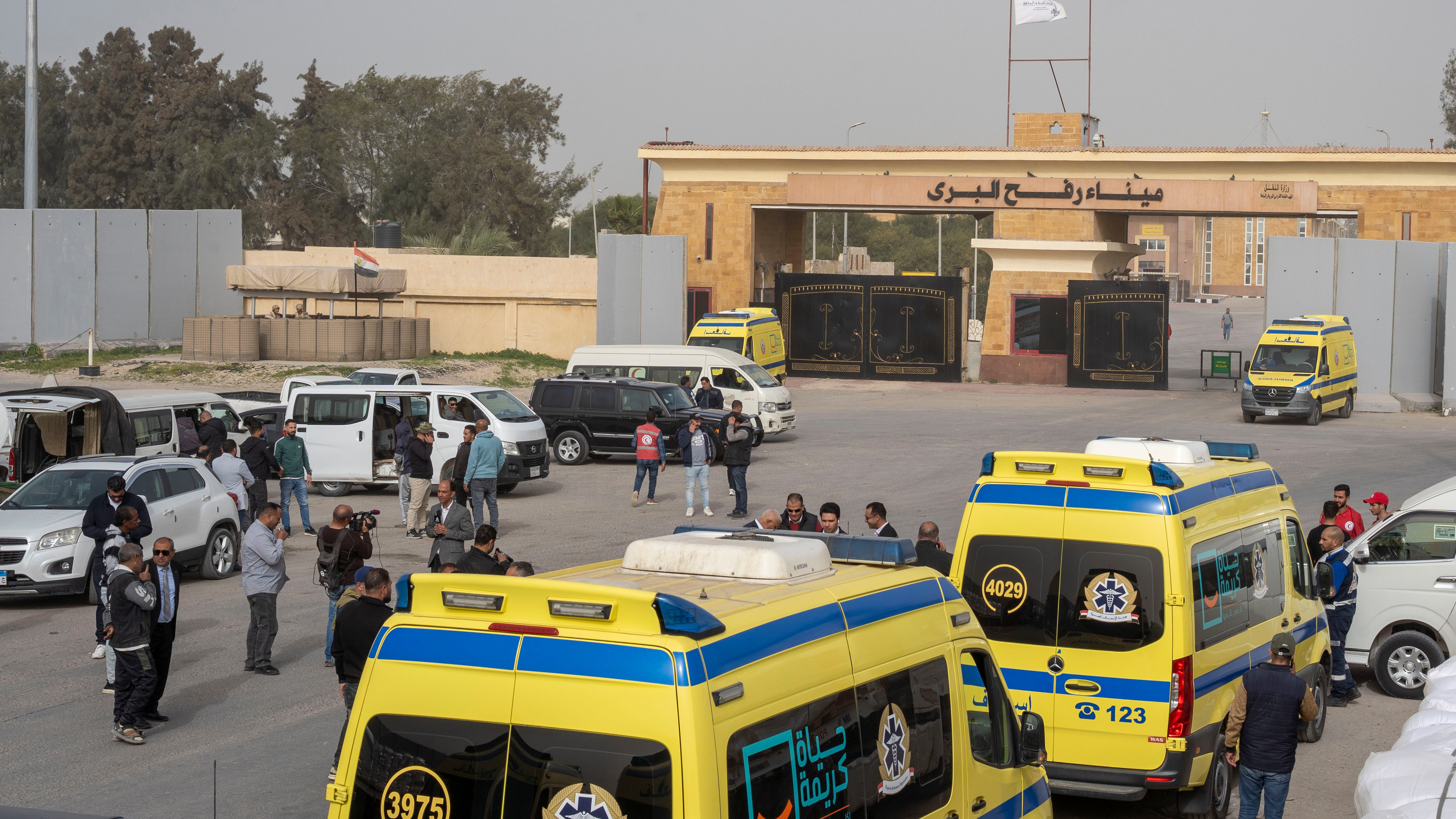


Alwaght- After weeks of waiting by millions of war-stricken Palestinians in Gaza to see Rafah Border Crossing with Egypt reopened, finally on Sunday the border gate was reopened for a few hours under strict security measures and complex screening. However, the way of the reopening soon turned the Palestinian hope into disillusionment.
Amid Israeli arrangements and new rules set for reopening of the key crossing, what grabbed public and media attention the most was the special tunnel the Israeli occupation army constructed along the entrance of the crossing.
The Israeli military stated Sunday that it has completed the construction of a new screening and inspection corridor for individuals entering the Gaza Strip from Egypt. In a statement, the army said the "Regavim" corridor, located in an army-controlled area under Israeli security service oversight, is part of preparations for the Rafah crossing's scheduled opening on Monday.
According to the statement, security forces will verify the identity of entrants against lists approved by Israeli security agencies. It emphasized that the corridor is part of efforts to tighten security control over the area.
Meanwhile, the Coordinator of Government Activities in the Territories (COGAT) clarified that the crossing's opening on Sunday was a pilot phase, coordinated with an EU delegation, Egypt, and all relevant parties.
COGAT explained that Palestinians who left Gaza during the war may return following coordination with Egypt and Israeli security approval. The agency stated that the European team would conduct initial passenger screening, with additional procedures to follow at the military-controlled crossing.
Israeli websites published a stark image of the new facility; a lengthy corridor with rough asphalt, connecting the Palestinian and Egyptian sides of the Rafah crossing, enclosed by thick barbed wire fences. Activists likened the scene to the "steel sliding doors", known as "lion traps", used by Israeli forces at prison gates and military checkpoints in the West Bank and East Jerusalem. One activist labeled the complex the "Gaza Central Prison," a reference to the largest prison Israel built in Gaza after 1967 and demolished following its withdrawal in 2005.
The websites also published a footage showing the EU peacekeeping mission forces entering Gaza through an unpaved route passing through a destroyed neighborhood. The images showed the large scale of destruction in the region since Israel invaded Rafah in May 2024.
Observers note the sprawling scale of military infrastructure constructed by Israeli forces at the crossing, which starkly contradicts the supposed civilian nature of the transit point.
The Israeli occupation forces are imposing severe restrictions and exhaustive controls on passengers, who are predominantly wounded individuals, frequently denying them passage under various security pretexts.
This manner of operation has drawn fierce criticism from Hamas. Hazem Qassem, a Hamas spokesman, labeled any Israeli obstruction or conditions regarding the Rafah crossing as a violation of the ceasefire agreement. He called on the agreement's mediators and guarantor countries to monitor the occupiers' conduct at Rafah.
Initial Israeli estimates set a daily cap of only about 150 people permitted to leave Gaza via this crossing. In stark contrast, Ismail Al-Thawabteh, director of the Government Media Office in Gaza, stated that approximately 22,000 sick and wounded individuals in the Strip urgently require medical treatment abroad and have completed their medical referral paperwork. Given the current rate, it would take roughly 147 days, about five months, to evacuate all these patients and wounded.
Figures from Gaza's health ministry indicates around 20,000 patients are awaiting travel through Rafah for treatment abroad. This number includes 4,500 children, 4,000 cancer patients, and nearly 6,000 injured individuals, 440 of whom are in critical or urgent condition.
Arabi21 website reported that since the crossing was closed following the Israeli military's assault on Rafah, 1,268 patients on the waitlist for treatment abroad have died. The ministry has repeatedly warned that patients continue to die daily as a result of the closure.
The need to travel is not limited to the wounded and sick. Tens of thousands of students, residency and foreign passport holders, and others are also waiting for the Rafah crossing to open.
Additionally, the current focus of the crossing's opening is solely on the exit of people, with no details provided for the entry of emergency supplies for the Strip's residents. Aid organizations estimate that a minimum of 600 truckloads of aid are needed daily to meet Gaza's desperate humanitarian needs.
Social media reactions
Palestinians on social media were caught by surprise at the first scenes of reopening of Rafah, saying that what is seen in the images and footages does not promise a good future and it bears signs of a plan to transform Gaza into big Jewish neighborhoods and a big open air prison, where the occupiers control the entry and exit through the iron gates surrounded by a thick wall of barbed wire.
A Gaza City user, Yousef al-Ayoubi (@yuofufauipy88), likened what he witnessed at the reopening of the Rafah crossing to a prison, writing: “Just moments ago, Rafah Crossing felt like Guantánamo Bay.”
Another user, Islam Bader (@islambader_1988), used a similar analogy, describing the reopening as “Gaza’s central prison.”
Mohammed Haniya wrote: “Throughout history, no crossing has ever been like this… never.”
Ahmed Abdel Aal (@ahbk_abdelal) framed it in stark, headline-style language:
“Rafah Crossing… one gate, an endless siege… the final door, the longest wait… God, grant peace to the people of Gaza.”
Islam Habib from Gaza (@ISLAMHABIB6), using the hashtag #Gaza_The_Real_Story, wrote: “They say ‘Rafah Crossing has reopened.’ The reality is captured in this image: a humiliating entry into Gaza through a prison corridor. So much regret over the decision to return—and the sense that if you had left, you wouldn’t even think of coming back.”
“This is not Gaza City,” he added. “This is a vast detention camp.”
Continued massacare ad Israel violates ceasefire
Amid cosmetic preparations for reopening of the crossing and movement of civilians, the deadly Israeli attacks continued to the moment of the reopening. On Saturday, a day before the border gate reopened, Gaza witnessed intensified Israeli bombardment that according to local sources left tens of Gazans dead and many injured. Some reports put the number of those killed at 29. On Sunday, as a trial phase of crossings was underway, an Israeli drone strike on northwestern Rafah killed another Palestinian.
The Palestinian Government Media Office described these actions as systematic and widespread violations, stressing that from the implementation of the ceasefire decision in October 2025 through the end of January 2026, a period of 111 days, Israeli forces committed hundreds of violations every day, in what it called a blatant breach of international humanitarian law.
Official figures from Gaza’s ministry of health document the scale of the ongoing humanitarian catastrophe in stark terms. According to the ministry, direct victims of ceasefire violations since its implementation have risen to 523 killed and 1,443 wounded, figures that underscore the absence of any genuine halt to hostilities. The latest data show that since October 7, 2023, the total number of Palestinian casualties has reached 71,795 killed and 171,551 injured.
Against this backdrop, two sharply opposing narratives have emerged. On one side, Israeli officials frame the recent attacks as a necessary response to Hamas military activity, including claims that fighters emerged from a tunnel in Rafah, presenting the strikes as acts of self-defense. On the other side, Hamas spokesperson Hazem Qassem dismissed these claims as false, calling them a pretext to justify the mass killing of civilians, and accused Tel Aviv of disregarding mediators and guarantors of the agreement.
Meanwhile, international rights organizations provide a tougher narrative. Salah Abdulatti, the head of the International Commission to Support Palestinian Rights, Salah Abdel Abdel-Ati, described the Israeli actions as acts of genocide against Gaza residents.
He described this mechanism behind these actions as "the extensive use of excessive force, the systematic destruction of infrastructure, the deliberate starvation of population, and the imposition of lethal living conditions." Pointing to the scale of devastation, he said that more than 90 percent of the residential infrastructure has been damaged or destroyed, hundreds of thousands of housing units have been reduced to rubles, and the near-total of the population displaced, one of the largest cases of forced displacement in the current century.
So, the truce not only had not helped stop the Israeli daily military violence, but also has given a cover to destroy what remained of the vital infrastructure.
Reopening of Rafah crossing in an environment saturated with violence, distrust, and devastation is promoted, on the one hand, as a measure facilitating humanitarian aid, and on the other hand, it is surrounded by daily death tolls and narratives ranging from systematic violations to genocide. This deep contradiction raises serious questions about the prospects for ensuring sustainable peace and any improvement to the humanitarian conditions as the Israeli systematic violence unfolds.










