







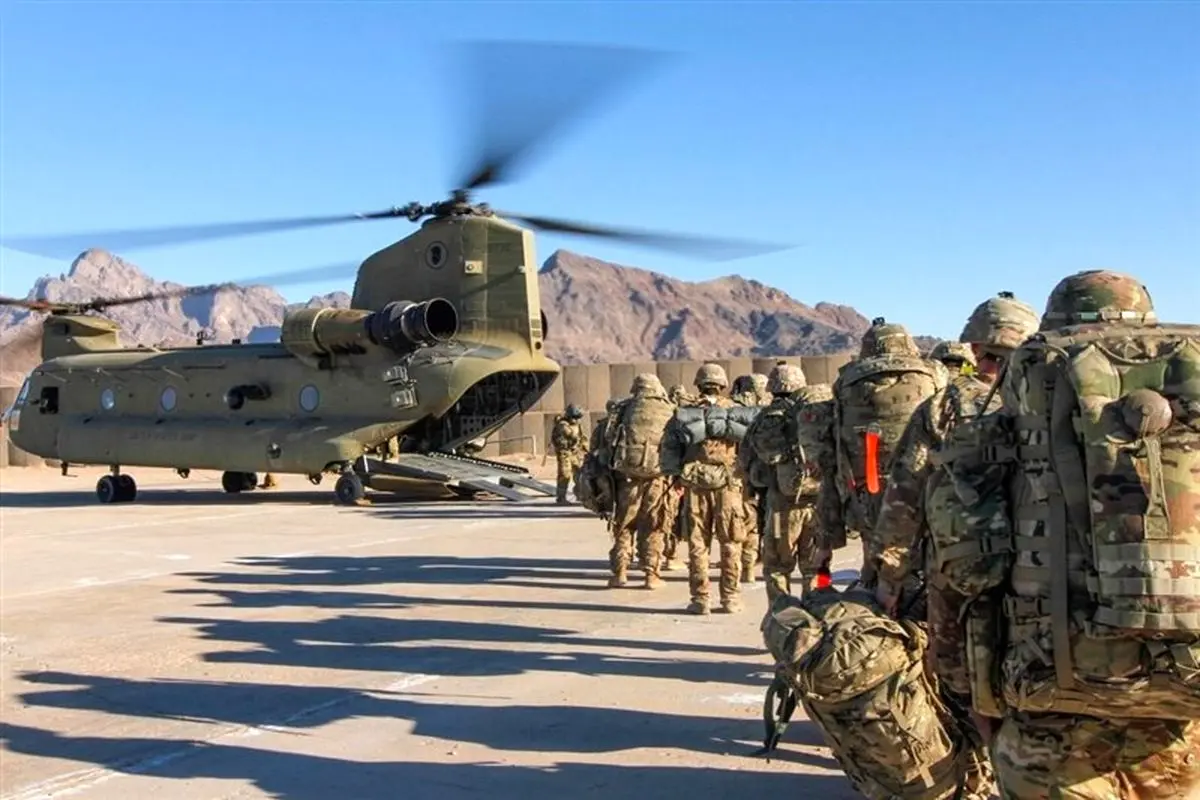


Alwaght- The occasional US military moves in Iraq, especially amid critical regional developments, have always made news headlines and fed various political speculations. In recent days, the US once again made an important new change to the deployment of its forces Iraq and, according to the official Iraqi news agency, it has fully evacuated Ain Al-Assad military base and handed it over to Iraq.
The Iraqi High Military Committee confirmed Sunday the complete withdrawal of all international coalition advisors from Iraqi federal territories, marking the formal end of the mission. A statement released by the committee stated all personnel have departed military bases and command centers.
According to an Iraqi security information unit, the remaining advisors stationed at Ain Al-Assad airbase and the Joint Operations Command headquarters have also been removed, with full control now transferred to Iraqi security forces.
The move aligns with the 2024 agreement between Baghdad and Washington. While the majority of US forces are now concentrated at Al-Harir base in Erbil, Kurdistan Region, all other US military facilities have been handed over to the Iraqi army. The first phase of the gradual, two-stage troop withdrawal, initially slated to conclude in September 2025, was completed last December. The second phase, extending to September 2026, anticipates the complete departure of all remaining personnel, including advisors, unless renegotiated or extended.
Ain Al-Assad, end of icon of US of occupation in Iraq
The US withdrawal from Ain Al-Assad is not a mere military relocation. Rather it is symbolically important and establishes a picture of end of occupation in Iraq, a long-time demand of Iraqi public. The US each time has evaded this move under various political and propaganda games.
Located in Anbar province, Ain Al-Assad previously served as the largest US military base in Iraq, functioning as a crucial transportation hub, fuel depot, and primary access point for American forces entering the country. It played a central role in managing the US military operations.
Originally constructed in the 1980s during Saddam Hussein’s rule in a desert region 160 kilometers west of Baghdad, the base was part of a five-base plan initiated in 1975 as a lesson learned from the Arab-Israeli conflict. Built by Yugoslavian state companies between 1981 and 1990 at a cost of $280 million, it was initially named al-Qadisiyyah, referencing a historic Arab-Persian battle. It later became known as Objective Webster before being renamed Ain Al-Assad.
Following the 2003 US invasion, the base rapidly expanded into one of the largest US facilities in the region. Australian forces initially secured the base during the “Operation Iraqi Freedom,” before it was taken over by American troops, becoming the second-largest base in the operation.
The base boasts a 4,000-meter asphalt runway, situated at an elevation of 188 meters above sea level, and covers an area of approximately 10 square kilometers – roughly the size of Baghdad’s Green Zone.
Ain Al-Assad was handed over to the Iraqi forces in 2009, but was again taken by the Americans in 2014, following attacks by the ISIS terrorist group. It served as the center of the command of the US operations in the region. In 2018, Trump visited the key military infrastructure.
The strategic and iconic significance of Ain Al-Assad brought it under an unprecedented Iranian missile attack in 2020 launched by the IRGC in retaliation for the assassination of two anti-terror commanders, Iran’s General Qassem Suleimani and Iraq’s Abu Mahdi Al-Muhandis.
Why Al-Harir?
Al-Harir Airbase, a key US military hub 75 kilometers from Erbil, and the closest American facility to Iran (115 km away), is undergoing significant expansion. Equipped with advanced radar, missile systems, and a fighter jet runway, the base was initially established in 2015 under the guise of fighting ISIS and later repurposed for training Peshmerga forces.
Observers predict a prolonged US presence, extending beyond counter-terrorism efforts. This stems from Washington’s political support for the Kurdistan Regional Government (KRG), which views the American forces as crucial for regional security, a stark contrast to the pressure from Iraqi factions in Baghdad demanding their withdrawal.
The US military’s shift from central Iraq to the autonomous Iraqi region in the north, coupled with the recent establishment of the largest US consulate in Western Asia in Erbil, suggests a deliberate strategy to elevate the city as a central hub for military, political, and diplomatic operations, potentially leveraging it as a pressure point against the Iraqi government.
Also, this will allow for lower cost military and political presence of the US in Iraq, as this base can also provide a logistical support platform for operations in northeastern Syria.
Mohanad Salum, a security studies professor at Doha Institute for Graduate Studies, told Al-Arabi: “Al-Harir cannot be regarded the only remaining place [for the US military in Iraq], but given the evacuation of the main bases, it can be described as the last and strongest base.”