






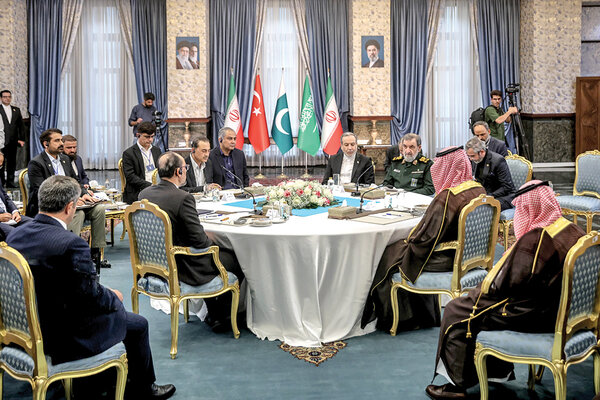


Alwaght- As tensions between the US and Iran have escalated, Tehran hosted a new round of diplomatic meetings in recent days. On Monday, senior security officials of Saudi Arabia, Turkey, and Pakistan held a meeting with Iran's General Mohsen Rezaei, the secretary-general of Supreme National Security Council, in Tehran, discussing the latest regional developments. The recent war's consequences, the impacts of the Israeli-American attacks on Iran and, and the need for cooperation of regional states were the top discussion matters of this quadrilatral meeting. Some political observers have assessed the meeting as carrying a sign of a push for arrangements in the region, but see a lasting agreement and a de-escalation contingent on dialogue and practical commitment of the countries.
In this relation, Alwaght held an interview with West Asia affairs expert Jaffar Ghanadbashi, asking him about the outcomes of Tehran summit and its influence on the future of security and regional equations.
Alwaght: What messages does the meeting of Mecca Pact members with Iran carry to the region and world?
Ghanadbashi: The meeting of the countries party to the Mecca Pact with Iran, under the current circumstances, sends a message to global public opinion that significant developments are underway in the West Asia region, developments that are affecting the region's previous political and military balances. In fact, this meeting carries a message about deep strategic shifts that could mark the beginning of new changes in the political geometry and geography of the region, as well as in its political balances, changes whose impact will extend to the entire international equation.
The significance of these developments stems from the special place West Asia occupies in global equations. Major industrial powers and the world's capitalist countries are, in a sense, dependent on the energy exported from this region. Therefore, international currents cannot continue on their path without paying attention to developments in this region. Hence, the message conveyed by the holding of this meeting could signal the beginning of developments that will affect not only our region but also global economic and political trends.
For example, even political developments and rivalries in the US, including its elections, are in a sense influenced by what is happening in West Asia. Therefore, if the process that has now begun continues, one could say that this meeting also carries the message of such a change. The continuation of this process could mean the emergence of a new chapter in regional and international equations, a chapter in which countries around the world will be compelled to adapt themselves to the new conditions.
As a result, the significance of this meeting is not limited merely to the holding of a summit or to relations among four countries; rather, its ramifications could affect various countries around the world. This issue can in itself be a sign of strategic shifts in the political decision-making of regional countries and even in their military approaches, changes that may ultimately lead to the end or reduction of the dominance and military presence of major powers in the region.
Alwaght: Can we see Tehran summit a sign of rise of a new security order order in the region centered by regional nations and without influence of the trans-regional countries? How determining is the Iranian role in emergence of this order? Can Tehran play a deterrent role in the face of the hawkish approach of Washington?
Ghanadbashi: This summit can be seen as signaling emergence of a new security order whose foundation was laid since several months ago, or even last year. Now we are at a historical juncture that can change the course of the regional and global developments. As the martyred Supreme Leader Ayatollah Sayyed Ali Khamenei said, we are on the eve of a "historical shift" or "historical turn" and this meeting should be seen as a sign of start of this trend. That is because past trends cannot continue as they were before and regional states have recognized the need to a new order proportional to national demands.
In the past, Western countries were following three main goals: First, political and economic domination over energy resources and other mineral resources; second, creating divisions among regional countries and placing them in two opposed camps, allies and opponents of the US; and third, consolidating Israel's superiority and expanding its influence. All three objectives have now been challenged. The decline in some regional countries' confidence in Washington's support and doubts about the credibility of its promises could pave the way for these countries to move closer to Iran and expand regional cooperation. Such a trend would help reduce past divisions and weaken previous alignments.
Furthermore, cooperation among regional countries to strengthen independent defense capabilities could affect the position of the Israeli regime and reduce its superiority and influence, and the formation of such an order also has the capacity to diminish Western domination over the region.
Meanwhile, Tehran, by virtue of its position as the Axis of Resistance, plays a central role in these developments. Iran's standing among countries opposed to American policies, its capacity to create and expand regional cooperation, and its defense capabilities are among the factors that could highlight Tehran's position in shaping a new regional security order. On this basis, Iran can be considered one of the main axes and even a leading actor in this important transformation and the process of forming a regional security order.
Alwaght: What factors and reservations have pushed Arab countries, Turkey, and Pakistan to expanding cooperation and convergence with Iran?
Ghanadbashi: Various factors have pushed Saudi Arabia, as well as Turkey and Pakistan, to broadening cooperation with Iran. One of the most important factors is the eroding distrust in the US and its security and military promises. The insufficient protection offered to Saudi Arabia in Yemen war and economic and security damages caused by regional conflicts have pushed Riyadh and other regional states to the notion that mere reliance on the West cannot bring them security and economic stability.
The second factor is the power and capabilities of Iran and its principled policies. Iran enjoys considerable military capabilities and has proven it carries the capacity for defense of itself and its allies and can firmly stand in the face of military policies and extensive attacks of Western powers. These capabilities are taken into account of the Arab countries' calculations and have changed the way they look at Tehran.
The third factor is the Islamic Republic's approach toward regional countries. Even toward some countries that had previously supported Saddam's war in 1980s or committed missteps against Iran, Iran adopted an approach based on overlooking the past and avoiding retaliation. This matters a great deal, because regional countries felt they were dealing with a militarily capable and powerful actor that, if they adopted the right policies, was prepared to welcome cooperation with a constructive approach and open arms.
Mutual economic needs are another important factor. Cooperation within the OPEC framework, interaction in the oil and gas market, and leveraging each other's industrial and economic capacities create common interests for Iran and the regional countries. Moreover, cooperation with Iran is not merely a security or economic choice; it can also have political and diplomatic dimensions.
Alwaght: Can the holding of such meetings be a sign of a shift in the approach of regional countries, a gradual distancing from the US, and a greater inclination toward Tehran? or is cooperation with Iran merely a temporary measure to get through the current crises and challenges?
Ghanadbashi: One distinctive analyses about visit of representatives of three countries to Iran is the rise in tendency of them to Tehran and distancing from Washington. These countries have largely lost their hope in American support and have concluded that close ties to the Americans, just contrary to their expectations, has not realized their intended interests, and even worse in some cases it has imposed costs on them.
Within these countries, too, segments of public opinion, opposition parties, and elites are calling for a review of relations with the US. Hence, expanding cooperation with Iran can be a way to respond to domestic demands and better secure their national interests.
Of course, all three countries still maintain strategic relations with Washington, and there is also the possibility that the Americans may seek to use their ties with Iran to advance its own regional objectives. However, the decline in the US credibility and the shift in regional countries' security calculations could prevent them from easily entering into confrontation with Iran as they did in the past. The failure to achieve certain regional objectives, including within the framework of the Mecca Pact and policies related to confronting Yemen and Iran, has also highlighted for them the necessity of reviewing previous approaches.
Therefore, these countries' inclination toward Iran cannot necessarily be considered a temporary move; this trend has taken shape against the backdrop of regional developments and shifting power calculations. Iran should seize this opportunity to strengthen sustainable cooperation and move toward the formation of a regional coalition.
Achieving this goal requires active and innovative diplomacy, holding joint meetings, inviting regional officials for continuous consultations, and leveraging the capacity of elites and experts. Additionally, offering practical proposals and utilizing creative and fresh forces in the diplomatic apparatus can help expand cooperation. Ultimately, turning this opportunity into a sustainable mechanism for regional cooperation could pave the way for the formation of a security order in which regional countries, relying on shared interests, play a greater role in ensuring their own security.
Alwaght: With the rise of new security arrangements in the region, how will the US role and place in West Asia's future equations change?
Ghanadbashi: We can expect the US role and influence to shrink, though this would be time-taking process. Partly force withdrawal and closure of some military bases are signs that can bear witness to shifting regional conditions. Also, eroding trust of regional allies IN Washington and opposition of some segments of the public opinion to presence of the American military on their soil, and Washington's limits in meeting all economic needs of its allies can cut dependance of these countries on the US and pave the way for formation of mee relations and arrangements.
Another factor is the weakening of the Israeli regime's standing in political and economic arenas and the growing opposition to its conduct. Since ensuring Israel's security is one of the main pillars of US policy in West Asia, any reduction in this regime's power and influence could also affect Washington's position.
Washington pursued two main strategic objectives in the region: ensuring the security of the Zionist regime and preserving the security of oil transit routes and energy flows. However, recent developments have confronted the realization of these objectives with challenges and have damaged Washington's international credibility. Therefore, accepting ceasefires in conflicts related to Iran and Yemen also demonstrates the limits of the US ability to achieve its military objectives and the gap between its claims about military power and the realities on the ground. If this trend continues, the US may depart from its current position of dominance and step back to a more limited place in regional and international equations, a situation in which Washington will no longer enjoy its past influence and determining level.