






Alwaght- The meeting in Tehran between senior officials from the member states of the "Mecca Pact" and Iranian officials ranks as one of the region's most heated diplomatic developments amid the military crisis in West Asia.
At the talks, senior security and military officials from Saudi Arabia, Turkey, and Pakistan sat down with Iranian officials to discuss the future of regional security, de-escalation, and diplomatic pathways to ending the crisis.
The significance of the meeting extends well beyond a ceremonial encounter: it demonstrates that Iran, despite mounting military and political pressure from the United States and the Israeli regime, remains a central player in any security arrangement in West Asia, an actor whose positions and interests cannot be ignored if lasting stability is to be achieved.
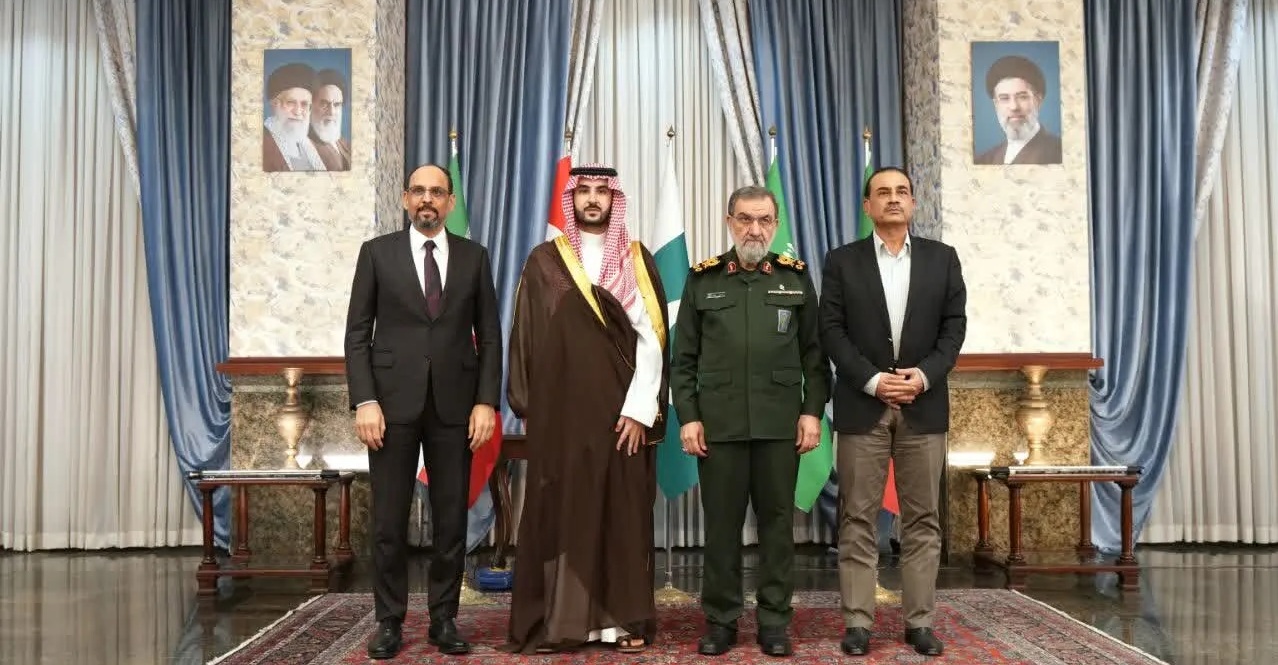
The meeting was held in Tehran on Monday. The delegation from the Mecca Pact states included Saudi Defense Minister Khalid bin Salman, Pakistani Army Chief Asim Munir, and Ibrahim Kalin, head of Turkey's intelligence service. On the Iranian side, President Masoud Pezeshkian, Mohsen Rezaei, secretary of the Supreme National Security Council, and Foreign Minister Abbas Araghchi took part in the consultations. The meeting concluded with a commitment to continue talks aimed at strengthening cooperation among the four countries on regional peace and security.
Tehran's diplomacy and Iran's undeniable place
The meeting's first political message is the very presence of high-ranking representatives from three major regional powers in Iran's capital, at a time when the region is grappling with the fallout of the US and Israeli regime's aggression against Iran, fears of a widening conflict, and disruptions to energy and shipping security.
Many experts see the visit as an opportunity to cement a strategic principle: that West Asia's security cannot be shaped solely by decisions made in Washington, Tel Aviv, or by a handful of regional governments without Iran's effective participation.
The presence of Saudi, Turkish, and Pakistani military, defense, and intelligence officials in talks with Iranian counterparts shows that the regional diplomatic track still requires dialogue with Tehran.
Reuters has reported that the consultations covered a regional non-aggression framework, the resumption of Iran-US negotiations, de-escalation, and the disruptions in the Strait of Hormuz. Such an agenda makes clear that the issues under discussion are not merely bilateral, but they are directly tied to strategic security, trade, and energy at both the regional and global levels.
Why did Mecca Pact members come to Tehran?
The Mecca Pact, signed in August 2026 by Saudi Arabia, Turkey, and Pakistan, emphasizes defense cooperation among its members, yet recent developments have shown that building a defense framework among a handful of countries is not, on its own, enough to contain the region's sprawling crises.
Al Jazeera reported, citing Reuters, the trip by the three countries' delegations to Tehran was part of efforts to reduce tensions and support Qatari and Pakistani mediation. Experts believe the circumstances put three key objectives on the meeting's agenda:
Preventing the war from spreading: establishing a direct channel of communication between Tehran and key regional countries to avert miscalculation and a wider conflict.
Consolidating a regional security mechanism: exploring the possibility of arrangements in which regional countries discuss their own security rather than relying solely on trans-regional powers.
Opening a diplomatic path: backing mediation efforts to end the crisis and examining the conditions for resuming Iran-US negotiations.
Against this backdrop, the simultaneous presence of Saudi Arabia's defense chief, Pakistan's army commander, and Turkey's intelligence head carries particular weight. The lineup shows that the talks were not confined to an exchange of political messages, but the military and security dimensions of the crisis were squarely in focus.
Saudi Arabia: From security confrontation to the need for talks with Tehran
One of the most consequential dimensions of the meeting is the presence of Saudi Arabia's defense minister in Tehran, a country that for years stood on the opposite side of Iran in many of the region's security equations, and that has now turned toward Tehran to help contain regional crises.
Political observers suggest that Riyadh now faces conditions in which continued regional tensions could impose heavy security and economic costs on the kingdom. In its statement on the Mecca Pact delegation's trip, Saudi Arabia's foreign ministry stressed de-escalation among the parties to the crisis, encouragement of dialogue and diplomatic solutions, and support for Qatari and Pakistani mediation.
Turkey and Pakistan, two key actors in Iran's calculations
The presence of Turkey and Pakistan also gives the Tehran meeting dimensions that go beyond Iran-Saudi relations. Turkey, by virtue of its geopolitical position, military capacity, and ties to Western and regional countries, can play a role in shaping future security arrangements. For Ankara, too, a widening war on its southern and eastern periphery carries economic and security risks.
Pakistan, given its relationships with Iran, Saudi Arabia, and the US, is well positioned to play a mediating role. Reuters reports that Islamabad has taken part in diplomatic efforts to bring Tehran and Washington closer together, and that proposals for narrowing differences were floated in the recent consultations.
For Tehran, cooperation with these two actors could open the way to diversifying its diplomatic channels, particularly at a time when the Iranian-American relations are marked by deep mistrust and disputes over sanctions, anti-Iranian sea and air blockade, and the nuclear program.