

















Alwaght- Recent military clashes in Yemen have been indicative of growing number and diversity of drone operations launched by Yemeni force, as well as the Saudi-backed mercenaries, so much so that drones have become one of the most determining tools in the war, something not imagined until recently.
Evolution of battle of drones
This shift came into sharper focus in August, when small drones and multirotor craft rigged to carry and drop munitions entered the fray. It unfolded as Saudi-backed mercenary forces scrambled to close the drone-capability gap with Ansarallah, which over the past decade has built out a diverse arsenal of unmanned aircraft.
Two main models stand out in Ansarallah's drone inventory. First are the Qasef drones, one-way attack aircraft whose design closely mirrors Iran's Ababil-T and which can carry an explosive warhead weighing roughly 30 kilograms. Unlike reconnaissance drones that can return after a mission, these systems are built to reach their target and detonate. Qasef-1 and Qasef-2 are among the best-known members of this family.
The second family is Samad, which has produced four models to date. Samad-1 is presented largely in a reconnaissance role, while Samad-2 and especially Samad-3 have been described in various reports as long-range attack drones.
One of the most prominent models is the Samad-3. Its declared range reaches about 1,500 kilometers, and it can carry an explosive warhead weighing around 18 kilograms.
Though the Samad-3 carries less munitions than the Qasef, its greater range lets it reach targets farther afield, deep inside neighboring countries.
The Samad-3 drew attention in Ansarallah's long-range strikes on targets in Saudi Arabia and the UAE, and later in attacks tied to the Red Sea. These drones are broadly designed for sustained flight over long distances.
The Wa'id drones were also built for Ansarallah's long-range strikes and fall broadly into the one-way attack category, designed to deliver an explosive payload to its target. The core focus of this class is reaching targets at long range.
The Yafa drone, three meters long with a six-meter wingspan, is a long-range suicide drone that Ansarallah unveiled and introduced after a successful operation in July 2024 that penetrated the Israeli regime's air defenses and struck a target in Tel Aviv.
FPV drones
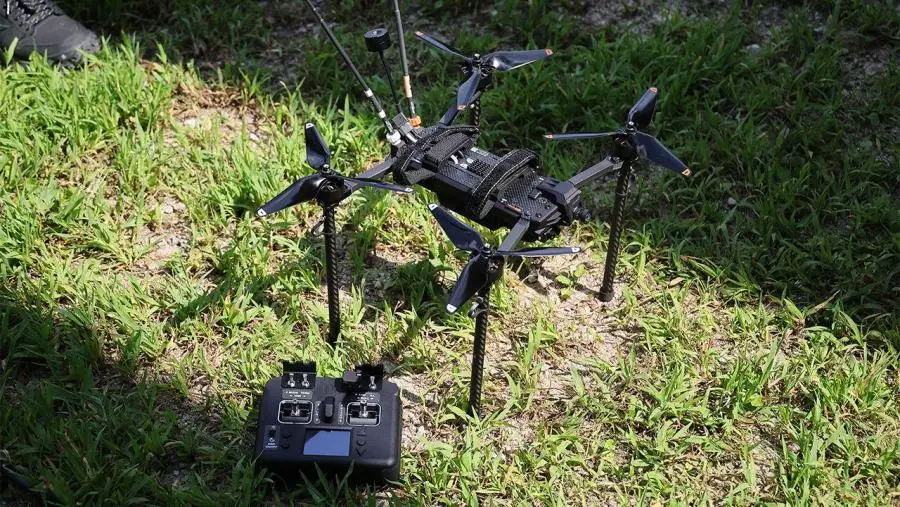
In a significant development, Saudi-aligned forces on the Marib front discovered and seized a small first-person-view (FPV) drone on August 11, according to a new Al-Arabi report, one equipped with a fiber-optic spool.
According to an analysis published by Shiba Intelligence, a platform specializing in Red Sea and Bab-el-Mandeb security, this marks the first documented instance of such a drone appearing in Ansarallah's arsenal.
It is noteworthy that over the past two months, Ansarallah forces have released numerous images and videos of drone strikes on Saudi-backed mercenary positions, underscoring the precision of these weapons. When the Saudi-Emirati coalition launched its campaign in Yemen in March 2015, Ansarallah relied mainly on light weapons. Now, leaning on indigenous capabilities, it has advanced in missile and drone production and widened the scope of its military reach.
Fiber-optic drones are relatively low-cost, tactical weapons typically deployed near front lines and used to target military vehicles, artillery positions, fortifications, and infantry.
The shift was not limited to FPV drones. Imagery released August 21 by a war media outlet affiliated with Ansarallah showed the use of quadcopter-type multirotor drones capable of carrying small munitions.
One Ansarallah drone capable of such missions is the Rajum, a hexacopter used for reconnaissance and munitions-release operations against ground targets.
On September 14, forces known as the "Southern Giants" claimed to have downed a large drone on the Kaboub front near Bab al-Mandab that resembled the Rajum.
Drones enter "kill chain"
The latest round of clashes has unveiled a new model of using the drones by Ansarullah, in a way that along with missile attacks on military positions, aerial images were recorded and published.
On September 7, Ansarullah war media published images of targeting trucks carrying military wares inside Al-Wadia airport near the Yemeni-Saudi border.
Pairing aerial reconnaissance with missile strikes could mark a step toward developing what military literature calls a "kill chain." This approach enables faster target identification, more precise geolocation, improved strike timing, and post-strike damage assessment, especially against moving targets or those that expose themselves only briefly.
Warring sides widely use drones
In addition to Ansarullah, Saudi allies have in recent months made relative advances in using drones on the battleground. In July, they announced using one-side attack drones in the clashes.
On September 18, Yemeni social media users circulated footage of a drone flying over Sana'a. Masbar team, citing visual similarities, suggested the drone resembled one of the aircraft displayed at a July military parade, though it could not determine the exact model.
Now, possession of these capabilities is no longer limited to Ansarallah and Riyadh-aligned forces. On August 17, the "Southern Giants" brigades also announced they had incorporated a group of drones into their combat structure.
The images and material released showed a mix of FPV attack drones, multirotor drones fitted with munitions-release systems, and one-way attack drones.
On August 28, Dira al-Watan forces, Arabic for Homeland Shield, unveiled what it called a new "strategic drone" during a military exercise, another sign of how widely this technology is spreading among the various forces fighting in Yemen.
Based on these developments, the evolution of drone warfare in Yemen is no longer confined to a growing number of drones or a wider array of models. Their mission set has shifted, too, from surveillance and reconnaissance to munitions release, direct strikes, and linking aerial surveillance to attacks. As a result, drones have become a key tool for managing and directing battles on the ground.










