
















Alwaght- As confrontation between the US and Iran enters its seventh month and clashes continue, the protraction of war has not shaken the people's resolve to turn to the streets in support of their country.
After months of organizing nightly rallies in support of the Islamic Republic and national security, on Friday people staged large-scale "Self-sacrificers' Exercise" to highlight their support to the country. The large gathering included people from all walks of life and social layers, stressing that their backing to the Islamic Republic, armed forces, and the Islamic Revolution is unwavering.
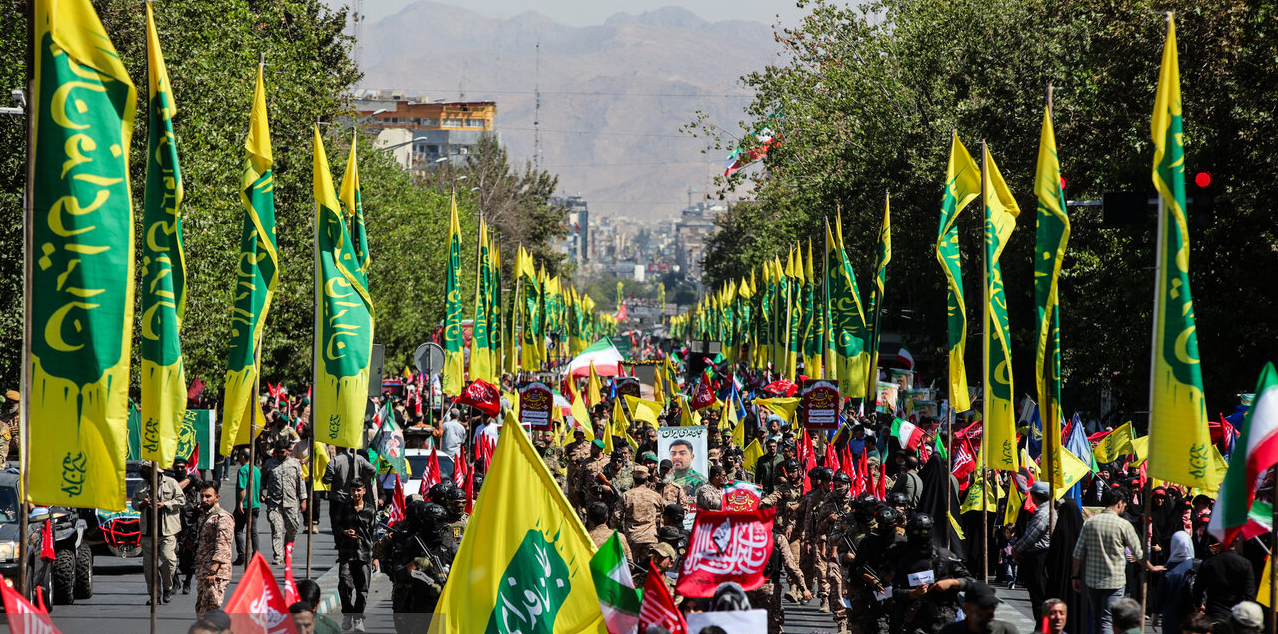
Iran’s large-scale "Janfada" exercise launched Friday with combat battalions and broad segments of the public taking part in Tehran and simultaneously across the country. In the capital, a 313,000-strong march, featuring Basij combat battalions, Janfada volunteers and other groups, wound from Imam Hossein Square to Enqelab Square.
President Masoud Pezeshkian and a host of military and civilian officials attended the event. Addressing the crowd, Pezeshkian called the massive turnout a clear symbol of the nation’s deep bond with Iran and its collective will to safeguard the country’s dignity, independence, territorial integrity and authority, and thanked citizens for their responsible and informed participation.
Hussein Taeb, head of the Basij Organization, described "Self-sacrificers"as a symbol of the popularization of defense and security.
“Janfada will be the embodiment of national authority and the country’s readiness to fight and defend against any threat, and to build the nation and conquer the peaks of civilization,” he said.
General Hassanzadeh, commander of Tehran's IRGC, announced that roughly 500,000 people had registered to take part in the Tehran exercise.
Participants spanned a diverse cross-section of society, from families and young people to war veterans, doctors, students, seminary scholars, shopkeepers, artists and members of other trades and social groups.
The Islamic Propagation Coordination Council said the event was meant to showcase society’s capacity to preserve cohesion, resilience and national preparedness under conditions of threat. A key feature of Janfada, then, was the effort to transcend the framework of a purely military drill and turn it into a public display of social readiness.
Among the notable sidelights was the symbolic presence of members of regional resistance groups, including Yemenis, as well as religious minorities such as the chief rabbi of Iran’s Jewish community.
Alongside the human turnout, the display of defense equipment was on the agenda. Iranian drones were showcased during the Tehran exercise, offering, alongside the popular forces, a picture of the country’s defense capabilities.
A women’s parade along the exercise route was among the other programs. In this way, organizers paired two elements: military capability in the field and social presence in the streets.
Even the media programming tied to the campaign has pursued military and relief training and the formation of popular units. Domestic media reported that the campaign had already drawn widespread interest, with registration for military and relief training within popular battalions continuing.
Held on the eve of Sacred Defense Week and after months of tension and confrontation among Iran, the US and the Israeli regime, the event was neither merely a military exercise nor a political rally. Its organizers sought to project an image of the bond between the country’s defense capacity and the social presence of its people.
Message to Israeli-American enemy
Since the public maneuver was held amid ongoing tensions between Tehran and the Israeli-American camp, the chants, as ever, focused on the two aggressors, highlighting resistance to threats by Washington and Tel Aviv.
Chants formed a central part of the gathering’s message, with slogans including "My soul be sacrificed for Iran", "Death to America," "Death to Israel," "Labbaik Ya Khamenei" and cries tied to resistance and steadfastness ringing out through the event. Janfada, then, was not merely the name of a popular maneuver, but it has become a framework for defining a kind of public participation under conditions of war and threat.
One of the exercise’s most important messages was a display of domestic cohesion in the face of foreign pressure. The commander Tehran's IRGC, had said before the drill that the enemy’s aim was to weaken cohesion and unity, but in his view the public’s turnout had shown those elements are only being reinforced. He also described the presence of people in squares and streets as a factor strengthening the armed forces’ deterrence.
Speaking to media at the event, several participants stressed their reason for attending: "Our goal is to declare our readiness to fight global arrogance, the US, Israel and those who cast a covetous eye on our country. One attendee said, “We came here to show the US and Israel that we will not abandon our country.” Another, dressed in military unifirm, said, “Until revenge is realized, this combat uniform will not come off our bodies.”
Assurance to armed forces
Though this urban drill was different compared to the previous gatherings, its significance does not lie in the number of people present in the streets. The message is that the defense power does not merely lie in the equipment, missiles, drives, and military forces. Rather, social cohesion makes up a major part of the national power. Therefore, in such a context, popular turnout sends a message to the armed forces, telling that if foreign threats continue, they have a considerable social support at their disposal to rely on.
For this reason, one of the exercise’s main functions can be seen as generating a kind of “social reassurance” for the armed forces, the idea that the battlefield is not the only arena of confrontation with the enemy, and that behind the front line, a large part of society also sees itself as invested in defending the country.
The same meaning can be captured by the phrase “the battlefield for the armed forces, the streets for the nation”, a slogan that has become a central refrain at nightly gatherings since the war began, underscoring the link between the public’s presence in the streets and the armed forces’ role on the battlefield. While the armed forces bear the responsibility for military confrontation, the people, through cohesion and social readiness, form another part of the country’s deterrence capacity.
Maximum pressure fails
The exercise also unfolded against a backdrop in which external economic and political pressure remains a central axis of Iran’s dispute with the US and its allies.
Washington had sought to widen the gap between the people and the Islamic Republic through intensifying the sanctions and tightening the noose of a maritime blockade. But the public’s turnout can be read as a clear message to its adversaries: economic pressure and military threats cannot easily sever the bond among the people, the political system and the armed forces. The presence of diverse segments of society alongside the armed forces thus projected an image of solidarity and cohesion in the face of external threat.
In effect, the street at this exercise became a stage for displaying social backing, a message that the enemy cannot drive a wedge between society and the country’s defense forces by ramping up economic pressure and military threats.
The parade of organized popular forces, the presence of varied groups, the display of drone equipment, Iranian flags and resistance chants together formed a package whose core message can be summed up in a single proposition: Iran wants to showcase military capability and social cohesion simultaneously in the face of foreign pressure.
The broad public turnout carries this message for Washington and the Israeli regime: maximum pressure cannot automatically translate into a change in the behavior of Iranian society simply by increasing economic pressure or military threats. On the contrary, the greater the external pressure, the more important it becomes to preserve domestic cohesion and the bond between society and the system.
Generally speaking, the Janfada campaign has demonstrated that mounting external pressure does not necessarily erode Iranian society’s resilience, and can even add to its readiness and social cohesion. This means that Washington’s hope that sweeping sanctions can shatter the determination of Iranians and sow division between the people and Islamic Republic will go nowhere.










