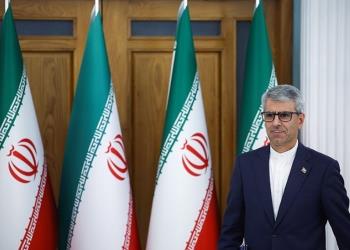






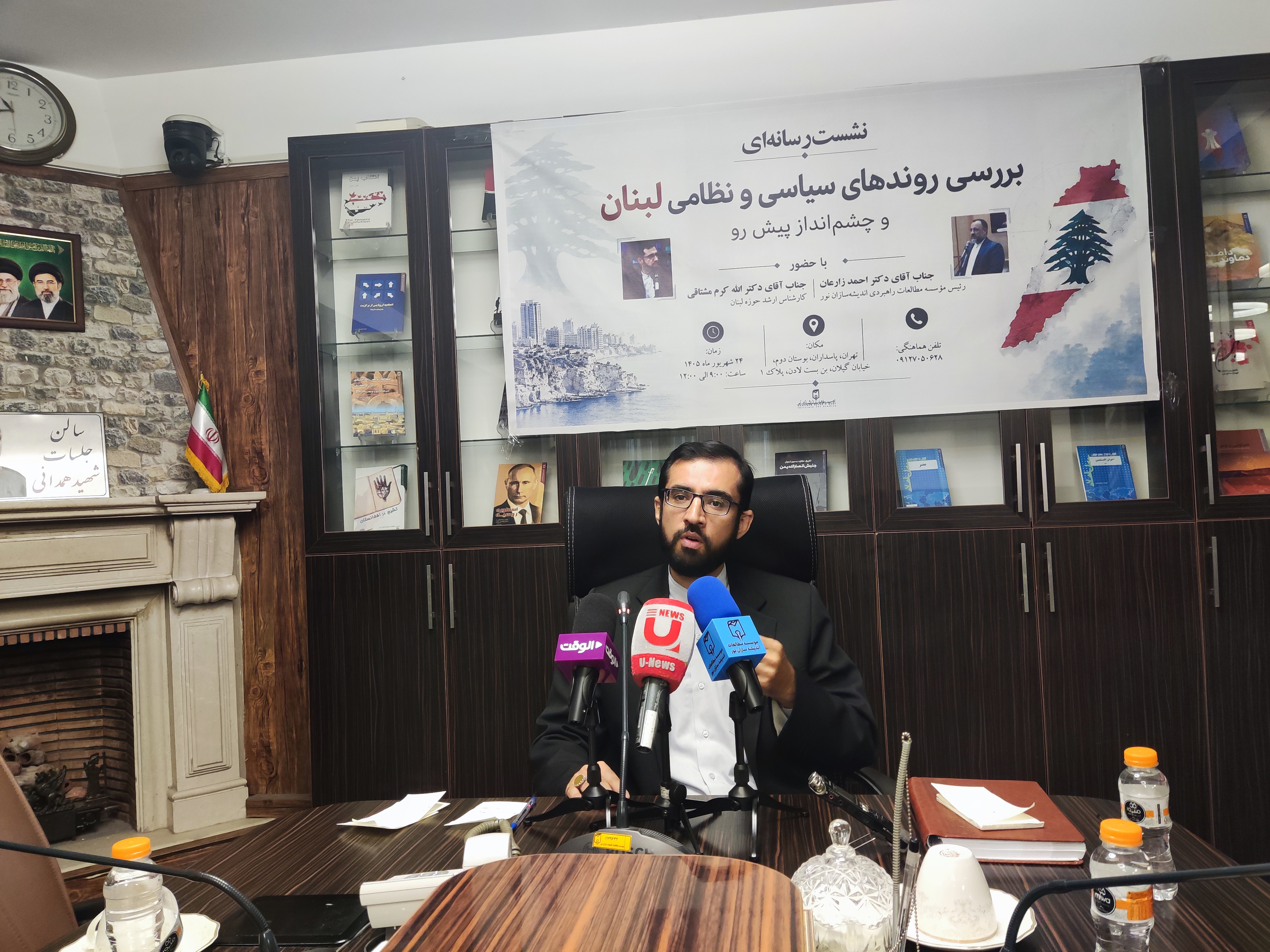


Alwaght- Andisheh Sazan-e-Nour Institute for Strategic Studies in Tehran hosted a meeting discussing Lebanon's political and military developments in Lebanon. Allah Karam Moshtaghi, a West Asia affairs expert, shed light on the Lebanese developments, political, security, and social pressures against Hezbollah, and role of Iran in Lebanon, and the recent developments in the southern Lebanon.
Pointing to the state of Hezbollah after November 27 ceasefire, he said that since this date, about 20 traps were set by the Israeli regime for Hezbollah, each was thought to eliminate the resistance movement by the next year. But by weathering all of these crises, Hezbollah should how deep-rooted and experienced Hezbollah is.
Israeli-American political project to undermine Hezbollah
The political expert identified the first level of pressure on Hezbollah as political, stating that the Americans and Israelis tried to sow political discord between the Lebanese government and Hezbollah. They also sought to drive a wedge between Shia groups and stoke divisions among Lebanon's political factions in a bid to spark something resembling a civil war against Hezbollah."
Moshtaghi also addressed the military dimensions of the plot, suggesting that they intended to pit the Lebanese army and military forces against Hezbollah so that the movement's capabilities would be consumed by internal conflict. They also sought a lightning occupation of southern Lebanon, believing Hezbollah would become so bogged down in domestic tensions that it would no longer be able to fight Israel.
On the social front, he continued, the Israelis and Americans tried to manufacture a crisis and drive the refugee issue to a dead end. They believed the civil and non-Shia movements that emerged in 2019 could gain more power in the next elections and morph into a political and media wave against Hezbollah and its ally Iran.
He went on that the enemies of the Hezbollah also believed they could forge a heavy Arab coalition against Hezbollah and Iran, and then bring Syria's new government into Lebanon to act against Hezbollah.
Iran standing by Hezbollah
Moshtaghi, emphasizing Iran's role in helping Hezbollah weather these crises, said: "Iran's shadow and role are visible in all these crises and in Hezbollah's passage through them. In each of these crises, Iran stood by Hezbollah, offered counsel, and provided assistance.
There is no political, cultural, or social crisis in Lebanon that Iran has abandoned, and this carries a lesson and a message for both friends and foes alike, according to Moshtaghi.
The regional affairs expert also addressed US policy following Nawaf Salam's appointment as prime minister, saying that the Americans, particularly after February 8, 2025, and Nawaf Salam's selection as Lebanon's new prime minister, intended to outsource certain political and military matters. Washington assumed it no longer needed a direct US or Tel Aviv presence and could install a government in Lebanon that would move under US's wing and eliminate Hezbollah.
Moshtaghi added that their assumption was that even if Hezbollah were not completely destroyed, it would be reduced to a small movement on paper, one like some others in Lebanon that have a nominal presence but no real influence.
Failure of political project and Israeli direct entry
He continued that the events that unfolded after February 8, 2025, and the failure of Washington's and the Israeli regime's dreams to materialize, led the Israelis to conclude that the only remaining path to destroying Hezbollah was their own direct entry into Lebanon. They tried 20 different types of threats and crises to eliminate Hezbollah, but when none of these methods worked, the Israeli regime itself entered Lebanese territory and embarked on a path of occupation.
Europe concerned about continuation of Lebanon war
Pointing to Europe's shifting stance, Moshtaghi said today, several things are unfolding on the political front. One is that the Europeans are deeply alarmed by the escalating crisis in Lebanon, because Europe will also be affected by the Lebanese crisis.
Europe sees that the Israeli regime has failed to achieve its objectives since launching its ground incursion into Lebanon, while Hezbollah keeps playing new cards.
Referring to Hezbollah's use of FPV drones, Moshtaghi held that the use of these drones began on March 22, a card the Israeli regime never imagined Hezbollah could obtain. Hezbollah still has many tactics up its sleeve against the Israeli occupation, and the Europeans have come to recognize this capability.
The Israeli regime is known for its lightning strikes and claims it paralyzes the enemy in the opening ground assaults, but in Lebanon it failed to achieve the desired result against Hezbollah.
If the Europeans believed the Israeli regime had the capacity to destroy Hezbollah, they would never have pursued a ceasefire and an end to the conflict. The fact that European voices are now being raised about the Lebanon war stems from their disillusionment with the Israeli ability to eliminate Hezbollah.
Regional countries worried about war expansion
Moshtaghi further held that Turkey and Arab countries have concluded that devouring of Lebanon by Israeli regime can stand a prelude to the next expansionist steps of Tel Aviv in the region.
In this regard, he pointed to the remarks of Janathan Pollard, an American-born Israeli spy and former American intelligence analyst who was jailed for spying for the Israeli regime. Pollard said that Israel's next war will be with Egypt and Turkey, unleashing a political and security quake km yjr region's political and media circles. He later said that these remarks were his personal position, but the course of developments showed that the worries of regional states about expansion of war have increased.
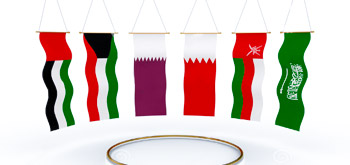
The political analyst added that today in the Arab countries like Syria, Qatar, Palestine, Lebanon, and Yemen we are seeing that just unlike the past they are not against the Axis of Resistance. And in some cases we can see Qatar and Turkey stepping in to end the conflict.
Hezbollah’s Ashura-style war
Commenting on the scenario of a broader war, Moshtaghi said that if Hezbollah wants to fight an Ashura-style war and apply scenarios that it has so far avoided, the Israeli regime will would suffer a serious blow. Hezbollah holds scenarios it has not yet deployed, but Netanyahu refuses to acknowledge this in order to preserve his own political standing.
Lebanon talks: A test for the US and Israel
The regional affairs expert devoted another part of his remarks to the multilateral negotiations among Lebanon, the US, and the Israeli regime, saying that if the Americans and the Israelis were sincere about finding a political solution for Lebanon, why did not they pursue negotiations before this?
As soon as Iran emphasized in Islamabad that the first term of the ceasefire deal must be an end to the fighting on all fronts, including Lebanon, the Americans rushed for a series of talks.
He held that now that the seventh round of negotiations has wrapped up in Rome, the Beirut government has realized what a huge con it fell for. Even anti-resistance media are brimming with frustration, astonishment, and anger at the current situation and Washington's framework, because the US has failed to honor its commitments, and in the areas where the Israeli regime was supposed to withdraw, no withdrawal has taken place.
Tel Aviv was supposed to pull back and the Lebanese army was to take control of those areas, but that did not happen. Hezbollah knew from the start what the outcome of the negotiations would be and let the process play out so that the result would become clear to the entire world.
The Israeli regime violated its commitments before the eyes of the whole world and escalated its attacks and crimes against Lebanese citizens. It is under these circumstances that we are now witnessing President Joseph Aoun's visit to the city of Nabatieh in southern Lebanon, which could be a sign of the Lebanese government's frustration with Israel.
Message of extending Iranian ambassador's mission in Lebanon
Moshtaghi described the extension of the Iranian ambassador's tenure in Lebanon as carrying a political message, saying that extension of the Iranian ambassador's stay in Lebanon sent a major message to both America and Iran that Beirut in more hopeful about Iran and that Iranian presence is more effective for Beirut.
This shows, he went on, that if Tehran has a plan for Lebanon, it should pursue it. Iran has both a military and a political plan for Lebanon, and both have proven effective so far.
The regional affairs expert, referring to Iran's position on attacks against the Dahieh, said that in June, the Khatam al-Anbiya Central Command, which is in charge of managing the war, announced that if southern Beirut and the Dahieh were targeted, Iran would also strike the northern Israel.
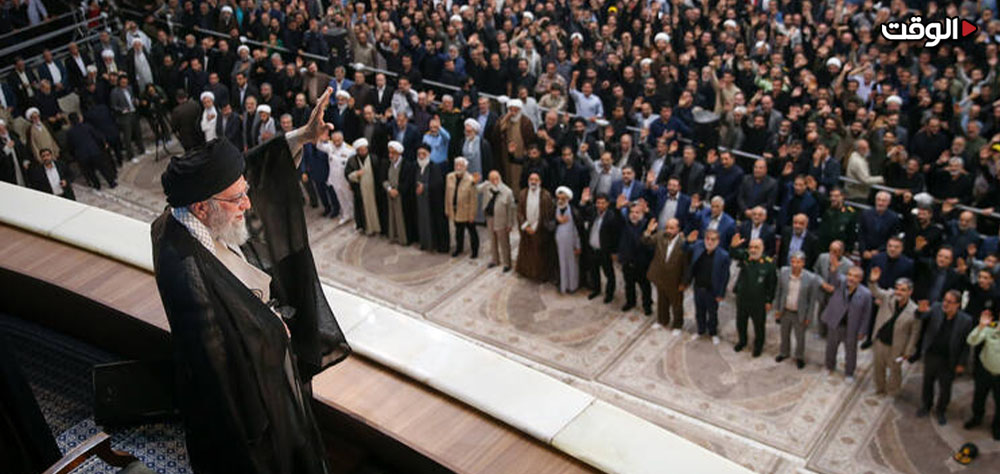
Simultaneously with the funeral of the Supreme Leader Ayatollah Sayyed Ali Khamenei on June 7, when the Israeli regime targeted southern Beirut, Iran struck the northern occupied territories that same afternoon, honoring its pledge to defend Lebanon. This demonstrated that Iran's red line is real.
The Israeli regime once again tested Iran's resolve on June 14. When the Khatam al-Anbiya Central Command was ready to respond, everyone stepped in and asked Iran not to act, pledging that this would be Israel's final attack. After that, we witnessed no further action by the Israeli regime against the Dahieh.
Iran has not forgotten Hezbollah
Moshtaghi denied the claims that Tehran scaled back support to Hezbollah, saying that this is a big media deception.
He added that Iran stood beside Hezbollah during all the 20 plots and crises that were designed to devour Hezbollah. When Iran says Hezbollah, it means all of the Lebanese people.
Referring to Iran's assistance during Lebanon's energy crisis, Moshtaghi said that when Lebanon was hit by an energy, fuel, and mazut crisis, Iran helped all of Lebanon.
He also pointed to Hezbollah's social base, saying that Hezbollah has proven it is not an ethnic party. This movement has repeatedly gone to war in defense of Lebanon's Christians and Sunnis and has sought to present itself as a patriotic Lebanese movement.
Time playing into Hezbollah’s hands
Wrapping up, the political analyst said that time is going in favor of Hezbollah, and the enemies fear the unity of the fronts. This is the great legacy of General Qassem Soleimani, Yahya Sinwar, and Sayyed Hassan Nasrallah, and we must honor this legacy.
We, he further maintained, must pay very close attention to the concept of the unity of the fronts, which means an attack on one branch of the Axis of Resistance is an attack on the whole body of this camp. The enemy is worried and afraid of the unity of the fronts. The unity of the fronts must become a law and, in the years ahead, evolve into a regional alliance.
There are signs that countries in the region welcome this strategy, as Arab states have concluded that they must unite against the Israelis for survival.