




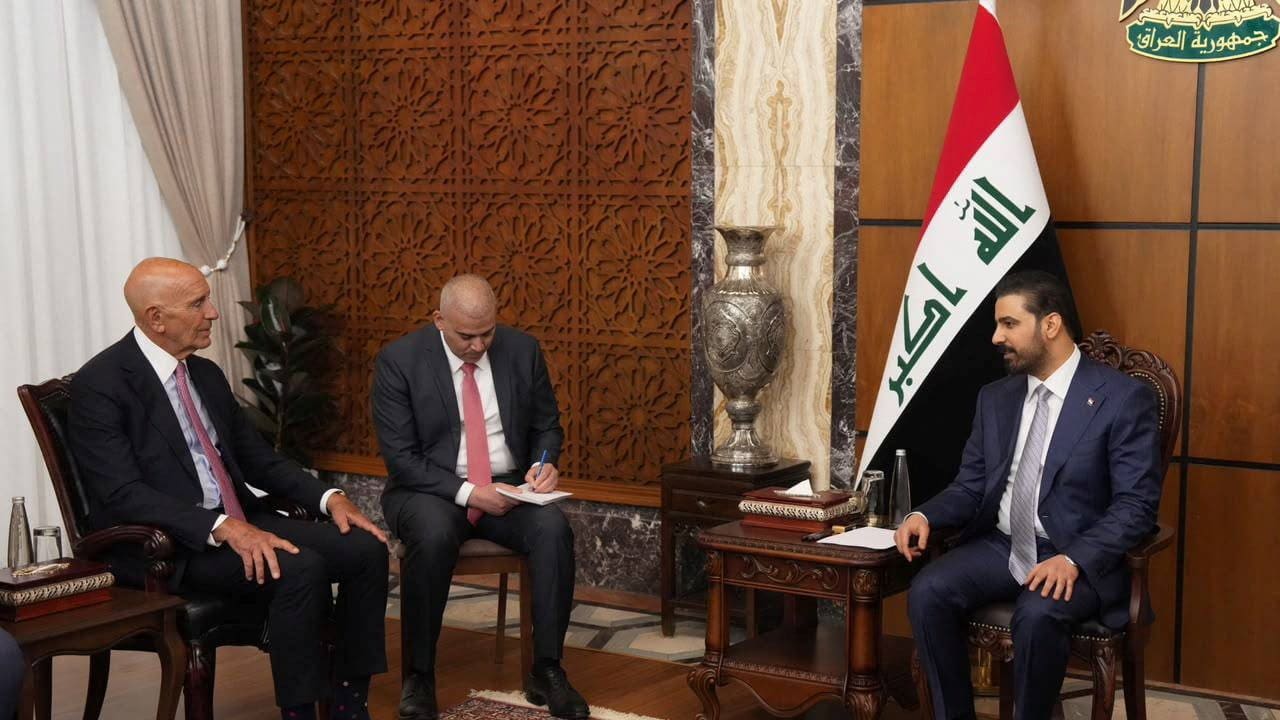


Alwaght- The visit to Baghdad and Erbil of the US special envoy to Syria and Iraq Thomas Barrack should be regarded as going beyond a simple diplomatic meeting and actually is an unveiling of a new and comprehensive architecture for redefining the Iraqi-American relations.
The merger of the Iraqi and Syrian cases under a single envoy who happens to be the American ambassador to Turkey bears sign to this shift of paradigm, suggesting that the White House no longer manages the West Asia crises separately. Rather, it has resorted to a strategic unification and engineering the power structure in the whole region.
This visit, coming after Washington-Tehran deal to end the war of aggression on Iran and also important developments in Iraq and Syria, is actually a document unveiling a multifaceted roadmap on West Asia region.
At the heart of this new architecture stands the most challenging case, namely fully disarming and dissolving all of the resistance groups off the circle of control of the government and the so-called restricting of arms to the official institutions.
What makes this period different from the others is the unprecedented move by the Iraqi prime minister's office: Reposting the American statement without any modifications.
This move is a blatant sign of Washington's maximum pressure campaign, and of the al-Zaydi's government's acquiescence to that imposed framework. The insistence on keeping Iraq out of regional conflicts is, in reality, a direct message to the Axis of Resistance, and specifically to the Islamic Republic of Iran, aimed at pressuring Iraqi sovereignty to freeze resistance, rather than any overt US or Israeli military intervention from Iraqi airspace and soil.
Strategic analyses show that targeting the legal and operational standing of the Public Mobilization Forces (PMF) and the resistance factions is not merely about degrading their military capability. It is a project to sever the social, political, and ideological roots of resistance and to cripple its wings inside Iraq. Yet Washington would do well to remember a historical fact: the Hashd, born from a supreme religious edict, is the backbone of Iraq's security in the fight against takfiri terrorism. Any structural weakening will do nothing but create a security vacuum and pave the way for the return of ISIS and terrorism, which may, in fact, be part of Washington's broader strategy to keep the pressure on Baghdad.
The Americans believe that success for this security strategy hinges on severing Iraq's economic dependencies on neighboring Islamic Republic. Fully aware of this, Washington has designed a portfolio of economic projects to complete the chain of pressure on Tehran. Negotiations with major oil companies Chevron and Excelergy, to develop the strategic West Qurna 2 and Nasiriyah fields, along with gas condensate projects, combined with licensing Starlink to operate, are all designed to hit multiple targets with a single shot.
Starlink in Iraq is not just a communication tool, it is a multirole instrument to ensure communication security of the Washington-controlled government in Baghdad, to collect intelligence on the Iranian borders, and to set up independent internal infrastructure to manage possible crises. Meanwhile, the support for reviving the strategic Kirkuk-Baniyas pipeline to connect Iraqi energy transit to the Mediterranean and neutralize the Strait of Hormuz tool leveraged by Iran, and also to prevent full economic collapse of Syria under the US ally Ahmad al-Sharaa.
These projects are shrewdly wiring Iraq's economy to the fate of sanctions against Axis of Resistance. By designing an Eastern Mediterranean economic corridor, Washington is actively working to reroute the region's trade and energy flows, tilting the map decisively in the West's favor.
To advance this intricate architecture, Washington needs either the alignment or the passivity of Iraq's internal power structures, which is precisely why it has activated political and judicial levers in tandem. Extending an official White House invitation to Prime Minister al-Zaydi for Washington visit was a pivotal political move, granting his government significant international legitimacy to push controversial agendas, such as the disarmament of resistance factions. Meanwhile, Barrack's private meeting with Faiq Zaidan, head of Iraq's Supreme Judicial Council, peeled back another layer of this new architecture. Washington knows full well that to bypass legal hurdles, securing new constitutional interpretations to dissolve resistance groups and ramming through major economic contracts without political push back, it needs the judiciary on board.
In Erbil, Washington pushed for settling the political stalemate and formation of a new local Kurdish government and also de-escalate tensions with the central Iraqi government. This was an effort to unify the home Kurdish front against the future pressures and use of the Kurdish cards in the border and energy equations against Iran's regional position. This political, economic, security, and judicial engineering makes it crystal clear that Washington is seeking structural change in Iraq through simultaneously activating internal and foreign levers.
In the lower layers, Barrack's main mission was not setting a simple ultimatum but redefining the socio-security contracts in Iraq based on an absolute dependence on Washington. The key difference in the earlier American interactions with Iraq is that the US presented al-Zaydi with a full package: Ensuring survival and international legitimacy of his government in return for full implementation of the American conditions.
Unlike past US support, which was conditional and doled out in drips, Barrack's new framework for long-term stabilization, tying Iraq's economy (through both carrots and sticks) to al-Zaydi's government survival, called the Iraqi PM not as a prime minister, but as a "primary partner in the new Middle East architecture."
The timing of this push, on the eve of al-Zaydi's Washington visit, is a multilayered maneuver: pre-drafting agendas and joint statements to turn the trip into a "signing ceremony"; feeding al-Zaydi's policy options, instructions, and decision-making templates behind closed doors, ensuring he raises no objections to Trump's demands while in D.C, and beaming a psychological signal to both the Axis of Resistance and Iraq's political elite that the project is now in its execution phase, and that Washington stands firmly behind its aligned leaders inside Iraq.
The anxiety over these closed-door consultations is precisely about this: bypassing parliamentary oversight, accepting commitments that exceed constitutional authority, holding the economy hostage to force political disarmament, and the distinct possibility of inking a geopolitical roadmap explicitly targeting the Axis of Resistance, one that would fundamentally reorient Iraq's strategic trajectory toward the West. This visit to Washington must be read as a "quiet diplomatic coup" by the US— a bid to transform the Iraqi government into a comprehensive agent of US policy before al-Zaydi even sets foot in Washington.
Yet the path to realizing this roadmap is strewn with major structural obstacles. Washington's first and most critical miscalculation is its reductive analysis of Iraq's resistance factions. These are not imported proxies or hired guns, they are an organic part of Iraq's social, political, and religious fabric, forged in the crucible of fighting occupation and takfiri terrorism. Their real capital is not merely missile and drone capabilities; it is the religious legitimacy derived from a supreme clerical edict, deep popular credibility, and an unbreakable bond with Iraqi national identity. Any rumored willingness by some factions to decouple their weapons from the broader struggle is a shrewd tactical shift, a calculated move to preserve the resistance's core structure under mounting pressure, and should never be misread as the collapse of the resistance paradigm itself.
The second challenge is vulnerability of the Iraqi security structure against the vacuum caused by undermining the PMF. The voluntary force makes the backbone of the nation's security in the fight against ISIS terrorist group and its impairment stands as a prelude to return of terrorism that can even endanger the US and its allies. So, as long as popular support, home cohesion, and regional coordination among the branches of thr Axis of Resistance and the religious authority exist, the project for full elimination of the resistance from Iraq's equations will not be more than a pipe dream. The visit to Washington of the Iraqi PM is a big test of Iraq's sovereignty resistance to the American dictates and Baghdad's loyalty to the blood of the martyrs of resistance.
In such a precarious moment, the greatest challenge facing the resistance front is not merely security pressure, it is the gradual erosion of social capital, the steady drain of political legitimacy, and the seeding of internal rifts through a full-spectrum hybrid war.
What is taking shape in Iraq today is part of a long-term blueprint to rearrange the entire power structure. Countering it demands nothing less than a strategic revolution in approach; one built on several core principles:
First, preserving and strengthening internal cohesion. This is the resistance's Achilles' heel against foreign infiltration and pressure. Internecine fractures could bring it down with startling ease.
Second, continuously regenerating legitimacy by elevating the resistance's national role, in reconstruction, security provision, and defending Iraqi sovereignty, from a mere historical achievement into a living, breathing discourse that resonates throughout society.
Third, engaging wisely with the government and actively participating in political processes. This remains the most formidable shield against the project of political disarmament.
Fourth, breaking free from reductionist thinking and grasping a hard truth that in today's battle, the economic, media, and legal dimensions matter just as much as missile and drone capabilities.
Finally, Iraq's future will be written not in the Washington-Baghdad meetings but in the Baghdad's streets and public resistance that already showed itself in two decades of fight against American occupation and against terrorism. So maintaining this spirit and turning it into a strategic demand will ensure failure of the American-Zionist "new Middle East" project and establish cementing the historical and national position of the resistance factions in the future West Asia equations.