









Alwaght- The latest Israeli election results are weakening Netanyahu's political standing and deepening internal rifts, even as the fallout from regional wars, unfulfilled security promises and profound party divisions cloud the future of cabinet formation.
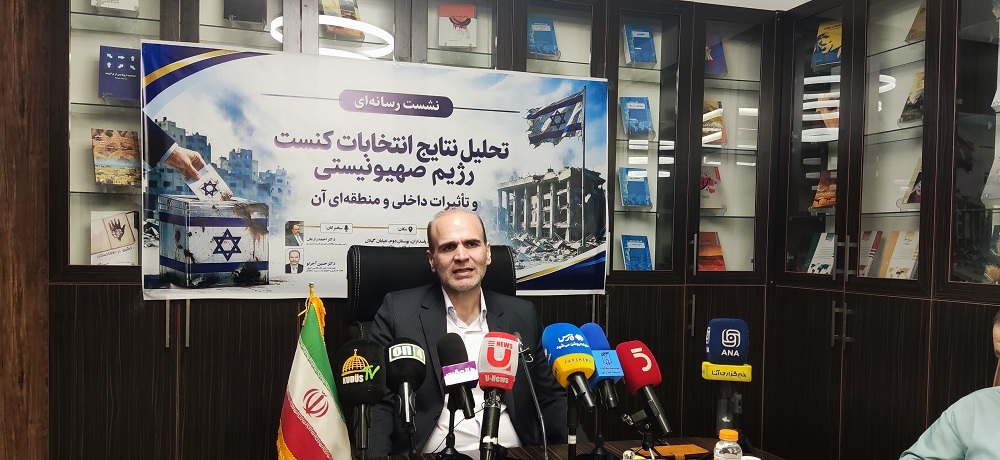
Addressing this issue, West Asia affairs expert Hussein Ajorlu at a meeting hosted by Tehran-based Andisheh Sazan-e-Nour Institute for Strategic Studies shed light on the reasons behind decline of Netanyahu-propagated victory discourse, shift in the political polarity, obstacles ahead of new cabinet formation, and the scenarios ahead of the Israeli political structure.
Collapse of the discourse of Israeli victory
Mr Ajorlu put the discourse dominating the election campaign front and center, tracing it to Netanyahu's military adventurism from Gaza to Lebanon and Iran, spoke of the collapse of the image of Israel as a democracy in West Asia, and finally laid out the most likely scenarios for cabinet formation.
Opening his remarks with an analysis of the election results, the expert said one narrative that pro-Israel media sought to spotlight was that Tel Aviv had gained the upper hand thanks to military victories and regional developments, but the election results showed this narrative was not accepted within Israeli society itself.
He added that even in the US, there was extensive propaganda about Israeli superiority and championizing around Netanyahu, yet this narrative failed to deliver. Netanyahu not only failed to hold on to his previous Knesset seats, but also his coalition's seats dropped from 67 to 53.
The regional affairs expert said Netanyahu resorted to tactics such as polarization to drive the election campaign, but this strategy, too, failed to produce the expected result.
Insecurity in the north and failed Netanyahu security promises
Citing the reasons behind the erosion of support for Netanyahu, Ajorlu said his discourse is no longer the dominant one inside the occupied territories. One of the most pressing concerns for Israeli society is the serious security threats on the northern front and anxiety over Hezbollah, even though Netanyahu had previously claimed to have eliminated insecurity in those areas.
He added that this very point shows Netanyahu's pledges to deliver security have failed to gain acceptance among Israelis. Settlers continue to feel insecure, and this has damaged the political credibility of the Israeli PM.
Iran war: Turning point of Netanyahu’s defeat
In another part of his comments, this political analyst referred to the 40-day war on Iran, saying that Netanyahu could claim victory before the war, but the 40- say aggression failed to bring about the transformation and gain he expected. Despite mobilizing his home and foreign powers, he failed to realize his stated goals, while he and Trump claimed they will bring Iran to its knees in three days.
He continued that the two nuclear powers took action, and despite the damage their inflicted on Iran, they failed to realize their goals. This failure made it no longer easy to accept the Israeli military superiority.
Mr Ajorlu added that the war on Iran destroyed the Israeli image at home and abroad. Support for war inside Israel dropped sharply and Netanyahu's rivals brazenly said that Tel Aviv should think other ways to deal with Iran since the PM's stated strategy turned into a failure story.
Expansion of international isolation and economic costs of war
Pointing to the international fallout from the war against Iran, Ajorlu said the 40-day war made global public opinion even more hostile toward Netanyahu and Israel, adding allegations of human rights violations and war crimes to his record.
The expert maintained that Netanyahu effectively widened the circle of Israel's enemies and critics. Countries such as Turkey, Saudi Arabia and Egypt have joined the ranks of serious critics of Israeli regime, and the Tel Aviv's international standing has been severely damaged as a result of the wars Netanyahu waged.
Referring to the economic consequences of the war, the regional affairs expert said war costs have weighed heavily on residents of the occupied territories and inflicted widespread economic damage on Israeli society. All told, the war with Iran turned the tables on Netanyahu, and Iran and the Axis of Resistance made a success in weakening Israel's position and image.
Contradictions of political coalitions: From secular right to religious right
Mr Ajorlu went on to unpack the complexity of Israel's coalition structure, saying the regime's electoral system is list-based, which forces parties with contradictory leanings into a single political alliance.
Pointing to the contradictions within Netanyahu's coalition, he added that Likud party is a secular right-wing party and, in political terms, would be expected to work with parties like Lieberman's, which are also secular right-wing, but instead of such an alliance, Netanyahu partnered with religious right-wing factions.
The expert continued that the religious factions themselves split into two camps. The first is the Haredim, who oppose military service, and the second comprises currents like Jewish Power, of Ben-Gvir, and Religious Zionism, of Bezalel Smotrich, which pursue different political and religious goals. These very contradictions have made a stable coalition difficult to form.
The Iranian expert further stated that Netanyahu's campaign appeared to have concluded that a maximum coalition was not feasible. On the other side, Eisenkot also faces obstacles to forming a cabinet, with the Haredi military service issue and Netanyahu's presence among the most important hurdles facing both camps.
Three scenarios of cabinet formation
Turning to the scenarios for government formation, Ajorlou pointed to the fraught conditions and layered complexities, saying that while a cabinet can be formed with 61 seats, holding it together requires at least 67 or 68 so that one or two parties can bolt and the government still survive. Eisenkot, for his part, cannot ally with Netanyahu, because he built his campaign on ousting Netanyahu and would also run into the Haredi military service dispute.
Several possibilities therefore present themselves. First, a coalition government could take shape under pressure from Trump, but such a government would be plagued by instability from the outset because of internal disagreements. Second is the question of who becomes prime minister, a challenge made especially serious by Netanyahu's track record of reneging, as in the episode with Benny Gantz.
The expert identified a second scenario as a coalition with Arab parties, saying both main camps declared in their campaigns that they opposed allying with Arabs, which complicates this scenario. The Joint List, for its part, has said it will not enter a coalition with Zionist parties.
The expert named a third scenario as a minority government, adding that Arab parties have indicated they might vote for an Eisenkot government without joining the cabinet directly. This scenario, too, comes with its own hurdles and complications, so a government can be formed, but it will certainly be fragile.
Comparing current conditions with the political crisis of past years, he said many observers liken the present situation to 2019, a period that saw at least five elections through 2022 and produced fragile governments. Some believe the October 7 events were themselves a consequence of that stretch of political instability.
Mr Ajorlu continued that current conditions suggest the latest election will probably not yield a stable government. Under the election law, the first candidate has 28 days to form a cabinet, extendable by 14 days, the second then gets 28 days with no extension, and the third has 14 days to try his luck. The present situation therefore points to another election being held. Netanyahu may target Eisenkot in the next election over his inability to form a cabinet.
Interim government and possible lingering of crisis
Pointing to the outcomes of prolonged political stalemate, Ajorlu said that the interim government faces restrictions in making major decisions and approving the budget, but Netanyahu during this period still can take some security measures and invest them to influence next vote.
The political disputes of the two camps can repeat themselves in judicial affairs, and even if a government is formed, odds are a fragile cabinet will form.
Rise of a new polarity between Jews and Palestinians
In his final remarks, Ajorlu traced the historical evolution of Israel's political polarities, saying that until 1973 Israeli governments were largely in the hands of the left, and from the 1990s onward a left-right polarity took shape. From the mid-2010s, a right versus center-right polarity emerged, and later the rift between the religious right and the secular right came to the fore.
He stressed that a new polarity is now taking shape, with Jewish factions on one side and Palestinians holding Israeli citizenship on the other. Beyond deepening social divisions, this rift carries an important message for global public opinion, suggesting that Israeli regime, contrary to its claims of being democratic, faces serious problems with racism and with accepting the political rights of Palestinians.
Arab election turnout a no to Netanyahu, not necessarily joining the cabinet
Asked whether the Arab community might be disillusioned if Arab parties fail to capitalize on their gains in the current election, Ajorlu said that in earlier rounds, too, Arab parties won a number of Knesset seats but their votes ultimately did not lead to the formation of a government.
Past experience has shown that the absence of Arab parties from the cabinet does not necessarily lead to disillusionment in the Arab community, because the main goal of these factions in the latest election was to block Netanyahu from staying in power. Therefore, even if Arab parties do not enter the cabinet, higher turnout and their strengthened standing in the Knesset still count as a significant political gain.