
















Alwaght- Eruption of protests in Europe initially was related to educational demands, a sign of growing discontent of the younger generation with the deteriorating public services, economic pressures, austerity measures, and dim social future in the European countries.
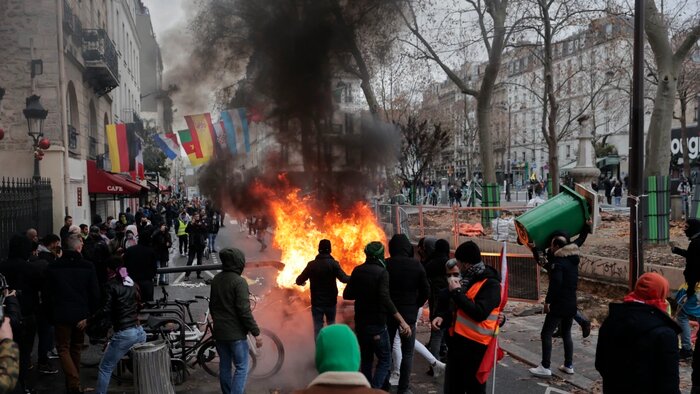
Over the past few days, France has become a hot spot for the biggest European student protests in recent years. Having started on September 17 in Paris suburbs, the protests addressed teacher shortages, overcrowded classrooms, dilapidated schools, and long education hours, but in a short time, they spread to various French cities. Reports suggest that hundreds of schools were affected by the student rallies and in recent days, number of schools partly or fully closed reached 400-500.
The scope of France demonstration has gone beyond schools and university students have reportedly joined the rallies. Reports say that around 30 universities were scene to protest gathering or closure of their entrances.
The police crackdown has poured a fuel on the fire of protests as the security forces have shown an iron fist to the protesters. Hundreds of police officers and students have been wounded and thousands arrested in the recent clashes. Reuters reports that by October 5, more than 5,000 people, most of them teenagers, had been detained during the protests, with roughly 1,800 now facing prosecution.
In one of the most harrowing episodes, a 15-year-old boy in the city of Lens lost his hand and part of his forearm during a confrontation with police. Human rights groups have condemned the police use of batons, tear gas and riot-control grenades against demonstrators.
The student protests are only one front in a broader social crisis gripping France. Labor unions and public-sector workers had already staged strikes and demonstrations against the government's austerity plans, rising fuel prices, stagnant wages and eroding purchasing power. Reuters reported in September that sweeping strikes had spread across swaths of the French economy.
Belgium: A second student front
As protests intensify in France, signs of the wave spilling into neighboring Belgium are mounting.
In the Belgian city of Liège, students rallied against education reforms and school budget cuts, blocking school entrances. Police arrested 16 people during Monday's protests, and reports emerged of property damage and clashes with security forces.
Student unrest in Belgium had in fact begun even before the French protests peaked. On September 16, thousands of university students marched in Brussels against tuition hikes and education reforms.
Spain: From Classrooms to Housing
In Spain, too, a separate wave of youth and grassroots protest is taking shape alongside the French demonstrations, though centered on a different set of grievances.
Tens of thousands have taken to the streets in more than 50 Spanish cities to protest the housing crisis, soaring rents, inadequate wages and government housing policy. The eviction of an 87-year-old woman in Madrid has become a symbol of the movement. The Guardian has described the French and Spanish protests as two distinct movements with shared roots, pointing to deep-seated discontent among the younger generation over economic and social conditions.
Britain, separate but coincident protests
In Britain, like other European countries, social and political protests have continued in recent weeks.
On Monday, in Gosport town in Hampshire about 350 people gathered protesting the housing crisis. The demonstration led to clashes with police who arrested 12. In other British cities, demonstrations related to migration and immigration have been one of the key themes of social discontent.
In British universities, labor protests and strikes by higher-education staff are also grinding on. The Guardian reported in late September that Edinburgh University had joined a growing roster of British institutions facing strikes and staff protests over budget cuts and working conditions.
The common thread running through Europe's protests
What unites the recent wave of protests across Europe is not simply education or housing, but it is a younger generation demanding that governments be held to account.
These protests are erupting at a moment when European governments, squeezed by rising defense spending, an energy crisis and economic pressures, are confronting severe budget constraints. In France, the government is scrambling to rein in its deficit and push through cost-cutting programs, yet those very austerity policies have become a driving force behind the escalating unrest.
If European governments fail to strike a balance between austerity, cuts to public spending and social demands, scattered protests could snowball into a broader political crisis, one that, with elections looming and radical parties on both the right and left gaining strength, could upend Europe's political equations.










