













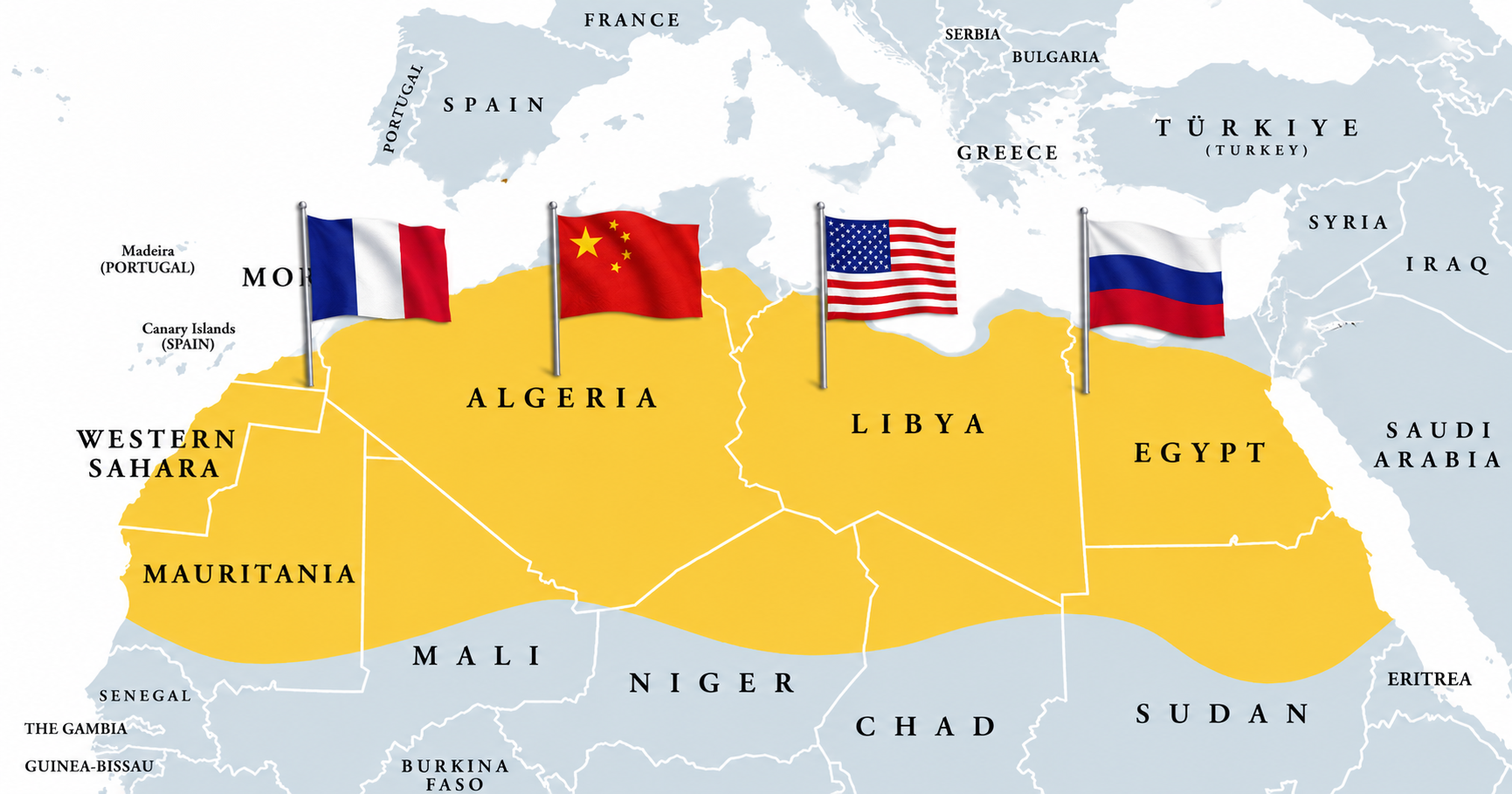


Alwaght- In recent years, the Sahel region of Africa has become one of the most important areas where the balance of power in African continent is redefined. It is a region where amid gradual drawdown of the French and other Western powers' presence, it has witnessed expansion of Russian and Chinese weight. Military coups in Mali, Burkina Faso, Niger, the withdrawal of the Western forces, and the emergence of new security arrangements have given Moscow and Beijing a fresh opportunity to consolidate their position in one of Africa's geopolitically most sensitive regions. The significance of Sahel, indeed, is not the same to these Eastern powers. Russia has majorly entered through security cooperation, arms sales, and military partnership, while China most importantly focuses on investment, infrastructure, trade, and access to resources. However, the difference of the tools does not necessarily mean clash of interests, and signs suggest a king of complementariness between the two approaches is in the making.
Sahel, power vacuum and Russian opportunity
The developments of 2023 in the Sahel, above all the coup in Niger, laid bare a deep crisis in the region's established security order. The military juntas in Mali, Burkina Faso, and Niger have not only scaled back ties with the West but have moved to deepen relations with Moscow. Into this vacuum, Russia has promoted itself as an alternative security partner, a path paved by the withdrawal of French forces and the broader Western pullback, which has handed Moscow more room to maneuver.
A telling sign of this shift came in September 2023, when Yunus-Bek Yevkurov, Russia's deputy defense minister, met with the leaders of Mali and Burkina Faso and Niger's defense minister, with an agenda announced as deepening military-technical and security cooperation. In the same vein, the three countries formed the Alliance of Sahel States, a bloc best understood as part of their widening departure from the old French-led security architecture.
The changing shape of Russia's presence matters greatly. The move from Wagner to the "Africa Corps" signals Moscow's shift from a deniable proxy force toward a more formal presence tied to the Russian Defense Ministry. As a result, Russia's role in the Sahel is no longer confined to the activities of security contractors; it can now be read as an extension of the state's official security and military policy.
This approach dovetails with Africa's rising place in Russia's foreign-policy documents. Moscow's 2023 foreign-policy doctrine names Africa as a priority region and stresses support for African sovereignty, including through security assistance. Russia had already sought to cast itself as a security provider at its 2019 summit with African nations, an effort that gathered pace after France's position in the Sahel weakened.
Security vs. interests: Russian pattern
Russian foothold in this part of Africa faces a key limit, too, which is that Russian economic power is never comparable to that of China or the European Union. Its trade with African states was less than $20 billion in 2022, which this amount for EU was $275 billion and for China around $200 billion. This drives Moscow to rely on an advantage where it has more competitive power: security and military equipment.
Here we can see the logic of "security vs. economic interests" of Russia, meaning that provides security, military training, and protection of key sites and facilities as a tool of influence in expectation of economic and political cooperation and strategic access. This model has allowed the Russians to, while not having the same investment capacity of China, build an effective place in the Sahel states.
China: Building foothold using economy and infrastructure
On the other side, China has pursued a different playbook. For years, Beijing has steadily expanded its economic ties with the Sahel countries, working to build a long-term foothold without framing its cooperation as a direct confrontation with the West.
China's declared policy rests on practical cooperation, mutual benefit, and multilateral partnership, an approach that has allowed Beijing to keep engaging with governments of all stripes.
China's footprint in Niger is a case in point. Chinese firms have been active in natural resources, oil, and infrastructure. The China National Nuclear Corporation entered in 2007 with a $300 million investment to develop a uranium mine, and the China National Petroleum Corporation held a 60 percent stake in the Zinder refinery project. At the same time, Chinese companies have helped build industrial parks, special economic zones, roads, railways, and medical facilities.
Niger's resource wealth matters enough to China that political upheaval there does not necessarily mean an end to economic cooperation. Beyond uranium, Niger's oil reserves are of interest to Beijing, and Sinopec signed a memorandum of understanding in 2023 on developing new oil blocks. China's approach, then, hinges less on the type of government in power than on preserving relative stability and continued economic access.
The same model has played out in Mali, where China kept its economic cooperation going after the 2020 coup and signed an agreement in 2022 to build two joint textile spinning plants in Bamako and Koutiala, creating roughly 5,000 jobs.
China is money, Russia is muscle
The contrast between the two models of influence can be summed up in a phrase: China supplies "money and infrastructure," Russia supplies "security and military muscle." Through the Belt and Road Initiative, loans, and the building of roads, ports, telecom networks, and big-ticket economic projects, China creates long-term dependencies. By 2025, it had signed roughly $61.2 billion in construction contracts across Africa and become the continent's largest official bilateral creditor. At the same time, China's security footprint is expanding: in 2017, Beijing opened its first overseas military base, in Djibouti.
Russia, by contrast, plays to its comparative advantage in environments where governments face security threats, terrorism, and weak military institutions. That is precisely what has let Moscow gain ground faster amid the security vacuum left by France's exit and the West's shrinking presence. Moscow has also moved to transfer Russian military equipment, weapons, and hardware to Madagascar, BMP-3 armored vehicles in particular, as part of a strategy of steadily deepening its foothold across African countries.
At the same time, Moscow has trained its sights on cultural influence. The Russian Orthodox Church has established an exarchate in Africa, complete with hundreds of churches, while the Russian Foreign Ministry works in parallel to strengthen cooperation with governments and media outlets.
Russian scientific institutions, meanwhile, are reportedly preparing expeditions to Africa under the banner of cultural heritage preservation, notably in Namibia and Ethiopia.
Cooperation or competition?
Despite the serious difference in the tools and paths, the the available evidence do not necessarily suggest there is a direct Russian-Chinese competition in Sahel countries. Both countries lean on anti-colonial rhetoric and criticism of the West's interventionist policies, and in a joint statement in March 2023 they stressed support for African nations' efforts to solve their own problems independently. Their cooperation on infrastructure, energy, and industrialization under the Belt and Road Initiative, along with their shared participation in frameworks like BRICS, shows that Moscow and Beijing have common interests.
Another example is the Russian and Chinese firms operating in diamond extraction in the Central African Republic, which shows that the two sides' economic cooperation in Africa goes beyond the political realm. Seen this way, an informal division of labor, Russia's security muscle paired with China's economic heft, could let both powers expand their influence without necessarily sliding into direct competition.
Strategic fallout for the West
The expansion of this dual model is not merely a matter of economic or security competition in Africa. The Sahel sits near Europe's southern borders, and its instability, terrorism, migration, and security shifts bear directly on European countries.
Russia's presence at bases, airfields, and logistics hubs across the region, coupled with China's economic and infrastructure reach, has effectively created a new strategic environment facing Europe.
Ultimately, the Sahel matters to both Russia and China because it offers a rare combination like a security vacuum, substantial natural resources, a sensitive geographic position, and governments eager to reduce their dependence on the West. Russia, leaning on hard power and security cooperation, and China, wielding capital, trade, and infrastructure, have carved out two distinct but largely complementary paths to influence.
West seeking to repeat Syria pattern in Sahel
The April attack by a coalition of Tuareg separatist militias and the rdical group Jama'at Nasr al-Islam wal-Muslimin, which claims affiliation to al-Qaeda, on the strategic northern Malian city of Kidal, an assault that forced Africa Corps forces to withdraw, showed that Europe is taking the competition in this strategic environment seriously and has turned to equipping and organizing militia groups to counter Russian presence and influence in the Sahel.
The coordinated, multi-pronged assault on the capital, Bamako, the military camp at Kati, and strategic points across the country's north, including Kidal, Gao, Sevare, and Mopti, points to a central command and an integrated command-and-control system, one capable of directing simultaneous operations by different units across a vast territory. That command-and-control model appears to have taken shape with foreign backing and expertise.
One of the first and most sensitive targets was the residence of Mali's defense minister, General Sadio Camara, who was killed when a bomb detonated in his vehicle. A successful strike on the home of such a senior official requires precise, up-to-date intelligence on his movements and daily routine. That suggests the insurgents have significant intelligence networks and possibly penetration at the highest levels of Mali's power structure. On that basis, the possibility has also been raised that actors linked to Western countries were used to provide intelligence and operational support to separatist and terrorist groups, a path the West previously followed to counter Russian influence in Syria.
Generally, though it is too early to talk about rise of a full-scale Russian-Chinese axis in Sahel region, the current developments show that cooperation and coordination of the two powers, at least in the present time, outweighs direct competition. The future of this cooperation is contingent on the developments of the Sahel Alliance, the extent of the Western retreat, and Moscow-Beijing camp's capability to coordinate their varying interests in this region.










