














Alwaght- A month to the Israeli parliamentary elections, talks are growing heated for forming political coalitions. Leaders of the opposition political parties who in the past entered elections independently are now moving closer to each other to form a united front against Benjamin Netanyahu.
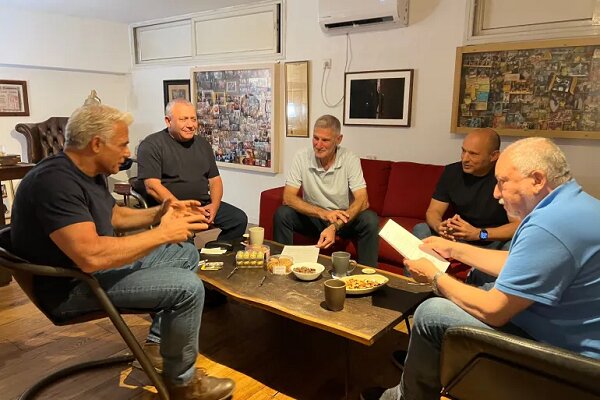
Leaders of the so-called "Change Group" gathered Saturday at the home of opposition leader Yair Lapid, vowing to halt their mutual attacks. The meeting brought together Lapid, head of Yesh Atid, Gadi Eisenkot of Yashar, Naftali Bennett of Together, Avigdor Lieberman of Yisrael Beiteinu; and Yair Golan of the Democrats.
The gathering aimed to coordinate party efforts, court more voters and strengthen the opposition bloc's odds of winning a majority and forming the next government.
Under a joint document, each party committed to working within its own ranks to boost turnout and draw voters from diverse constituencies so the opposition alliance can secure a majority and build a new coalition. The bloc has infuriated Netanyahu, who fired back at his rivals: "Only a big Likud will stop them."
Reasons for unity
The opposition parties' coalition should not be seen just as a electoral convergence, but it is an outcome of a complex of political, security, and social developments, most important part of which is driven by the Netanyahu’s performance.
The first flashpoint was hardline ministers' push to overhaul the judiciary, which triggered mass protests from the very start of the government's formation.
Opponents argued the proposed changes would gut the courts' independence and tilt the balance of power toward the executive, a fight that became a central driver of domestic unrest and deepened the country's political fault lines.
Alongside the domestic crisis, the government's security policies have opened multiple fronts against Tel Aviv and fueled growing security fears. Much of the public and Netanyahu's critics believe he has sacrificed the state's interests for personal gain to cling to power and dodge his domestic woes, a course they say has imposed heavy costs on society and sharpened a sense of insecurity.
Corruption charges against Netanyahu also continue to cast a long shadow over his political future, with opponents insisting the prime minister must answer for the cases. Rivals are aiming to beat him at the polls and pave the way for him to face trial.
What sets this election apart is that while past races centered on who would be the next prime minister, Netanyahu's opponents are now less focused on a particular person or party than on a single shared goal: blocking him from another term. "No to Netanyahu" has become the rallying point for factions that may disagree on almost everything else.
Influence of opposition unity in the Israeli society
The unity of Netanyahu’s opponents can impact the political atmosphere of the Israeli society more than ever. The significance of this coalition does not lie just in sitting beside each other, but the main message to the society is that they are pushing to cross the political fragmentation and to create a united front against the ruling coalition and this issue can draw support of part of society which is still undecided on who to back.
Independent and undecided voters, along with intellectuals still weighing their options now loom especially large. Their stance could shift in the final weeks of the campaign, particularly if Netanyahu's opponents can project a coherent, clear vision of the political future.
Polls published in recent weeks point to a tight race, with the opposition parties' combined seats holding an edge over Likud and its right-wing allies, a sign the electoral landscape remains fluid and that undecided voters could still upend the political equation in the campaign's closing weeks.
Opposition's hope to win
The opposition camp, reading the political winds, appears to have entered the campaign's final weeks with growing confidence and high hopes of victory, so much so that Bennett has said outright he is certain the opposition parties can capture 63 seats and form a new government. Lieberman echoed the sentiment: "On October 27, we will put Israel back on the right track", a clear signal of the bloc's intent to replace Netanyahu and build a new government.
The confidence of Netanyahu's rivals has increased since his contentious UN speech, as events after the address did not unfold as the prime minister had hoped. A Ma'ariv poll found Netanyahu's coalition lost ground after the General Assembly speech while opposition support is climbing, making it hard to imagine the right closing a 12-seat gap to form a government.
Netanyahu, for his part, had hoped political backing from the US President Donald Trump would shore up his standing. But Trump's failure to meet him in New York once again laid bare signs of friction between the two, and under such conditions, even White House support may not be enough to repair Netanyahu's political fortunes. Given Israelis' sensitivity to Trump's dealings with Netanyahu, overt Trump backing on the eve of the election could backfire rather than bolster him, playing into his rivals' hands.