















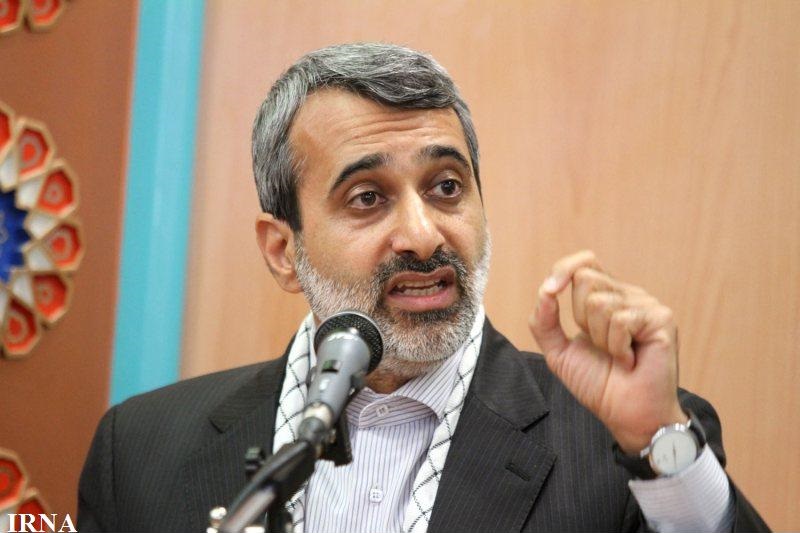


Alwaght- Alwaght has asked Iranian member of parliament Abbas Moghtadaee for comments on the years of the US hostile policy against Iran and the current war conditions. He said that the Americans for decades have vastly used an array of instruments to stop the Iranian advances in various areas; from using the UN and political pressures to spreading lies, pushing economic pressure, and tens of other tools. In all of these years one threat has been repeated by the Americans and it is "all options are on the table."
But the reality is that over the past year or so, the Americans have thrown virtually every option in their arsenal at the problem, and still failed to achieve their objectives. For years, Washington has threated war against Tehran, warning that its superior technology and firepower would overwhelm any Iranian resistance. The Islamic Republic, the message went, stood no chance against American military and technological dominance.
Today, the tables have turned. Despite the fact that the US has burned through the bulk of its equipment, capabilities and strategic options, few in the world would now dare claim that Iran has been defeated. Indeed, no fair-minded observer or even an unfair one, could easily swallow the assertion that Iran has lost. Even inside the US itself, voices across the political spectrum, among both Donald Trump's allies and his detractors, have acknowledged the plain truth: Trump has failed to achieve his objectives against Iran.
An equation changed
And the key issue is that today, Iran looks bolder than ever, while the US appears more afraid of war than ever. Trump's political predicament has only deepened that fear. The same Americans who once spoke of war with swagger now discuss it, and its potential to drag on, with caution and anxiety.
Alongside this, another reality is asserting itself more forcefully than before: Iran has managed to achieve a level of internal cohesion and global public sympathy unmatched in its recent history, a shift whose fingerprints are plainly visible in the political and media factions surrounding the war.
Lies that do not work anymore
One of Donald Trump's go-to tools is lying, a device he deploys mainly to keep the facts from surfacing and to paper over his own failures. But here's the problem: Trump's lies have piled up so high that even this weapon is growing threadbare and ineffective.
The rule is simple. The more Trump lies, the more exposed the credibility crisis becomes, for the US, for its president, and for his accomplices. One of Iran's key moves during this period has been to discredit Washington's military and political claims, a campaign that has chipped away at the credibility of American officials' statements and narratives, laying bare the widening gap between claim and reality.
Washington's worn-out tools
The UN is now in its weakest condition and the UN chief, who is about to change, is known as a weak one.
The humanitarian crisis in Gaza, the upheaval in Lebanon, the Iran case and a host of other flashpoints all point to one thing and it is the UN's failure to play an effective role.
Against this backdrop, Washington keeps exploiting the US apparatus, even leaning on its own debt leverage to the organization, to bend its various bodies, from the Security Council to the International Atomic Energy Agency, to its own ends. This proves the claim that the UN is being hollowed out.
Meanwhile, the Iranian president's remarks at the United Nations show that Tehran has once again sought to put global pushback against the US, and an end to Washington's ruthless actions, front and center. Those positions also signal that Iran has made striking gains in soft power and global persuasion, and now commands more of the world's attention than ever before.
Iran's logic: War for defense not violence
Under these circumstances, Iran has sought to offer global publics a logic they can grasp, one that signals both a readiness to safeguard its own security and that of others, and a readiness to confront those who have made destabilization the core of their conduct.
That logic rests on two clear balances: if others start a war and keep it going, Iran will fight; but if others do not pursue war, Iran would not pursue violence either.
The message, in essence, is an attempt to paint a clear picture of Iranian policy, one that combines self-defense and confronting threats with an aversion to warmongering under normal conditions.
The US in front of a new reality
The US now has little choice but to accept what Iran is saying, because Iran has entrenched itself not only in military hardware and capability, but in geography itself.
A growing number of observers now believe that if Iran so chooses, much could happen, and that is precisely why others are calling on Iran to exercise restraint.
So, the US finds itself staring down a new reality and it is that Iran's power no longer boils down to military calculations alone. Geography, deterrence, political clout and soft power have all been added to the equation.
In this situation, Washington's options are narrower than ever, and it has no choice but to accept Iran as a regional superpower with global reach and influence.










