













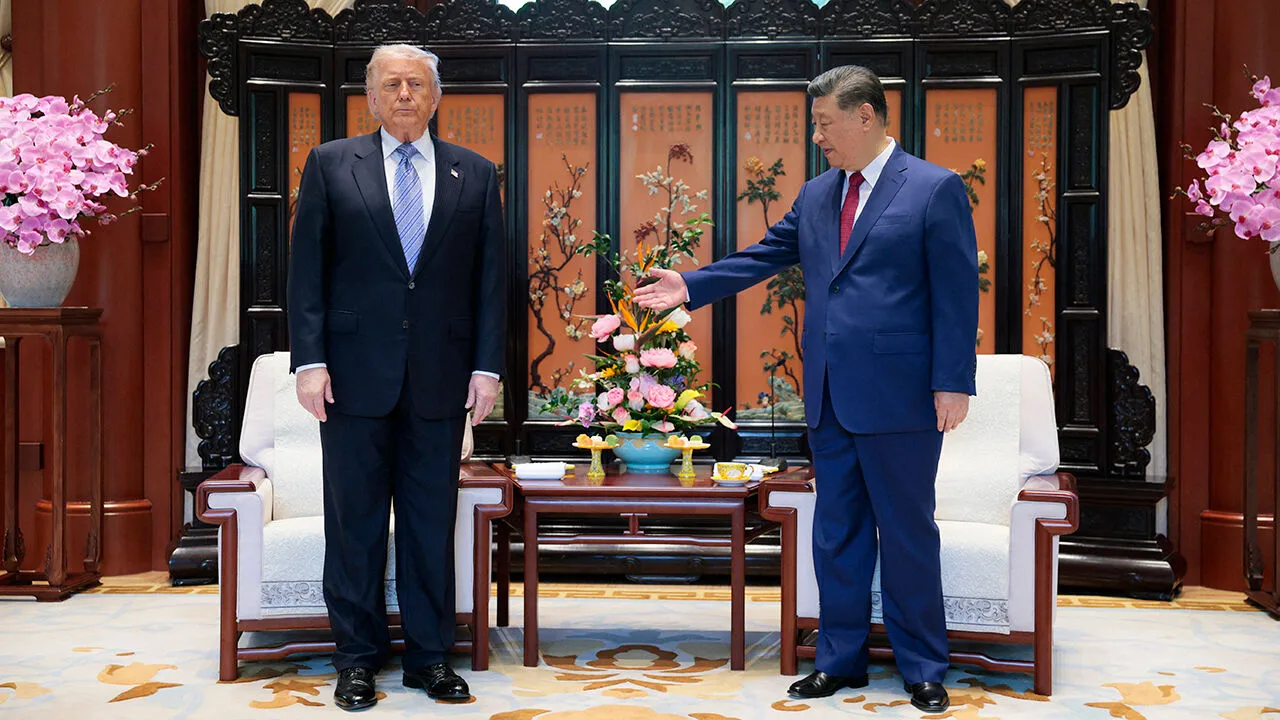


Alwaght- As the economic and geopolitical contest in the world escalates, eyes once again return to Washington and Beijing, where leaders of the two economic heavyweights are pushing to, through a face-to-face meeting, discuss the growing differences and bilateral issues, as well as the critical international developments.
In this regard, President Xi Jinping of China visited the US heading a high-ranking delegation, the first since 2015 and a sign of the significance of talks between the two rival powers at the present time.
Chinese Foreign Ministry spokesperson described the trade of visits of the two leaders in four months as "historic", adding that this will serve to guide the strategic relations of Beijing and Washington. The spokesperson added that China will work with the US to boost dialogue and cooperation, manage differences, and help spread global peace, instability, and welfare.
A number of senior Chinese companies CEOs, including those of the EV giant BYD and Xiaomi accompany the Chinese leader to the US.
Main themes of Xi-Trump talks
Xi Jinping’s visit to Washington comes at a time when US–China relations, unlike the atmosphere that typically surrounds official visits by heads of state, are defined by intense economic, technological and geopolitical competition.
The significance of the visit lies in the fact that the two sides are coming to the negotiating table not to declare an end to their differences, but to manage them and prevent their rivalry from spiraling out of control.
The most important issue on the agenda is the future of the US–China trade agreement.
According to The Washington Post, "US officials said Washington and Beijing may be ready to lower some tariffs on certain non-strategic goods."
A trade agreement reached after last year’s summit is set to expire in November, leaving markets waiting to see whether Trump and Xi will announce an extension.
The previous tariff war between the world’s two largest economies, at one point involving reciprocal tariffs exceeding 100 percent, posed a serious threat to global supply chains. As a result, even a limited agreement to extend the existing trade deal could carry significant implications for the global economy.
For Trump, the trade deal could include increased purchase of American goods and products like Boeing airplanes and agriculture products. Reuters reported that China was assembling a large business delegation to accompany Xi, with talks underway over a possible major Boeing deal. Some Western outlets have also reported that China plans to purchase substantial agricultural products from the US.
The US-China chip rivalry has emerged as one of the most critical arenas of technological competition between the two powers, as advanced semiconductors underpin not only artificial intelligence, cloud computing and telecommunications infrastructure but also defense industries and a host of strategic technologies. That is why Washington has spent recent years tightening export restrictions on advanced chips and the equipment used to make them, seeking to curb China's access to cutting-edge semiconductor technology. Those very restrictions, however, have pushed Beijing to accelerate development of its domestic chip industry.
The US holds a key edge in chip design, design software and parts of the manufacturing equipment chain, while China commands a massive home market, expanding production capacity and sprawling state investment. That mutual dependence has turned chips into one of the most powerful bargaining chips in the relationship.
Emerging AI technologies have likewise become a central battleground in the rivalry.
Rana Mitter, a professor of US-Asia relations at Harvard University, argues that "the three main axes of negotiation remain trade, technology and Taiwan, but the rapid evolution of AI has injected greater urgency into the technology file."
AI is one of the few areas where limited cooperation is conceivable, given that both countries share concerns about AI misuse and its security implications. Still, fierce technological competition makes a comprehensive agreement in this space a long shot.
Another flashpoint is rare earths and critical minerals, of which China controls vast supplies. Washington officials said the issue of maintaining an acceptable flow of these mineral exports from China will be on the table, but a deal in which the US rolls back its export restrictions in return is unlikely to materialize.
China holds a critical position across the extraction, processing and production of many of these materials, and Washington wants guarantees that their exports will continue to flow, while Beijing is seeking to ease US technology restrictions on Chinese companies.
Taiwan is also one of the most sensitive issues at the meeting. China considers Taiwan part of its territory, while the US is the island’s most important international backer and arms supplier. More sensitive still, a roughly $14 billion US arms package for Taiwan is awaiting final approval. China wants the sale halted and views the issue as directly tied to its national security.
Reuters reported that US allies in Asia are concerned that Trump could soften Washington’s position on Taiwan in exchange for economic gains, a prospect of particular concern to Japan and Taiwan.
Importance of Xi-Trump meeting
A meeting between the Chinese and American presidents has always been more than just a bilateral sit-down, and its significance stems first and foremost from the economic weight of the two countries.
The US, with an economy of roughly $30 trillion, and China, at $19 trillion, are the world's two largest economies, and their decisions can reverberate across global trade and the world economy well beyond their bilateral ties.
That is why any summit between the leaders of Beijing and Washington is typically watched closely by governments, markets and economic players alike, so much so that the International Monetary Fund has reported that the trade integration of the US and China played a major role in shaping the global economy over the past three decades. The fact that CEOs and heads of Chinese and American corporate giants have been invited to the Trump-Xi meeting underscores just how much is at stake.
These summits also offer a chance to set the "rules of the game" on regional stability, energy and international affairs, matters that directly affect the economies of other nations. For that reason, every meeting between the two leaders is not merely a diplomatic event but an opportunity to take stock of the future trajectory of the global economy, international trade and the geopolitical order.
US-China relations are so vast and complex that a substantial share of their disputes simply cannot be resolved at the level of ministers or negotiators alone.
The Atlantic Council has described the current state of affairs as a kind of temporary, fragile stability rather than genuine de-escalation, with both sides still testing each other's red lines while simultaneously working to prevent chain reactions and further escalation.
Xi's trip can thus be seen as an effort to institutionalize "managed competition", even if the two sides hold fast to their fundamental disagreements over Taiwan or technology, establishing a direct channel between the leaders can reduce the risk of miscalculation.
Iran war
The Iran war will also be a key item on the Trump-Xi agenda. Washington believes China can leverage its close economic and political ties with Tehran to influence Iran, but analysts say Beijing has so far shown only limited appetite for applying serious pressure on Tehran.
Rubi Othman of the Tony Blair Institute argues that "stability in the relationship serves both leaders, allowing them to focus on their more pressing priorities, for Trump, the Iran war; for Xi, hardening China's domestic resilience for whatever lies ahead in US relations."
Against that backdrop, a potential trip to Beijing by Mohammad-Bagher Ghalibaf, the speaker of Iran's parliament, takes on particular significance after the Xi-Trump meeting, because the two events together signal that the Iran question is no longer merely a bilateral file between Tehran and Washington and it can now become part of a broader US-China conversation about security, energy and regional order.
In that context, Ghalibaf's visit can be read as an attempt to convey Tehran's perspective directly to one of the few powers that both maintains a strategic relationship with Iran and has an effective channel to Washington. Beijing, for its part, has not formally declared that it will act as a direct mediator between Iran and the U.S., with Chinese officials instead emphasizing dialogue, de-escalation and rebuilding a negotiating mechanism between Tehran and Washington. Xi has also recently unveiled a five-point initiative calling for an immediate end to hostilities in West Asia.
American officials have said economic talks with China related to Iran are underway and could come up in the two presidents' discussions. In this framework, the Iran war is not just a political issue for China, energy security, shipping lanes and oil market stability are directly tied to Beijing's economic interests, and a prolonged war directly undercuts them. The Iran war may therefore figure as a secondary but important item on Xi's trip to the US, alongside the core cases between the two sides.