









Alwaght- Though the Israeli regime is considered an air power in West Asia and North Africa, its geographical position, economic dependence on the sea routes, and serious limits in territorial depth have given sea a significance beyond a subordinate operation scene in the Israeli security strategy. For a regime that has a major part of its population and economic hubs in the coastal areas of the Mediterranean and the distance between ground and sea borders in some areas are too short, control of maritime environment means creating a kind of strategic depth, something its territorial geography lacks.
In this connection, the Israeli Prime Minister Benjamin Netanyahu has recently visited a naval base in Ashdod port city and talked about plans to boost naval power on the surface and subsurface with the aim of turning this regime to a sea power, beef up its deterrence against threats, and maintain Tel Aviv's dominance over the Mediterranean Sea. The PM stressed that sea has turned into an "international battleground", citing clashes in Strait of Hormuz and Bab-el-Mandeb.
"Our enemies are threatening our dominance of the Mediterranean, ports, and sea traffic," Netanyahu was quoted as saying.
Netanyahu further said that sixth submarines have been delivered to Israel and "they [the navy commanders] want more ships and equipment and here I do not get into the details."
Experts believe that importance of the Israeli navy is not limited to defending the coasts, and this force is playing a role in securing energy, trade routes, controlling the Eastern Mediterranean, addressing regional threats, and maintain power to retaliate, and provide the power to carry out operations in the Red Sea and Indian Ocean.
Sea, Israeli strategic depth without territorial depth
Since its founding, the Israel has faced a fundamental geographic problem: a lack of strategic depth. A substantial share of its population and critical centers sit close to the Mediterranean coast, and the territory it controls is in places extraordinarily narrow. In a full-scale war, that means a large portion of its vital infrastructure and population centers could fall within range of enemy missile and naval systems.
Under such conditions, the sea is not merely a natural border for Tel Aviv, but a part of its strategic depth. Control of surrounding waters allows Tel Aviv to avoid direct pressure on its coastline while expanding the operational freedom of its air and ground forces.
This was evident from the very first of the regime's wars. In 1948, its navy still lacked meaningful capacity, and no decisive naval battle ever took shape. Yet maritime control by outside powers made it possible to transfer weapons and forces to occupied Palestine, demonstrating that even when the regime's own navy plays only a limited role, maritime security can be vital to its survival.
But the experience of later wars laid bare the true importance of naval power for the Israeli regime. In 1973, its navy, unlike ground and air forces that came under intense pressure in the opening days, took the offensive. Israeli missile boats struck the Syrian fleet first, then part of Egypt's naval capability, and went on to seize control of parts of the eastern Mediterranean.
The significance of that development laid in the fact that control of the sea allowed ground and air forces to pursue their missions without worrying about a serious naval threat. Put another way, naval power gave the Israeli army "security in its rear."
Experience of 1973 war, when sea turned into a tool of offensive operations
The 1973 war marked one of the most important turning points in the Israeli regime's view of naval power. In that conflict, the Israeli fleet, using missile boats and electronic warfare, managed to gain the upper hand against Egyptian and Syrian naval forces. After several initial engagements, the Israeli navy secured maritime control of the eastern Mediterranean.
That control was not merely a tactical victory. By limiting the ability to move forces and equipment to the Israeli shores, the navy effectively narrowed the enemy's options. Control of the Gulf of Suez also allowed the Israeli regime to more easily deploy air-defense systems near the Suez Canal and to ratchet up pressure on the Egyptian army.
Within this framework, two historical functions can be defined for the Israeli regime's navy: first, securing the rear and preventing the enemy from pressing its coasts, and second, creating operational flexibility through intelligence-gathering, narrowing enemy options, and providing freedom of action for air and ground forces.
This pattern still forms an important part of the Israeli regime's military philosophy. Because the regime lacks sufficient strategic depth, it seeks, should war break out, to push the battlefield as far beyond its own borders as possible. In such a doctrine, the navy, like the air force, is not merely a defensive tool but a means of shifting the arena of conflict into the surrounding environment.
A small fleet that is expanding
In terms of number and tonnage, Israeli regime does not operate a big navy. In fact, historically, the navy has played a secondary role in the Israeli armed forces after army and air force.
Until recent years, no ship or submarine of Israeli regime weighed more than around 2,200 tons and the largest warship has been 1,900 tons. The newest and most advanced military technology in the regime's naval arsenal is the Reshef-class missile boat, a Sa'ar-class vessel. It draws on advanced weapons systems from Israel's defense industries to deliver exceptional capabilities and maritime superiority. These new ships will replace the Nirit-class Sa'ar 4.5 missile boats, which were decommissioned after four decades of service.
In December 2024, the regime's defense ministry announced a $780 million contract with Israel Shipyards to purchase five Reshef missile boats, a deal aimed at modernizing the navy's fleet and strengthening domestic defense production.
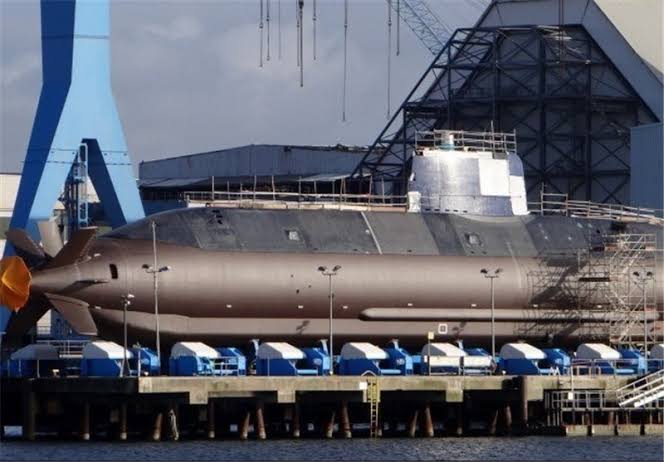
But the backbone of the regime's naval power has been its German-built Dolphin-class submarines.
The importance of these submarines in this structure far outstrips the size of the surface fleet. Dolphin-class subs, especially those equipped with air-independent propulsion, allow for longer endurance and more covert operations. That feature matters enormously for a regime seeking to preserve deterrence under the conditions of a full-scale attack. Under its latest agreement with Germany to buy submarines, Tel Aviv can also purchase a seventh submarine at the previously agreed price. According to reports, defense officials prefer to exercise that option before costs rise, and to move later on buying an eighth.
Alongside the submarines, Sa'ar 5 and Sa'ar 6 corvettes form another part of the fleet's combat power. These vessels are equipped with anti-ship missile systems, air-defense systems, and helicopter-carrying capability. Their design philosophy, in effect, is that even relatively small vessels can pack considerable combat power against air and missile attacks. Below them sit the Sa'ar 4.5 missile boats and dozens of fast coastal craft.
In recent years, the regime's navy has moved toward ever-greater development of unmanned vessels, a trend showing that the future of the Israeli regime maritime capability rests not solely on the number of large ships, but increasingly on a mix of small vessels, missiles, unmanned systems, intelligence, and electronic warfare.
This approach in fact aligns with the Israeli regime's economic and geographic constraints. Rather than building a massive fleet, Tel Aviv has sought to create a small navy armed with high firepower and advanced technology.
Submarines, the most important ring of sea deterrence chain
The most important part of the Israeli naval power should be sought in the submarines. The reason is clear: Limited Israeli geographical size. In a full-scale attack, Israel could lose a considerable part of its military and strategic infrastructure in a short time.
Seen this way, stealth submarines can keep part of a military's power beyond the reach of a first strike, and preserve the ability to retaliate. On that basis, deploying attack submarines in the eastern Mediterranean creates a kind of "strategic depth" for a regime with such geographic constraints.
For Israel, the Eastern Mediterranean is not merely an operating environment; it can serve as part of its strategic deterrence architecture. That is why protecting submarine transit routes and preventing their detection becomes one of the primary missions of surface vessels.
This doubles the importance of naval power: the navy must, on one hand, defend the regime's coasts, and on the other, provide the environment needed for strategic submarines to operate.
Energy security: When gas field becomes part of Israeli sea power
Another important point about significance of the Israeli navy is related to discovery of energy resources in the Eastern Mediterranean.
Discovery of Tamar, as well as Leviathan, gas fields made sea shift from a security arena to energy and economy issue. Eastern Mediterranean energy reserves will transform the Israeli regime into an energy exporter and this is what has increased the strategic value of the Israeli-claimed sea regions.
From this viewpoint, the navy has a duty beyond protection of ports and coastlines: Protection of offshore energy infrastructures.
The Israeli regime's gas fields sit in an environment where border disputes, competition over energy resources, and rivalries among regional actors are tightly interwoven. For that reason, Tel Aviv must be able to control parts of the Eastern Mediterranean extending to the areas around Cyprus.
Here the link between economic interests and naval power becomes clear. The more the Israeli regime's dependence on offshore energy resources grows, the more protecting them will become one of the navy's core missions. As a result, energy can serve as a driver for expanding the scope of the regime's naval operations.
Turkish challenge: Rivalry over Eastern Mediterranean
One of biggest Israeli concerns over sea is growing Turkish naval power.
Ankara has gone from a limited naval power in past decades to an actor striving to expand its influence across the Eastern Mediterranean, Libya, Syria, and other surrounding areas. The development of larger ships, submarines, and indigenous capabilities has turned Turkey into a major naval player. Its navy, for instance, is the second largest in NATO after the US Navy. Turkey currently has 14 active submarines, two more under construction, and aims to grow its submarine fleet to 18.
Turkey recently showcased 37 naval assets and platforms of various classes, including vessels currently in service, during the Teknofest Blue Homeland exhibition.
Among the most prominent equipment displayed were Turkey's largest warship, the TCG Anadolu; the TCG Istanbul; the TCG Barbaros; the TCG Salihreis; the TCG Turgutreis; the TCG Kemalreis; the TCG Oruçreis; the TCG Burgazada; and the TCG Derya.
Other naval assets included minesweepers, patrol craft, amphibious ships, and support platforms. The country even intends to build its own indigenous aircraft carrier in the near future.
Israeli media reported Tuesday that Israel's defense establishment, closely monitoring the growing capabilities of Turkey's navy, has proposed expanding its own submarine fleet to eight.
This trend could lead to direct or indirect competition between Turkey and Israel over the Eastern Mediterranean, especially in the energy domain.
For the Israelis, the issue is not merely a dispute over a single gas field. If Turkey can become the dominant power in the Eastern Mediterranean, that shift could constrain Tel Aviv's naval freedom of action and, in turn, affect energy security, trade, and even submarine operations.
One of the Israeli regime's long-term naval objectives, therefore, is to preserve conditions in which no regional power can seize control of the Eastern Mediterranean.
From the Mediterranean to Red Sea; Bab-el-Mandeb chokepoint
Despite the weight of the Eastern Mediterranean, the Israeli strategic view is not limited to this region.
Eilat port's location in the Red Sea has made Bab-el-Mandeb of great importance for the Israeli martime security. 1967 and 1973 wars and Gaza war in 2023 showed that disruption of the Red Sea route can bear direct economic and strategic impacts to Israeli regime.
This is specially important since any disruption in Bab-el-Mandeb navigation is not only a military matter and directly relates to Israeli trade and energy. This comes while during recent inter-Yemeni clashes, Ansarullah resistance movement, which has been holding the capital Sana'a and much of northern Yemen since 2014, has managed to make quick progress on battlegrounds of the west coast, hence, boosting its grip on Bab-el-Mandeb and developing further power to control navigation in the Red Sea, something arousing the ire of Israeli officials.
Indian Ocean, a ring that is weak yet
Despite all Israeli naval capabilities, there must be an emphasis on one major weakness in the Israeli regime's navy, which is its limited capacity for long-range operations, especially in the Indian Ocean.
The regime's small fleet is designed to defend the Eastern Mediterranean, and its limited number of submarines does not allow it to carry out all its intended missions in the Mediterranean and the Indian Ocean simultaneously.
Furthermore, the geography of Eilat port imposes a natural constraint. The maritime route from Eilat to the Indian Ocean passes through the Strait of Tiran and then Bab-el-Mandeb, two chokepoints that, in a crisis, could restrict the Israeli access to open waters.
For this reason, the Israeli regime, seeking to counter and balance the threat from Iran, is likely pursuing the ability to maintain a long-term presence in the Indian Ocean, a capability that probably depends above all on long-range submarines and the capacity for prolonged endurance at sea.
This matters all the more when we consider attacks on vessels linked to the Israeli regime in the Sea of Oman and the Indian Ocean. The 2021 drone attack on a tanker affiliated with an Israeli company near the coast of Oman showed that, should Iranian maritime pressure escalate, the Israeli regime would not have reliable naval support from its Arab partners east of Bab-el-Mandeb.
As a result, weakness in the Indian Ocean could leave Tel Aviv facing a dilemma which is to either absorb pressure against ships linked to it, or move toward military confrontation.
Dependence on foreign suppliers as the hidden weakness of Israeli naval power
One of the key contradictions in the Israeli regime's naval power is that while it has sought to become a technological and independent power, it remains dependent on foreign suppliers for a major part of its naval equipment.
The US played a central role in building the Sa'ar 5 corvettes, and Germany in building the Sa'ar 6 and the Dolphin submarines. A significant part of the Israeli regime's naval power therefore hinges on production chains and political decisions in foreign countries.
In normal conditions, that dependence may not pose a serious problem, but in a prolonged war or a multi-front crisis, it can become a vulnerability.
The broader the war, the greater the need for repairs, replacement parts, ammunition, and new vessels. True naval independence, then, is not achieved merely by building advanced ships; it requires the capacity to independently produce engines, combat systems, weapons, and components, along with maintenance and repair infrastructure.
Future war, naval power on multiple fronts
Several scenarios in the future can put the Israeli naval power to a serious test.
First is possible clash with Lebanese Hezbollah. In 2006 war, the Lebanese resistance movement showed it even can use its missile power against an Israeli naval ship. In addition to controlling and blockading Lebanon's coast, the Israeli navy should also guard Israeli-affilated commercial ships.
Second, escalating tension with Iran, and its spread into the Sea of Oman and the Indian Ocean. Under such conditions, vessels linked to the Israeli regime could become targets for Iran's armed forces.
Third, competition with Turkey in the eastern Mediterranean, especially where energy disputes merge with political and security differences.
Fourth, the crisis innBab-el-Mandeb and Red Sea, an area of vital importance to Tel Aviv's connection with the Indian Ocean.
And finally, the broader scenario of great-power rivalry in Eurasia, which, should China's presence in the Indian Ocean grow and Russia continue to play a role in the Mediterranean, could turn the region into part of a wider contest among major powers. In such conditions, the Israeli regime can no longer rely solely on American naval support.
Naval power, complementary to air and missile forces
At the end, it must be said that the Israeli navy is not supposed to be a large fleet of aircraft carriers and ocean liners like the US. Its main mission is defined in line with the regime's geography and strategic needs which are maintaining control over Eastern Mediterranean, securing coasts, protecting energy infrastructure, preventing smuggling weapons to resistance groups in Gaza and Lebanon, providing safe environment for maritime activities, and creating room for limited operations in faraway waters.
So, Tel Aviv has sought to offset its quantitative shortfall with quality, technology, precision missiles, stealth submarines, electronic warfare, unmanned systems, and an intelligence network.
Yet, this very model has serious limitations. A small fleet, if forced to operate simultaneously in the eastern Mediterranean, the Red Sea, and the Indian Ocean, will run up against the limited number of its vessels and submarines. Furthermore, the expanding presence of rival powers such as Turkey and Egypt, the intensifying naval threat from Ansarallah at Bab-el-Mandeb, and Iran's grip on ship traffic through the Strait of Hormuz can all narrow the regime's freedom of action.
Therefore, The core issue for the future of Israeli navy is not simply increasing the number of ships; it is the ability to maintain maritime control across multiple theaters at once, and under conditions in which direct US support declines.