
















Alwaght- Unprecedented details have emerged about Donald Trump’s covert exit from Turkey following the NATO summit on July 8, now one of the most explosive security flaps of his presidency.
The story took a new turn when The Washington Post, citing intelligence sources, reported that US spy agencies secretly swapped out Trump’s plane mid-trip, diverting him onto a military aircraft over an alleged Iranian assassination threat, rather than letting him fly home on Air Force One.
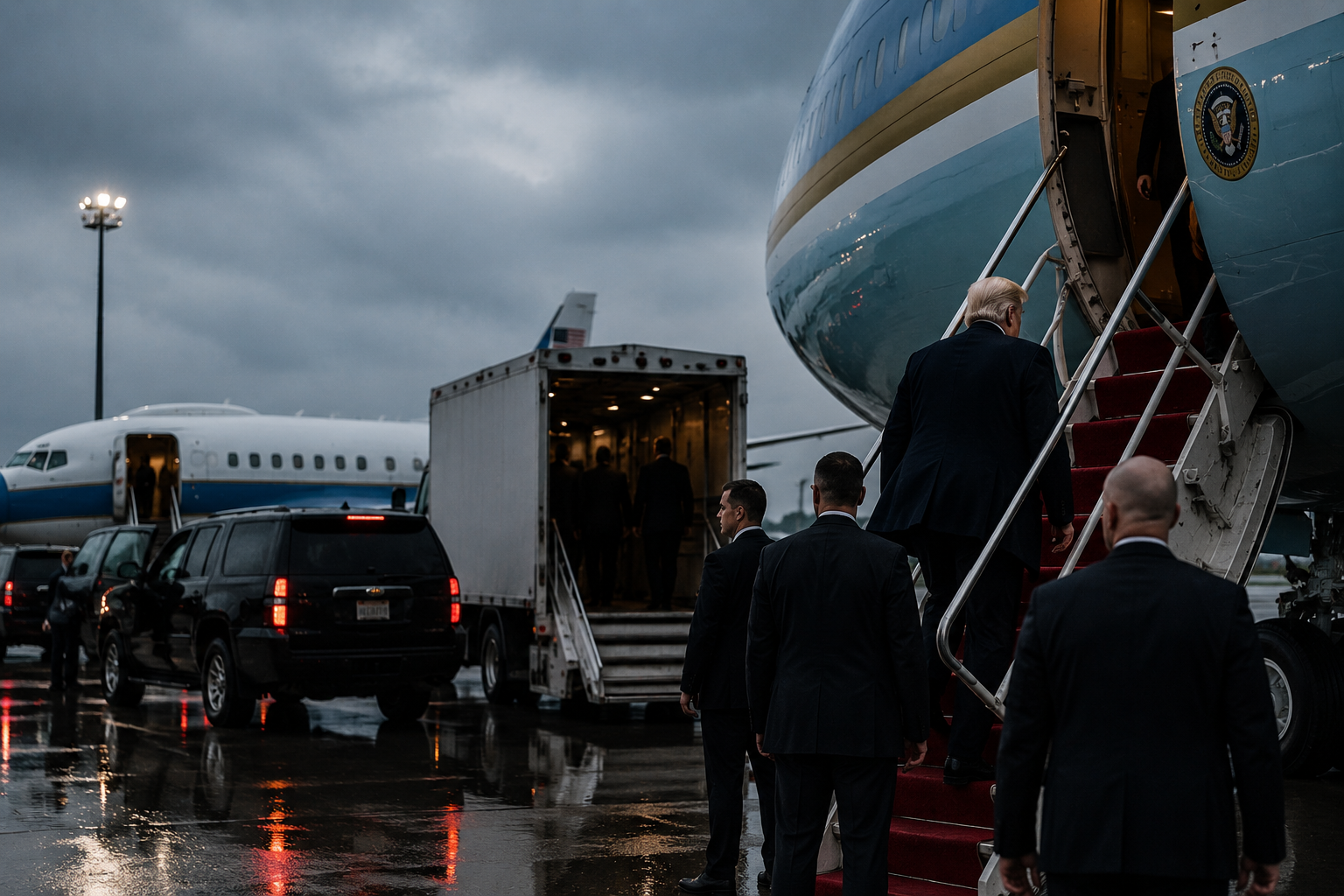
According to the report, the presidential jet, which was carrying White House staff and the press corps, was effectively used as a decoy. Trump boarded the old Boeing 747 in Ankara in full view of TV cameras, then, minutes later, slipped off via an airport catering truck of the kind normally used to load meals and supplies, transferring to a smaller C-32A.
Journalists traveling with Trump were ordered to keep their window shades drawn in the press cabin for security reasons, they later reported.
Notably, the White House at the time insisted Trump had flown on the usual presidential aircraft, a claim that would later unravel. Weeks after the news broke, Trump himself confirmed that the Secret Service had ordered the plane swap.
The leak of the covert operation has not only raised sharp questions about just how alarmed American security agencies really were about threats to Trump, it has quickly become a political lightning rod, fueling chatter across media, intelligence circles, and among his detractors.
Trump's security scandal for the White House
At first glance, swapping out the president's plane and wrapping him in layers of security might read as routine, standard protocol for any world leader facing a credible threat. But what turned this into a full-blown media firestorm was not the operation itself. It was the political fallout and the psychological whiplash that came with it.
Trump has spent years casting himself as the embodiment of American might, the muscle flexing commander-in-chief who projects strength and deterrence. He has repeatedly touted US military supremacy from podiums and threatened Washington's adversaries with swift, crushing retaliation. So when word broke that he had been spirited out of a NATO ally's capital in a covert operation straight out of a Hollywood thriller, the optics cut the other way. This was not strength. It was panic, laid bare at the highest levels of American power.
In the playbook of Trump's election campaigns, assassination attempts, even failed ones, have always been grist for the campaign mill. He has framed them as proof of shadowy forces arrayed against him, determined to take out the one guy in the White House fighting for the people. That narrative has worked before. After the July 2024 attempt on his life, Trump turned it into a rallying cry, and many analysts credit that moment with helping turbocharge his ground game and lock in popular support on the road to victory.
This time, though, the Ankara getaway backfired spectacularly. The images and accounts that leaked were not of a defiant leader standing tall. They showed a man slipping away in secret, leaving a planeload of reporters and staff effectively flying as decoys while he ducked out the back on a catering truck.
The Secret Service framed it as standard protective protocol. But to much of the media and a growing chorus of critics, it read as a prestige wound for Washington, especially coming on the sidelines of a NATO summit where Trump had been positioning himself as the alliance's undisputed leader. Instead of projecting command, the covert exit projected something far less flattering: fear and vulnerability.
Media reaction to Trump's escape
The Trump escape story has dominated US media coverage, with outlets drawing a sharp line between the security rationale and the administration's handling of the story, saying thar it could erode public trust.
CNN tore into the spectacle of a sitting president slipping out of a NATO ally's territory via a catering truck, calling the episode "embarrassing" and arguing that the "ruse" fed a damaging, almost cinematic narrative: that of a grinding confrontation with Iran that Trump has proved unable to end.
The network framed the covert exit as a fresh challenge to US credibility, asking a pointed question: If the American president cannot guarantee his own security on the soil of a key ally, how can anyone buy his administration's claims about genuinely destroying Iran's military capabilities?
The New York Times, in a sharply worded piece headlined "Trump's Shameful Flight," assessed the political toll on the White House. Critics, the magazine noted, saw the Ankara getaway as the mirror image of Trump's tough-guy persona, not strength, but disarray, and a symbol of Washington's muddled Iran policy.
MSNBC went further, describing the episode as evidence that Trump has lost control of the narrative, forced to ditch his own official account and slip out under extraordinary security, an emblem of his failing approach to Tehran.
On the other hand, Trump-friendly outlets pushed back. Fox News framed the Secret Service's moves as professional protective tradecraft, noting that decoy tactics and alternate transport have a long history in presidential travel, more about prudent planning than about weakness.
The scandal set the social media ablaze. Social media users seized on the contrast with leaders who stand their ground in times of crisis, using the moment to re-litigate what strength and courage really mean when the threat is not a slogan, but a bullet.
Why has this become a media success for Iran?
Whether the alleged threat against Trump was ever real is almost beside the point. The leak of his covert escape from Turkey has handed Tehran a media victory on a silver platter.
For years, Iranian officials and the public have kept up a relentless chorus of calls for vengeance over the assassination of General Qassem Soleimani, whom Trump ordered killed in Baghdad in January 2020. That cry only grew louder after US and Israeli aggression on Iran late last winter martyred Supreme Leader Ayatollah Sayyed Ali Khamenei and several senior commanders, turning retribution into the very backbone of Iran's political discourse.
Into that fevered atmosphere landed the news of Trump's secret plane swap and his heavily choreographed exit from Ankara. The message to the world was unmistakable: Washington was taking Tehran's threats seriously — seriously enough to scramble the president out of a NATO ally's capital like a fugitive.
Many observers read it plainly: when the American president requires that kind of covert security theater just to get out of Turkey, it signals that US intelligence agencies are genuinely worried about the fallout from their own past actions.
In terms of psychological warfare, the development was a gift to Iran. It reinforced the narrative that the Islamic Republic is serious in following revenge, so much so that it forced the most senior American official to take extraordinary security measures. Iran, as it has shown in recent confrontations to have the capability to respond to military threats, tries to send the message that it has not forgotten revenge for its martyred leader and has made it a strategic priority.
Vengeance to haunt Trump forever
The revelation of Trump's palpable fear, and his security apparatus's deep anxiety over Iranian threats, now raises an urgent question: will he ever again travel with the same swagger he once did, especially to hot zones like West Asia, Africa, or even Europe?
Trump will almost certainly still show up at summits and global events and the presidency does not allow for hiding behind threats. But after what went down in Turkey, the security calculus around him has entered uncharted stage.
From now on, Trump may find himself in a bind eerily similar to Benjamin Netanyahu's. Since the International Criminal Court issued its arrest warrant, the Israeli prime minister has canceled some trips, rerouted flights, and leaned on extraordinary security measures just to set foot abroad. The playbook is now familiar: keep the itinerary dark, swap out aircraft, change routes on a whim, and coordinate obsessively with host nations.
So, the White House is expected to go even further. More backup planes, decoy flights, last-minute course corrections, airtight operational secrecy, and ramped-up intelligence-sharing with allies, all will likely become standard fare for Trump's future travel.
The secret exit from Turkey made one thing clear: Iranian threats against Trump are no longer rhetorical. They have become hard data, real variables in the threat matrices that shape presidential movement. And that shadow, by all indications, is now cast permanently over every foreign trip he will ever take.










