











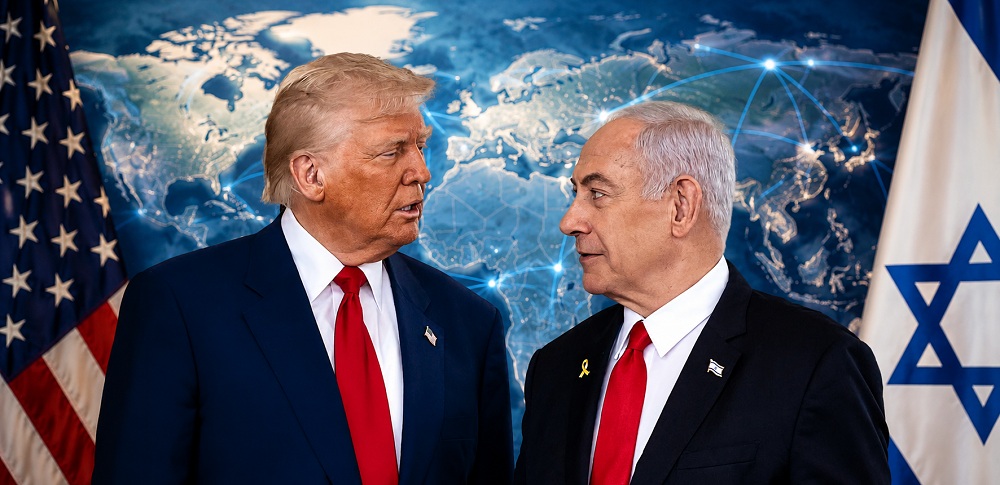


Alwaght- Israeli Prime Minister Benjamin Netanyahu’s visit to the US this week is not what his seven previous meetings with the US Donald Trump were. Rather than a summit to coordinate strategy on regional developments, this visit is about mending a relationship fractured by the fallout from the war with Iran. In the early months of their partnership, the White House and Tel Aviv were closely aligned on most cases. Now, signs of disagreement over the West Asia’s most critical security issues have burst into plain view.
Netanyahu is walking into the White House for the eighth time since Trump returned to power, but he no longer commands the sway over Washington’s decisions that he once did. Sources close to the US administration say the president has in recent months sought to calibrate his regional policies independently of Israeli demands, a shift that has pushed the personal and political ties between the two leaders into uncharted territory.
CNN has uncovered another telling indicator of Netanyahu’s diminished standing at the White House. He had wanted to travel to Washington last week, the network reported, but the White House refused to carve out time for a meeting. According to a US official and an Israeli source, Netanyahu spent weeks angling for a formal invitation to talk Iran and press Trump to take a harder line on Tehran. But Trump showed little interest in hosting him, and was even displeased with some White House aides who tried to arrange a sit-down. In the end, Netanyahu only secured the meeting as a sideline to his trip after announcing he would be in Washington for the funeral of Senator Lindsey Graham. For observers, the whole episode underscores a stark reversal where Netanyahu once secured meetings with the US president swiftly and at the White House’s own initiative, this time he had to lobby for weeks, and ultimately hitch his visit to a funeral to get his foot in the door.
Iran, the center of cleavage
The main item on the table, without question, was Iran. Tel Aviv is pressing its case that military and political pressure on Tehran must persist after the war to ensure Iran cannot rebuild its military and nuclear capabilities. Trump, however, while not taking the military option off the table, is trying to keep a diplomatic channel open to Tehran and avoid being dragged into another broad regional war. His calculus is driven by the staggering costs of a conflict with Iran, and by his overriding domestic concern: the upcoming midterm elections. A Reuters-Ipsos poll found that only 33 percent of Americans support continuing the war with Iran, the lowest level since the fighting began. Roughly 70 percent say the Trump administration has not clearly explained the war's objectives. That is a flashing red warning for Republicans heading into the midterms.
Many US experts argue that the military strikes have failed to achieve Washington's strategic goals. A Reuters analysis shows widespread skepticism that ramping up attacks would force Tehran to bend to American demands, with analysts warning that escalation would only raise the odds of a wider regional conflagration.
In essence, many analysts believe Netanyahu sees sustained military pressure on Iran as beneficial to his own political survival, but Trump does not share that calculation. An Israeli official told Al-Monitor that the difference comes down to this: Trump has the ability to start a war, but no appetite to sustain one given the heavy political and economic toll. Netanyahu, by contrast, may need the crisis to continue for his own political reason, but without US backing, he cannot drive it forward.
Shift of Washington’s priorities
While Netanyahu trained his focus on Iran during his meeting with Trump, the administration is operating with a far wider lens on the region. Beyond the Iran case, the White House has also prioritized Lebanon's future, Syria's trajectory, and Gaza's fate. That divergence in priorities signals that Washington is no longer viewing West Asia solely through Israel's security prism, and that it is increasingly wary of the political costs that come with full alignment with Tel Aviv.
A Middle East Eye report highlights one of Netanyahu's core anxiety, which is the growing independence of Trump administration decision-making on sensitive regional cases. The recent US nuclear deal with Saudi Arabia, the review of advanced fighter jet sales to Turkey, and the effort to keep a dialogue channel open with Iran, all of these have been tracked with alarm in Tel Aviv, where Israeli officials have found themselves unable to steer the outcomes. In their view, some of these decisions were made without prior coordination with Israel, underscoring that Tel Aviv's traditional leverage over White House policymaking has eroded.
Trump initially claimed that any nuclear deal with Saudi Arabia would be conditional on Riyadh joining the Abraham Accords and normalizing ties with Israel. But just days later, he pivoted, saying he had not actually discussed the matter with Saudi leaders. For its part, Saudi Arabia has made clear that it has no plans to normalize relations with Israeli regime until Palestinian legitimate rights, including an independent state, are recognized.
Trump skips support to Netanyahu
Netanyahu’s trip to Washington is no routine visit, but carries special political weight for the man himself. He is barreling toward a make-or-break election, and he knows full well that a show of close ties with the US president could pay dividends back home.
Yet Trump has so far refused to offer an official endorsement. While he has praised Netanyahu’s wartime role in public remarks, he has stopped short of any explicit political or electoral backing, a reticence that observers see as the White House hedging its bets on Netanyahu’s political future.
Will past relations be restored?
Al-Monitor has reported that despite the growing friction between Tel Aviv and Washington, neither side wants to let these differences spiral into an open crisis. The US still regards the Israeli regime as its most critical strategic partner in the region, and Israeli officials knows they cannot manage the region's security challenges without American backing.
That said, the reality is that personal relationship between Trump and Netanyahu no longer carries the warmth it once did. Both are now treading more carefully, working to preserve strategic cooperation while pursuing their own independent interests and priorities. In that light, this eighth meeting between the two leaders looks like a test case for the future of a long-standing alliance, one that will determine whether they can manage their recent disputes and revive past collaboration, or whether the emerging chasms are hardening into a permanent feature of US-Israeli relations.