







Alwaght- While the US President Donald Trump with the ceasefire deal and the Board of Peace initiative tried to present a beautiful image of the future of Gaza, the realities on the ground show that nearly seven months after truce, there is no correlation between that image and the current catastrophic situation in the Palestinian enclave. Even worse, many human indices have worsened compared to the war days. This contrast between words and reality raises many questions about rate of efficiency of this initiative, the degree of Israeli commitment to its promises, and also the role of international community in guaranteeing enforcement of terms of the deal.
Full displacement in Gaza
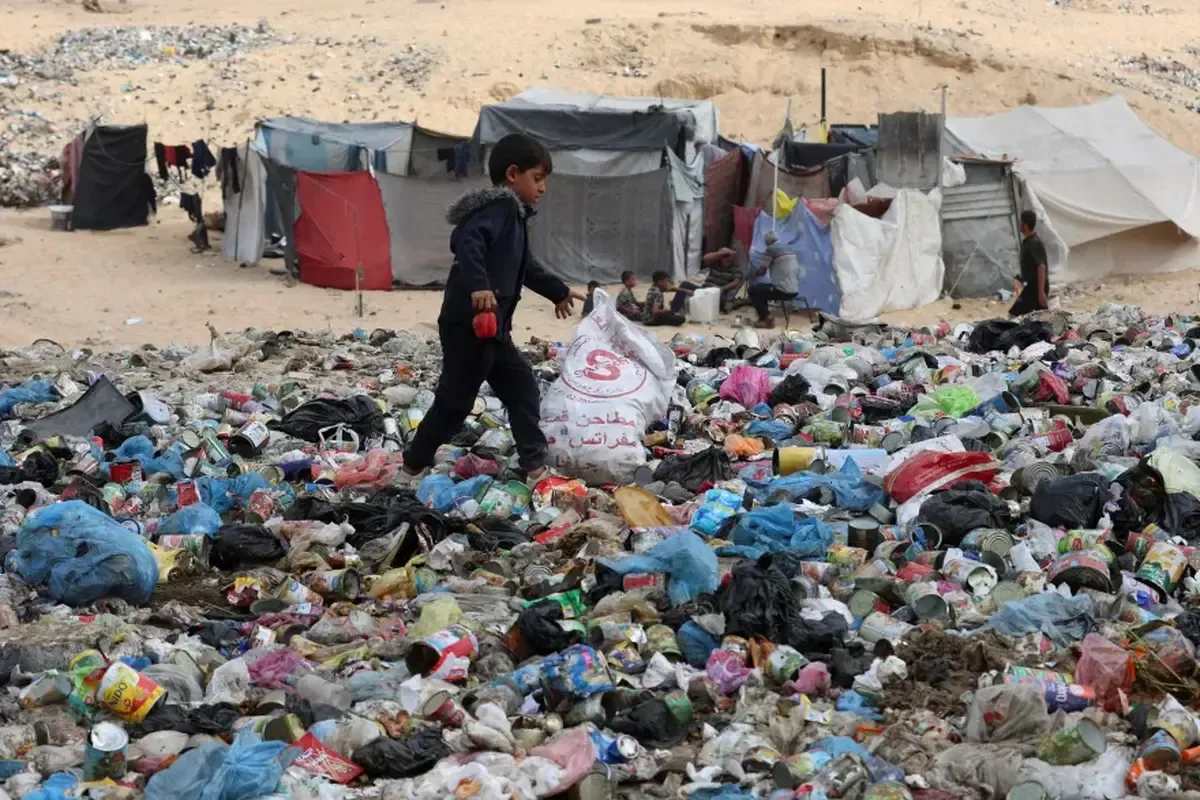
Reports published by the US bear a clear picture of the depth of the humanitarian crisis in Gaza. Khaled Khiari, assistant UN secretary-general, in a recent report said that almost 1.8 million people in Gaza, nearly the total population, have been fully displaced and are living in makeshift camps and are dependent on foreign aid for basic needs. He recommended that plans progress not just for humanitarian aid but also for preliminary improvement and for reconstruction.
"Two million in Gaza are hostage to starvation, massacre machine, and Israeli blockade," Khaiari added.
Published maps from the Israeli regime show thousands of displaced Palestinians spread across a narrow zone, penned in by borders that the regime’s military says are constantly shifting. Meanwhile, Reuters reports that estimates suggest at least 64 percent of Gaza is now under Israeli control, leaving roughly two million Palestinians trapped along a tight coastal strip.
This reality effectively calls into question any claim of rapid recovery or the success of short-term plans. What is unfolding in Gaza today is not just a limited humanitarian crisis, it carries all the signs of a widespread collapse of life's basic infrastructure, including housing, healthcare, food, and security.
Against this backdrop, UN Secretary-General spokesperson Stéphane Dujarric has underscored the deteriorating situation. He made it clear that no tangible progress has been made in getting construction materials and equipment needed for temporary shelters into Gaza.
He said that the recent UN expert mission to Gaza found that many displaced people are now living in makeshift tents or half-destroyed buildings, places that offer neither safety nor the basic necessities for a dignified human existence. This situation not only threatens physical health but also inflicts severe psychological pressures on residents, with potentially deep and irreversible long-term effects.
“UN teams need clean water, sewage systems, and more health support; they need to provide shelter and other essential supplies, scale up food and health services, and strengthen educational support,” Dujarric said.
Though the seige was supposed to be relieved gradually and the way paved for entry of humanitarian aid according to the deal terms, not only this did not materielize, but also in some cases the restrictions tightened. Reports say that Israeli military forces in recent weeks have launched attacks under various excuses, killing and injuring hundreds of civilians. Such actions practically target the spirit of the ceasefire and depict a lack of effective supervisory mechanisms to ensure execution of the terms.
During the ceasefire, Tel Aviv, like in the past, has violated the deal thousands of times. Hamas said that "we and all of other Palestinian groups are fully committed to the terms of the deal, while occupiers violate their obligations. The daily breaches of ceasefire by the occupiers bear clear witness to the disregard of the cabinet of Netanyahu to the efforts of mediators and its push to undermine the deal."
Gaza health system on the brink of full collapse
The health situation for Gaza residents is even more alarming. Reports from Thameen al-Khaeetan, the UN human rights spokesperson, show that shortages of clean drinking water, food, fuel, and other basic necessities have reached crisis levels. If this continues, it could trigger a massive humanitarian catastrophe. The UN official has called for the removal of all restrictions on humanitarian aid entering the Gaza Strip.
Even on its own, the lack of safe water heightens the risk of contagious diseases. Coupled with food shortages, it has made life especially brutal for vulnerable groups like children and the elderly.
Meanwhile, Tedros Adhanom Ghebreyesus, head of the World Health Organization, described the situation in Gaza as "catastrophic" and urged the international community to allow immediate entry of essential medicines and medical equipment to begin rebuilding the war-ravaged region's health services.
"The WHO has supported the establishment of a new family health center in northern Gaza," he said, adding: "An area where health services are extremely limited and most residents lack access to medical care."
With medicine and medical supplies in short supply, and health centers destroyed or knocked out of service, Gaza's health system is virtually incapable of meeting people's needs. Many hospitals have either been completely destroyed or are operating at bare-minimum capacity. As a result, even patients with treatable conditions are losing their lives.
Rafah, hostage to Israelis
Reacting to this pathetic situation, many rights organizations have called for immediate action. One of the core demands is reopening the Rafah Border Crossing with Egypt, a route that can play vital role in delivery of humanitarian aid to Gaza. The crossing remaining shut represents the core obscale to the aid operations.
The crossing was to reopen gradually according to the Sharm El-Sheikh agreement brokered by the US in October 2025, but the Israeli occupation military kept it closed. The border gate is vital to transfer of patients to Egypt. However, only a limited number of Gazans managed to cross it to neighboring Egypt and it remains tightly controlled by the occupation forces.
The Israelis also refuse to allow people who previously left Gaza through the Rafah crossing into Egypt to return. This policy is effectively a form of forced displacement. Since Palestinians have refused to abandon their homeland under US and Israeli pressure, Tel Aviv's leaders are now trying to push Gaza's residents out through such measures, which is a clear violation of fundamental human rights under international law.
In response, Munther al-Hayek, a Fatah spokesman in Gaza, warned that Israel's efforts to impose a new reality on the Rafah crossing, aimed at establishing full administrative and military control over Gaza, could turn the crossing into a trap for Palestinians. Speaking to Voice of Palestine radio station, al-Hayek stressed that "the complications and restrictions the Israeli regime is seeking to impose are an attempt to obstruct the natural movement of Palestinians and instrumentalize the Rafah crossing for pressure against them."
Countering Soumoud (Steadfast) Convoy
Resolved to obliterate the Palestinians, the Israeli regime even blocks symbolic aid on board popular ships aimed at breaking the siege under Soumoud Convoy. A humanitarian aid flotilla named Soumoud 2, made up of 58 ships and carrying hundreds of civil activists from around the world, attempted to sail to Gaza. Their goal was to symbolically break the siege and deliver limited aid to the defenseless people there. But once again, the Israeli occupation forces took criminal action: they arrested the crew members and seized the convoy's supplies.
Having drawn a wave of global condemnation, the interception shows that even independent, grassroots relief efforts face severe obstacles. Tel Aviv has repeatedly confiscated the cargo of such humanitarian convoys and blocked aid from reaching Palestinians.
Analysts see the repeated interception of relief ships as a deliberate tactic to intimidate global civil society. The message to international organizations, NGOs, and people's convoys is clear: if you try to help Gazans, you will be met with Israeli military force. By fostering a climate of threat and fear, the Israeli regime aims to prevent repeat efforts like the Freedom Flotilla or other international aid efforts. This is not just a security or military measure, it is part of a broader Israeli strategy to maintain the total siege of Gaza, break the spirit of resistance, and undermine global solidarity with the Palestinian people.
What we can see of current Gaza conditions is that without full lift of Gaza blockade and providing average security, any reconstruction is practically impossible. Reconstruction requires infrastructure, resources, labor force, and free flow of aid, all restricted under current conditions.
Finally, we can suggest that Gaza crisis is multifaceted and complex whose settlement requires a comprehensive, coordinated approach relying on true commitment from all sides involved. Mere ceasefire or providing political initiatives without enforcement mechanism will do nothing to fundamentally improve the grave Palestinian conditions. So, as long as there is distance between promises and field realities, not only the humanitarian crisis will drag on, but also it is likely to spread to the whole region.