













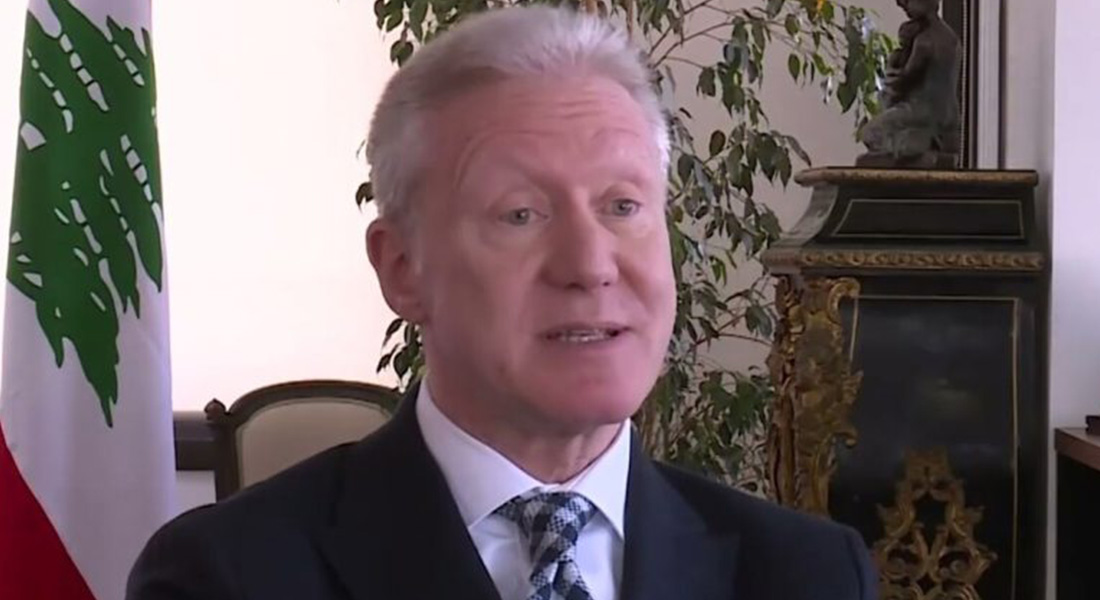


Alwaght- In recent weeks, the Lebanese politics have seen escalation of stances of anti-Hezbollah figures to pursue the Israeli-Arab-Western plan aimed at disarming the resistance movement. One of the leading figures at the center of this political and media campaign has been Youssef Raji, the foreign minister of the government of Prime Minister Nawaf Salam. His stances have made him the top opponent of Hezbollah in the current government.
Having shown his adversarial approach by a set of moves like summoning Iranian ambassador to Beirut and also expressing unwillingness to meet visiting Iranian Supreme National Security Council’s Secretary General Ali Larijani two months ago, Raji in recent weeks has become on top of the list of adversaries of the government, and even tied the reconstruction of southern Lebanon and demanding for international aid to Hezbollah disarmament, signaling striking alignment with the US and Israel.
A wave of domestic criticism has erupted in response to a series of statements by Raji. Critics accuse the FM of overstepping the bounds of his ministry’s authority, meddling in affairs they say belong to the president and the cabinet, not to a minister aligned with the controversial ‘Lebanese Forces’ party.
They contend that Raji’s statements exceed diplomatic protocol, framing them as acts of “political maneuvering” and “partisan vindictiveness.” This comes, they argue, at a time when the government should be preserving national unity in the face of external threats.
These criticisms intensified when media reports revealed that merely two weeks before his inflammatory remarks, Raji met with Morgan Ortagas, the US Special Envoy, a figure with staunchly anti-Hezbollah views who has urged Lebanese leaders to adopt a similar stance.
From the critics’ perspective, the Foreign Ministry, under Raji’s direction, is being transformed into an instrument of a foreign project: a scheme allegedly designed in cooperation with the US and the Lebanese Forces party to inflame internal discord, promote Israel’s narrative within Lebanon, and ultimately weaken the nation’s defensive capacity, embodied by Hezbollah.
Therefore, the issue is no longer merely one of harsh rhetoric; it is seen as a sign of a political shift within the Lebanese government, a shift that could have far-reaching consequences for the country’s entire power structure.
Raji, a technocratic FM or a means of Lebanese Forces
On the surface, Raji is an experienced diplomat, but he is by no means a prominent diplomat. The most important posts he has ever occupied hade been an employee of the Lebanese embassies in Morocco and Belgium and presence in the Lebanese embassy in the US as a diplomat do charge of political affairs and also the first vice president of the Lebanese mission at the UN and other international organizations. So, he owes his post as FM practically to the political and gives and takes among the parties present in the cabinet.
The Reality is that Bou Habib is Not an Independent Figure, But a Member of the Lebanese Forces Party
The reality is that Raji is not an independent political figure, but a member of the Lebanese Forces party, a party with a long history of hostility towards Hezbollah and its allies in Lebanon. In recent years, it has sought to leverage every opportunity to pressure Hezbollah.
In his remarks, Raji has repeatedly claimed that “the Americans love Lebanon,” and his political rhetoric consistently reinforces the belief that “Lebanon’s strength lies in its weakness.” However, this notion is not new; it is a revival of the historical theory of Pierre Gemayel, founder of the Kataeb (Phalangist) Party, who believed that “Lebanon is a weak country that must rely on Western support.”
Gemayel, who sought to link Maronite Lebanon to the West, argued that:
1. If Lebanon becomes strong, regional countries will perceive it as a threat.
2. Lebanon’s weakness makes it dependent on foreign support, which he deemed essential for internal stability.
3. The country’s mosaic-like structure and the central government’s weakness, by creating a “balance of fear,” could prevent unilateral domination.
This theory became the foundation of political thought for a segment of Lebanon’s right-wing Christian factions that later applied this same framework in its relations with Israel, France, and the US.
One of the most serious consequences of this outlook has been its influence on the military calculations of the Israeli regime. At times, it has led Israel to believe that the Lebanese government would not respond to limited attacks, and that only Hezbollah would be responsible for retaliation. In practice, this perception has contributed to an increase in pinpoint Israeli attacks in southern Lebanon, airstrikes on Hezbollah commanders, and repeated aggressions that have, in recent months, also violated the ceasefire.
Therefore, critics mock the FM, saying: “Raji’s diplomacy is based on going to the Americans and weeping before them.”
He and his political party are well aware that Lebanon’s real power lies in the existence of Hezbollah, a force that since 2000 has been a significant bulwark against the Israeli regime’s aggressions and has created a rare deterrence. Yet, Raji, by following American and Western embassy directives, calls for the disarming of Hezbollah and seeks to push Lebanon into a position of strategic weakness.
The media discourse aligned with the US operates precisely along this path, a faction that strives to portray Hezbollah as the source of crisis and a violator of UN Resolution 1701, while omitting any mention of Israel’s continuous acts of aggression.
But in the face of “Lebanon is weak” claim, Hezbollah insists that such an equation is Washington’s instruction to insinuate the end of the role of Hezbollah in the Lebanese developments and prepare the public opinion in Lebanon to tip the power scales in the country.
Raji does not, in fact, speak from the position of a minister in a unified government, but acts as the political representative of the Lebanese Forces party. He has openly crossed this legal red line without significant pushback from the president or prime minister, a behavior that experts believe violates the principle of ministerial neutrality after a government is formed.
In this context, Wassim Ismail, an international relations researcher, notes: “The foreign ministry’s exaggerated reactions under the guise of ‘sovereignty’ come at a time when the same ministry ignores blatant US interference in Lebanese affairs.” He adds that it has issued no statement or taken any diplomatic action to condemn the Israeli regime’s attacks on southern Lebanon and the killing of Lebanese citizens.
While villages in southern Lebanon face daily Israeli assaults, Raji parrots Israeli and Western narratives in the media, framing Hezbollah as the party violating UN Resolution 1701, even though the UN and its Secretary-General Antonio Guterres himself have repeatedly highlighted Israel’s ongoing breaches of the resolution.
This contradictory conduct leads many to conclude that Raji Habib is not acting as a minister in a national government, but as the de facto spokesperson for the Lebanese Forces, a party that has strategically opposed Hezbollah for decades.
The foreign ministry, which should serve as the “front line defending Lebanon’s rights,” has instead become an extension of the Lebanese Forces’ partisan agenda, an agenda aimed at justifying US and Israeli pressure and undermining Hezbollah.
Therefore, the persona and positions of Raji cannot be viewed in isolation; they are part of the broader political project being pursued by the Lebanese Forces.
Lebanese Forces and the push for a political coup from within government
The recent conducts of the Lebanese Forces are not limited to media levels or provocation of the FM. Political sources in Lebanon suggest that the Lebanese Forces are applying a plan to shift the balance of power from within government, a plan some analysts dub “sift political coup.”
The first manifestation of these efforts is to remove Nabih Berri, the parliament speaker, from national decision-making processes. Ministers affiliated with the Lebanese Forces party in the cabinet have recently intensified their attempts to weaken Berri’s position. They believe that by sidelining Berri from the decision-making circle and diminishing his influence, they can first, limit the role of the two Shiite parties of Amal and Hezbollah in the government; second, reconfigure state power according to their own interests; and most importantly, create a new power structure in which the Lebanese Forces plays a central role.
For decades, Berri has been one of the pillars of political stability in Lebanon, both due to his parliamentary position and his national-sectarian standing. However, following the Israeli regime’s attacks on Hezbollah leaders and efforts to weaken the military position of the resistance movement, the Lebanese Forces views this environment as a “historic opportunity” to seize Berri’s position or at least push him out of key processes. Reports indicate that in recent cabinet sessions, verbal attacks and sharp criticisms have also been directed at Berri.
Another dimension of the actions by Lebanese Forces ministers involves reigniting old disputes within the tripartite power structure, the presidency, the prime minister’s office, and the parliament speaker. They believe that in the current government, especially given the absence of a decisive majority for the two Shiite parties, an opportunity has emerged to apply pressure and change political rules. The Lebanese Forces ministers feel that with parliamentary elections approaching, they must shift the balance in their favor from now on.
Will Lebanese Forces exit the government?
Sources familiar with the matter suggest that withdrawal from the government is still not on the agenda of the Lebanese Forces. Presence in the government gives the Lebanese Forces the opportunity to press from within and leverage the government instrument for its projects. But escalation of disputes is a permanent option on the table when it serves their interests.
Lebanese Forces’ behavior should be recognized as the continuation of a “hybrid warfare” that was launched at military levels against Hezbollah and whose final aim is to downgrade the movement’s role in the Lebanese power structure and redrawing the equation in accordance with the US and Israeli wishes.
The Lebanese Forces also attempts to portray the post-war situation as if the era of Hezbollah’s dominance is over; however, municipal election results have proven otherwise.
According to reports, Hezbollah’s popularity among its social base has not only not diminished but has actually strengthened. As Mohanad Haj Ali from the Carnegie Middle East Center states: “Shiites today feel their fate is more intertwined with Hezbollah than ever before.”
In such a climate, the Lebanese Forces’ political project for engineering power does not align with Lebanon’s social and security realities; yet, the attempt to impose it through the government continues unabated.
Conclusion
Lebanon is in a situation in which more than any other time it needs responsible diplomacy, national unity, and prioritizing addressing of foreign threats. Daily Israeli violations, regular breach of the November 2024 ceasefire, assassinations, and ongoing threats raise the necessity for a united and coherent foreign policy apparatus.
In such situation, strong-toned and biased stances of Raji not only do not help Lebanese national interests, but also deepen internal gaps, boost Israeli and American narrative inside Lebanon, derail the foreign ministry from its national role, and practically become part of a foreign political project to weaken Lebanon.
Therefore, Lebanon more than any other time needs to return to the principles of its national sovereignty, redefine its foreign ministry’s role based on national interests, and prevent the government from becoming an instrument in the hands of a specific party. Continuation of the current trend can endanger the internal cohesion and make the country more vulnerable to foreign threats.
Today, a diplomacy that defends national interests of Lebanon is crucial, not a diplomacy that ignores Israeli attacks, parrots the enemy's narrative, and targets forces that defend the country.










