







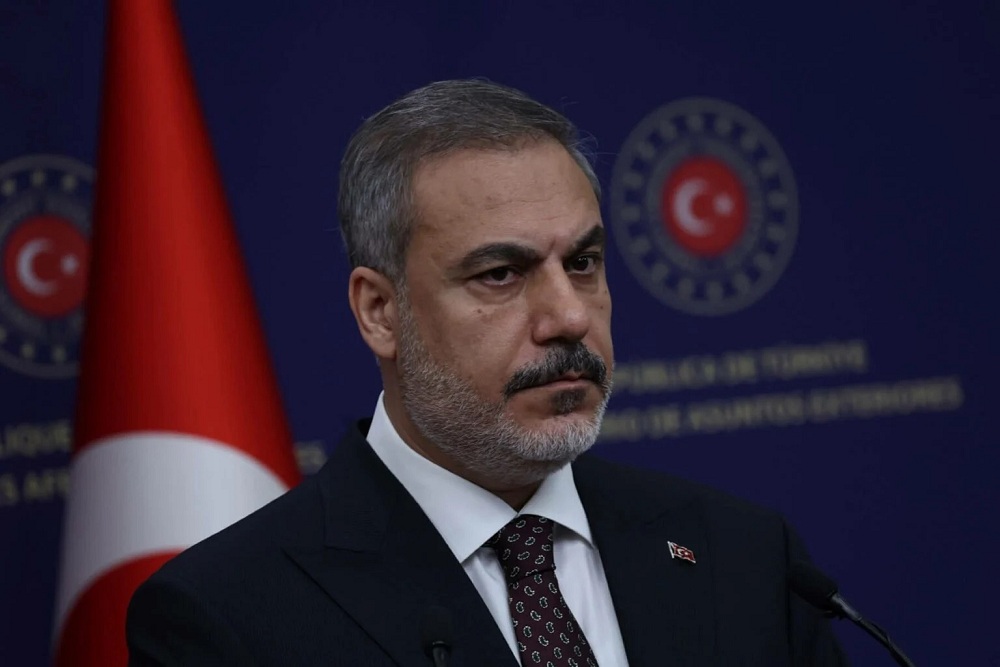


Alwaght- Many describe Hakan Fidan the architect of the current foreign policy of Turkey. This description is more a description of a doctrine shift and way of Turkish foreign policy model than a title given to the intelligence chief-turned-foreign minister. It is the shift of the center of gravity from classic diplomacy of the foreign ministry to a model in which intelligence, security, operations, and negotiations are integrated to advance more pragmatic and more active plans in the region. As a man who has sat on the top intelligence agency (MiT) seat of Turkey for 13 years and then occupied the foreign minister post, Fidan carries a new doctrine, one that pushes Turkey to a preemptive, multi-route and security-obsessed foreign policy in a tense and polarized environment. In this framework, the foreign policy is not just a means of regulating relations with other countries but also an instrument for engineering the threats inside the borders, managing peripheral regions, and building bargaining leverages in the face of world powers.
Fidan’s career trajectory largely explains this transformation. He emerged from the Turkish Land Forces School of Communications and the Armed Forces Language School, institutions where communications, cryptography, data, and language are forged as primary instruments of security. He completed a significant portion of his university studies while on NATO assignment and earned a degree in politics and management from the University of Maryland. He then pursued a doctorate in international relations at Bilkent University, later teaching there and at Hacettepe University.
This unique amalgam comprising hands-on military intelligence experience, an insider’s familiarity with Western structures through NATO, and the academic language of international relations, has enabled him to grasp the logic of the field while mastering the narrative logic of diplomacy. Actually, he can convert a threat into an operational case and, simultaneously, frame it within a legitimizing, persuasive framework for public consumption.
Fidan’s rise also illustrates his journey from the technocratic periphery of the Turkish state to the core of its foreign policy. His leadership of TİKA (the Turkish Cooperation and Coordination Agency) was not merely a developmental post; it was a masterclass in network-building across the wider region, linking economics, cooperation, cultural influence, and politics. Subsequent key roles, including senior positions in the prime ministry’s office focusing on foreign and security policy, a seat on the board of governors of the International Atomic Energy Agency, and appointments as the special envoy of the prime minister and later the president on critical cases. These posts made him a bridge between the bureaucracy, security establishment, and political decision-making.
Now, as head of the MiT, he operates at the heart of matters where diplomacy and covert operations blur. His role entails backchannel negotiations, managing transnational threats, orchestrating regional networks, and redefining foreign policy on turbulent West Asia stage.
Out of heart of this experience come the key ideas of Fidan. First a peripheral lens, viewing Syria and Iraq as the fields that directly impact the Syrian home situation. For Fidan, Syria is not just a foreign case but an extension of the home security. Migration, border control, and non-state armed actors like PKK on the one hand and the spillover of the insecurity to Turkey on the other hand are exactly the cases Fidan has managed to deal with. Iraq, with its entanglements in energy and regional influence competitions, is part of the same strategic calculus.
Second, a focus on instrumental de-escalation as a tool to reduce border risks and free Turkey’s hand for economic and geopolitical maneuvering. This calculated easing of tensions can run parallel to military-security posturing. In Fidan’s narrative, Turkey can, on one front, leverage its fight against the PKK as a terrorist group to justify security operations, while on another front, open channels of cooperation with regional partners to keep the costs of threats as low as possible.
Third, there is the ideological-identity layer, expressed in his discourse through a language of humanitarianism and liberation, as seen regarding Syria’s Bashard al-Assad and Israeli regime. This language serves two primary functions: it provides an ethical cover for interventionism in West Asia region, and it elevates Turkey’s stature as an actor with a historical responsibility within the Muslim world.
In line with this, Fidan pursues a form of spiritual leadership and a coordinating role for Turkey, positioning it not merely as a regional player, but as the reference point for managing crises across the Muslim world and the Middle East. This idea manifests in the Gaza case, where his emphasis on a potential Turkish presence signifies an attempt to transform the Palestinian crisis into a platform for legitimacy of Turkish regional role. Even his response regarding Hamas’s disarmament, dismissing it as not a current priority, can be understood within this framework.
The main cases in which Fidan’s logic is noticeable, are both security-obsessed and political. In the Kurdish case, Turkey experienced a period in which the secret talks and crisis management replaced mere military approach, signaling that even when processes and initiatives fail, the Turkish intelligence apparatus can assume a diplomatic role, too. In Syria, Turkish policy has been coincidentally dual: Supporting aligned actors and pushing to shape field dynamics and arrangements along with adopting serious sensitivity regarding Kurdish entities like the Syrian Democratic Forces (SDF) and voicing concerns about the militia organization becoming a border threat.
In Iraq, the interconnection of border security, counterterrorism, energy, and trade has pushed Turkey toward more intensive security and diplomatic engagement with Baghdad and local actors. On a broader scale, the intelligence-led diplomatic style, from confidential backchannels to phased exchanges and agreements, has become a key foreign policy tool. This approach, a hallmark of a security chief’s career, has now gained formal traction with Fidan as foreign minister.
Finally, Cyprus remains one of the most critical identity and security cases. Turkey’s advocacy for a two-state solution and its standoff with Greece and Greek Cypriots underscore that, on some issues, Ankara is unwilling to accept classic compromise logic. Instead, it insists on grounding political solutions in the facts on the ground. With recent activities by the Israeli regime and its deepening alliance with Cyprus and Greece, Fidan’s role in this case is expected to become even more active than before.
Meanwhile, many have questions about Fidan’s relation to Erdogan. Many believe that Fidan’s activities can give ruse to worries in upper power blocs, especially Erdogan himself as the relation of the two politicians can at best be regarded as strategic alignment. Without Erdogan’s support, Fidan could not rise this high in the power structure and additionally, Erdogan is looking at him as a security manager and reliable executer of sensitive decisions. Ideologically, they both move in a single intellectual apparatus, thinking that Turkey should grow more independent, more active, and more demanding within the world order and play a determining role in its peripheral environment.
The difference lies more in method than in ultimate objective. Erdogan views foreign policy as an extension of domestic politics and mass mobilization, employing symbolic language to generate power. Fidan, by contrast, is generally more technocratic and operationally-focused. He gives fewer speeches, rarely grants interviews, and when he does, his remarks are measured and cautious. He is, above all, a deal-maker.
This very difference allows Fidan to pursue a form of de-escalation while simultaneously remaining within the overarching ideological framework of the administration on dossiers like Gaza or Syria. Any potential divergence between the two is not over principles, but over tactical weighting. Fidan would likely prefer, in many instances, to lower costs through phased agreements and backchannel management. Erdogan, on the other hand, may at critical junctures favor a more dramatic political display to amass greater symbolic capital for his own legitimacy.
Ultimately, Fidan symbolizes a Turkey striving to be both an effective security state and an identity-driven actor in the Muslim world. This is a combination that may grant Ankara greater room for maneuver in the short term, but in the long run, it will confront the nation with profound and difficult contradictions. The more Turkey stresses on its discourse of spiritual leadership and an anti-Israel role in Gaza, the more it complicates managing relations with the West. The more Turkey seeks to curb Iranian and Iraqi influence in Syria, the more it is inevitably drawn into complex regional rivalries. Either way, all these can lead to a kind of radicalism in making the foreign minister security-obsessed. Still, it remains to see how far Fidan can go with advancing his plans and who, either home power groups or regional and international rivals, will put the brakes on him.