

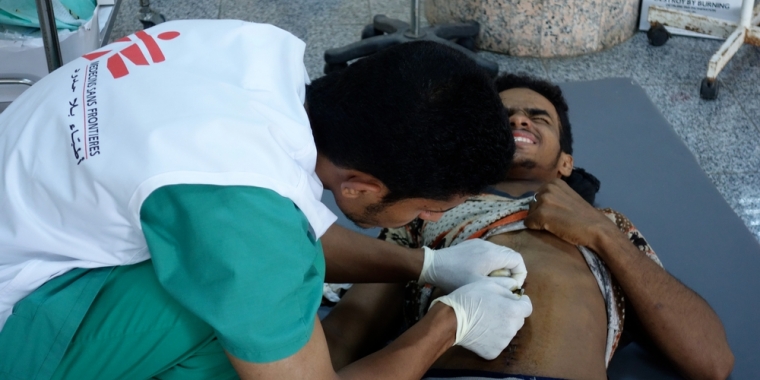


Alwaght - The situation in the Aden, seaport city in Yemen is deteriorating with emergency response teams unable to move around the city to provide healthcare to the injured, and many patients unable to access hospitals.
Médecins Sans Frontières/Doctors Without Borders (MSF) reported that "Hospitals in Aden are full, some are placing mattresses in front of their front gates to accommodate patients.
"Daily fighting and airstrikes are still heavy and we are concerned for patients who are unable to access care, while patients who are already in hospitals are too scared to leave," MSF added .
Saying that "Our teams have been blocked on many occasions from moving within the city and from receiving shipments of medical aid from the port,” Goffeau, a member of MSF emphasized that "We need to be granted free access to be able to provide medical care to those who need it.”
Civilians in Aden are not only suffering due to the fighting, but also as a result of being cut off and surrounded by frontlines.
Hassan Boucenine, MSF Head of Mission in Yemen, criticized Saudi-led aggression on Yemen saying that "There are shortages of food, cooking gas, fuel and drug... The health system is collapsing, patients with chronic diseases cannot get their drugs, bodies are on the streets, and the city is an open dump with trash covering the streets.”
"It is extremely important to lift the blockade on food and medication and to set up unobstructed channels for air, sea and land access, to provide the population with what they need to survive,” added Boucenine.
Since March 26, Saudi-led coalition has been pounding Yemen under the pretext of reinstalling the fugitive Yemeni president Abd Rabbu Mansur Hadi.
Over the course of the last two and a half months, thousand of Yemeni civilians, mostly women and children, have been massacred and the infrastructure has been dealt a serious blow. Electrical grids, water supplies, sewage, food shipments and medical supplies have been affected.
Already the poorest country in the region, Yemen is now quickly becoming a major humanitarian crisis. According to the UN, 20 million people, or 80% of the population of the country, are now in urgent need of humanitarian assistance.
- As Netanyahu Falters, Israelis Turn Deaf Ear to Trump’s Vote Support Message
- Istanbul Meeting, A Frustration to Delusion of anti-Iranian Coalition
- Iran Slams Europe for Double Standards Over US-Israeli Aggression
- Ghalibaf Warns Any Infringement on Iranian Territory Will Provoke an Unimaginable Response
- Yemeni Forces Strike Key Targets Deep Inside Saudi Arabia
- Iranian Greco-Roman Wrestlers Claim Four Medals on World Championships’ Opening Day
- Saudi Arabia vs. Ansarullah: The Neutralized Saudi Conventional Power
- Iraq’s Cabinet Completion: From Winners and Losers to Quota System
- Leader Calls for Stronger Anti-Corruption Measures and Compensation for US-Israeli War Damage
- Yemeni Forces Target Riyadh Airport and Saudi Oil Facilities in Seven Operations
Editor's Choice

Gen. Solemani, A Living Resistance Legacy General Solemani of Iran caused a transformation to the region that blocked the way of the Israeli and American projects in West Asia.
A Review of Newly Published US National Security Document The US national security document may be an unwanted admission that the US hegemony is diminishing.
US or Venezuela? Who’s the True Oil Thief? Trump says Venezuelan nationalization of its oil was theft of American oil companies’ assets, justifying oil blockade on South American nation.
Why Are Tel Aviv and Washington Stepping Up Pressures against Hezbollah? Israel knows that disarming Hezbollah makes occupation of Lebanon a piece of cake.
Is Yemen on the Verge of Split? The country is sinking in chaos as conflicting forces in the south are going separate ways and Yemenis are less involved in the fate of the south.
News
Iran Slams Europe for Double Standards Over US-Israeli Aggression
Iranian Foreign Ministry spokesman Esmaeil Baghaei has condemned Germany and other European countriesGhalibaf Warns Any Infringement on Iranian Territory Will Provoke an Unimaginable Response Iranian Parliament Speaker Mohammad Bagher Ghalibaf has warned that any attack on the country’s sovereignty would prompt a forceful retaliation
Yemeni Forces Strike Key Targets Deep Inside Saudi Arabia Yemen’s military has launched a new wave of strikes on Saudi targets
Iranian Greco-Roman Wrestlers Claim Four Medals on World Championships’ Opening Day Iran secured four medals, including one gold, two silver and one bronze, in the opening four weight categories of the World Wrestling Championships
Leader Calls for Stronger Anti-Corruption Measures and Compensation for US-Israeli War Damage Ayatollah Seyyed Mojtaba Hosseini Khamenei, Leader of the Islamic Revolution, has urged authorities to intensify the campaign against corruption
Yemeni Forces Target Riyadh Airport and Saudi Oil Facilities in Seven Operations Yemen’s armed forces announced that they launched seven attacks on Saudi territory
Iraqi Resistance Vows Support for Iran Against Any New US-Israeli Aggression The Islamic Resistance in Iraq has vowed to support Iran if the United States and the Zionist regime launch another attack on the country
Two Supertankers Sustain Damage After Hitting Sea Mines in Strait of Hormuz Two supertankers transporting over 4.5 million barrels of crude oil were put out of action after striking sea mines
Ayatollah Khamenei and Ghalibaf Review Latest Developments in US-Israeli War on Iran Ayatollah Seyyed Mojtaba Khamenei and Parliament Speaker Mohammad Bagher Ghalibaf held talks on the ongoing conflict
Source: Iran Ready for Full-Scale, Multi-Front War Against Adversaries A senior security official said Wednesday that Iran is fully prepared for a large-scale conflict spanning multiple fronts as regional tensions intensify
Iran: US Political Targets Could Be Legitimate if Assassinations Resume An Iranian security official stated that American political figures could become legitimate targets if targeted killings of officials resume
Iranian FM Warns US of Greater Strategic Defeat Without Honorable Agreement Washington faces a choice between reaching a fair and honorable agreement with Tehran and risking a more severe strategic setback
IRGC Deputy Says Iran Prepared to Repel Any Attack by Adversaries The Islamic Revolution Guards Corps (IRGC) deputy for political affairs said Iran’s military is ready to counter any hostile action
Iranian Security Chief Vows No Enriched Uranium Will Leave the Country Iran’s top security official has firmly rejected transferring enriched uranium abroad, declaring that all nuclear material will remain within the country
Iran Warns of Threat to Hormuz Undersea Cables in Event of Infrastructure Attacks IRGC official Yadollah Javani warns submarine cables in Strait of Hormuz could be endangered by attacks on Iranian infrastructure
Israel’s Latest Gaza Attacks Kill At least Four Palestinians Amid Genocide Allegations At least four Palestinians have been killed in Israeli strikes on Gaza, further raising doubts about Israel’s commitment to a year-old ceasefire
France Tightens Curbs and Threatens Large-Scale Police Deployment Ahead of Demonstrations French officials have prolonged nighttime movement restrictions in Paris and several other major urban centers
Iranian Military Chief Vows Armed Forces Will Defend Nation in All Circumstances Iran’s senior military chief has affirmed that the country’s armed forces are fully prepared to safeguard national sovereignty and confront any threat
IRGC Warns Further Attacks on Iran Could Spark Worldwide Energy Crisis The Islamic Revolution Guards Corps (IRGC) cautioned that renewed attacks on Iran would provoke a far stronger retaliation
Araghchi: Tehran-Moscow Ties Vital for Regional Peace and Stability Iranian Foreign Minister Abbas Araghchi stressed that closer ties between Tehran and Moscow could contribute to greater regional stability
Most Viewed
As Netanyahu Falters, Israelis Turn Deaf Ear to Trump’s Vote Support Message
Istanbul Meeting, A Frustration to Delusion of anti-Iranian Coalition
IRGC Deputy Says Iran Prepared to Repel Any Attack by Adversaries
Source: Iran Ready for Full-Scale, Multi-Front War Against Adversaries
Iran Warns of Threat to Hormuz Undersea Cables in Event of Infrastructure Attacks
Damaged Tankers and Lasting Wound of Energy Market
Israel’s Latest Gaza Attacks Kill At least Four Palestinians Amid Genocide Allegations
Iranian Security Chief Vows No Enriched Uranium Will Leave the Country
Netanyahu’s Transition from Ben-Gurion Doctrine to His Own
Iran’s Sovereignty over Hormuz: The Road to Transform Iranian Ports into a Regional Hub
Iran: US Political Targets Could Be Legitimate if Assassinations Resume
Three Cases That Brought Pakistan’s Munir to Tehran
Iranian FM Warns US of Greater Strategic Defeat Without Honorable Agreement
Two Supertankers Sustain Damage After Hitting Sea Mines in Strait of Hormuz
Iranian Greco-Roman Wrestlers Claim Four Medals on World Championships’ Opening Day
Yemeni Forces Strike Key Targets Deep Inside Saudi Arabia
Egypt’s Yemen War Dilemma: Balancing Political Reservations and Strategic Interests
Britain Halts Dozens of Additional Weapons Export Permits For ‘Israel’ While Keeping F-35 Deal in Place
Lebanon Govt. Frustrated with US as Talks with Israel Run into Deadlock
Where have American Forces and Military Equipment Gone after Iraq Withdrawal?
Leader’s Adviser Warns of New Front if Iran Faces Another Attack
Ayatollah Seyyed Mojtaba Khamenei Pays Tribute to Nasrallah, Reiterates Iran’s Commitment
Iran Denounces Trump’s ‘Hateful and Disgusting’ Threats in UN Filing
Iran Says Trump Is Trapped in A “Quagmire” And Struggling to Chart a Course
US Military Withdrawal not End of US Iraq Presence, Iran Needs Long-term Iraq Strategy: Expert
Iranian Armed Forces Fully Prepared for Any Scenario: Spokesperson
IRGC Chief: Iranian Youth’s Successes in Sports and Science Frustrate Adversaries
Yemen War Highlights Growing Saudi-Israeli Military Coordination
Ghalibaf Dismisses US Assertion That Iran Lacks Control Over Strait of Hormuz
Second Sayyed Nasrallah Anniversary: Display of Loyalty to Resistance Legacy
Honesty, Bluntness, and Resistance Are Secrets Making Nasrallah Remembered: Iranian Expert
Iranian Parliament Speaker Says Threats to Iran’s Oil Exports and Security Could Have Wider Consequences
In Focus

Ansarullah
A Zaidi Shiite movement operating in Yemen. It seeks to establish a democratic government in Yemen.
Shiite
represents the second largest denomination of Islam. Shiites believe Ali (peace be upon him) to be prophet"s successor in the Caliphate.
Resistance
Axis of Resistances refers to countries and movements with common political goal, i.e., resisting against Zionist regime, America and other western powers. Iran, Syria, Hezbollah in Lebanon, and Hamas in Palestine are considered as the Axis of Resistance.
Persian Gulf Cooperation Council
A regional political u n i o n consisting of Arab states of the Persian Gulf, except for Iraq.
Taliban
Taliban is a Sunni fundamentalist movement in Afghanistan. It was founded by Mohammed Omar in 1994.
Wahhabism & Extremism
Wahhabism is an extremist pseudo-Sunni movement, which labels non-Wahhabi Muslims as apostates thus paving the way for their bloodshed.
Kurds
Kurds are an ethnic group in the Middle East, mostly inhabiting a region, which spans adjacent parts of Iran, Iraq, Syria, and Turkey. They are an Iranian people and speak the Kurdish languages, which form a subgroup of the Northwestern Iranian branch of Iranian languages.
NATO
The North Atlantic Treaty Organization is an intergovernmental military alliance based on the North Atlantic Treaty which was signed on 4 April 1949.
Islamic Awakening
Refers to a revival of the Islam throughout the world, that began in 1979 by Iranian Revolution that established an Islamic republic.
Al-Qaeda
A militant Sunni organization founded by Osama bin Laden at some point between 1988 and 1989
New node











