












Alwaght- The UN General Assembly has always offered a stage for strengthening diplomacy and international cooperation, and, above all, for leaders to lay out their views on the world's most pressing issues and challenges. Yet even the noisy presence of Benjamin Netanyahu, the Israeli prime minister and convicted war criminal wanted by the International Criminal Court (ICC) for genocide and crimes against humanity, did nothing to ease his regime's global isolation at the UN gathering. Instead, it became a spectacle laying bare the depth of worldwide revulsion toward this illegitimate regime.
Netanyahu tried to use the UN podium as a campaign platform to shore up his standing in elections in the occupied territories, rattling off imagined victories from the past four years to preserve his image as leader of the right-wing, hardline camp. But the mood in the General Assembly and the reactions to his presence and his remarks turned the affair into an unmitigated fiasco.
For years, Netanyahu has used the UN platform to project an image of strength, a leader who will not bow to international pressure and retreat from his policies of suppressing Palestinians.
His latest speech followed the same playbook. He spoke about attacking Iran, the war in Gaza, Hamas and security threats against the occupied territories. Yet the turmoil wrought by his newly cemented status as a war criminal forced him, even while denying the killing and the starvation imposed on the people of Gaza, to fall back once again on his worn-out, threadbare tactic of casting Jews as victims.
Addressing empty seats
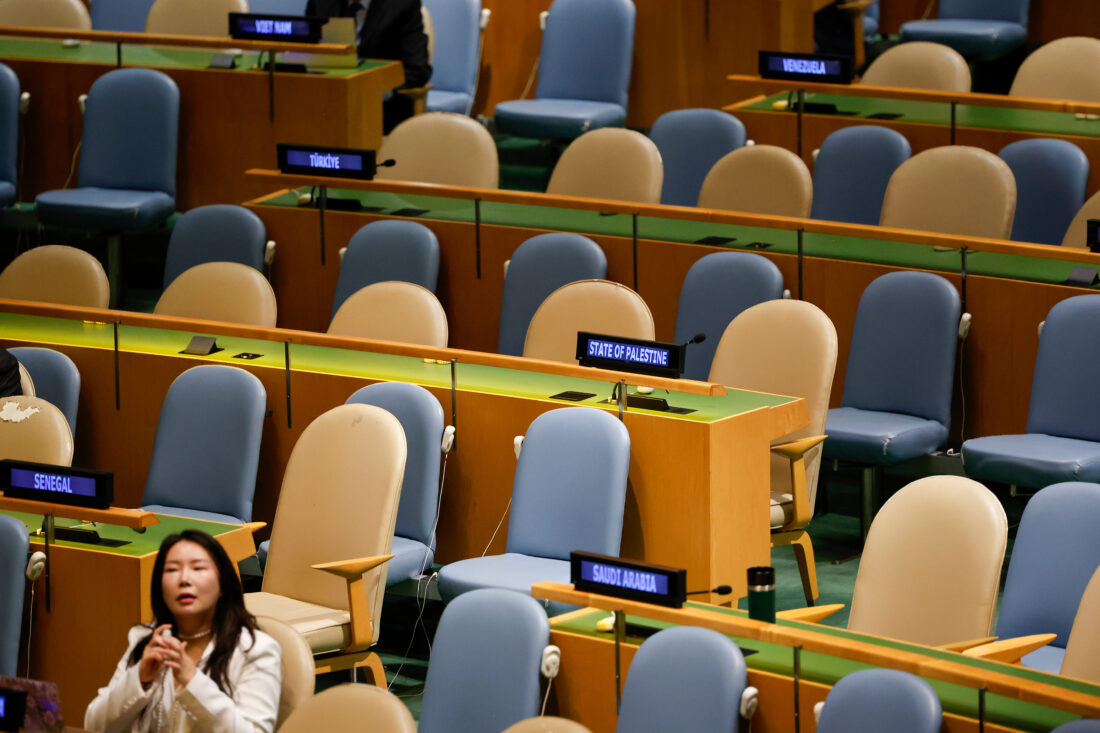
But the most striking feature of Netanyahu's UN speech lay not in his words but in the camera's wide shots of delegates walking out en masses, and of him addressing empty chairs. As soon as he began speaking, a large bloc of political delegations, 77 countries, stormed out of the hall chanting pro-Palestinian slogans. It was an almost unprecedented move: Foreign Policy reported that more than 100 delegates walked out, compared with The Washington Post's account last year that diplomats from 50 countries had left during his speech. The numbers tell the story: more countries chose this year to boycott the war criminal's address.
The scene was so extraordinary that a video of an Israeli diplomat circulating on social media shows him calling the roll, compiling a list of those who oppose the occupying regime.
The protests against Netanyahu were not confined to the walkout inside the General Assembly hall; demonstrators also gathered outside the UN building against him.
The Jewish Voice for Peace movement organized the demonstrations to demand an end to the war in Gaza and to protest Netanyahu's trip to New York. Protesters carried placards reading "Stop the genocide," and the scene turned violent as police moved in.
The episode makes plain that in today's politics, the content of a speech is not all that matters, the image an event projects in the media can count just as much. Netanyahu meant to stage a tableau of power and victory at the UN. In the end, it was the image of a hall emptying out that became the defining symbol of his weakness and of his appearance at the gathering.
The walkout by political delegations was a meaningful scene of diplomatic defeat for Netanyahu, showing that international opposition to Israel's policies is mounting and that the regime now faces more isolation and global criticism than ever before.
Home atmosphere against Netanyahu
The main addressees of Netanyahu were not the representatives of other countries, but the Israelis in the occupied territories; those who are set to vote in a month in a decisive election to judge the performance of the right-wing government. Over the past four years, Netanyahu and his cabal have imposed heavy costs on the Israeli society by opening various fronts, further risking the security and peace of the Israelis. The Israelis have spent a major portion of the past years in small and dark underground shelters and the economic challenges have made their days even more horrible.
So, even as polling showed Netanyahu and his hardline allies losing popularity, he tried to use the UN platform to reintroduce himself to the domestic public as a powerful, seasoned leader. His aim was to show Israelis that he remains the only reliable option for another term as prime minister. But events did not unfold as he had hoped, and Israel's own media landscape turned on him fast.
The Wall Street Journal, citing analysts, noted that Netanyahu delivered his speech in English during Israeli prime-time television hours, a move that may have been aimed at shoring up his poll numbers.
A poll by the newspaper Ma'ariv found that Netanyahu's coalition lost ground even after the General Assembly speech, with opposition to him on the rise.
According to the survey, the Netanyahu coalition shed a seat and now holds 49, at least 12 short of a majority. Closing that gap and expanding the ruling coalition's support by 25 percent looks so daunting as to seem far-fetched.
Hebrew-language media also sharply criticized the images the cameras captured on the sidelines of Netanyahu's UN appearance.
In a sharply critical analysis, Yedioth Ahronoth described the speech as packed with attacks and accusations but devoid of any vision for peace or an end to the war, calling the walkout by diplomatic delegations a sign of Israel's growing isolation.
The newspaper, in its analysis of the speech, wrote that the defining image of the event was neither the props Netanyahu brought to the podium nor any particular passage of his remarks, it was the delegations walking out. Dozens of delegates left the hall as Netanyahu approached the podium, the outlet noted, and images of their exit spread around the world within moments.
The Times of Israel, pointing to the same scene, wrote that Netanyahu, despite his well-known public relations skills, delivered a speech that was overshadowed by the image of empty chairs. Those empty seats laid bare the cost of a failed foreign policy.
The Jerusalem Post, reacting to Netanyahu's humiliation on the UN floor, wrote: "Israelis need more than the list of achievements Netanyahu offered, and after three years of war, one simple question remains: Where are we going?"
In addition, Yaakov Katz, a researcher at the Jewish People Policy Institute, said: "Israel today is more isolated on the international stage than at any time since its founding in 1948."
Roni Mana, a prominent Israeli businessman, addressed Likud members, advising them to remove Netanyahu from their options and name a new PM since the" world hates Israel because of Netanyahu’s policies."
All in all, the image left after Netanyahu's UN speech is not that of the narrative of his so-called victories but that of empty seats and the highlighted Israeli isolation; an image demonstrating that, amid dropping home support for him, Netanyahu’s push to make this international platform a pad for a political comeback faces serious barriers.