















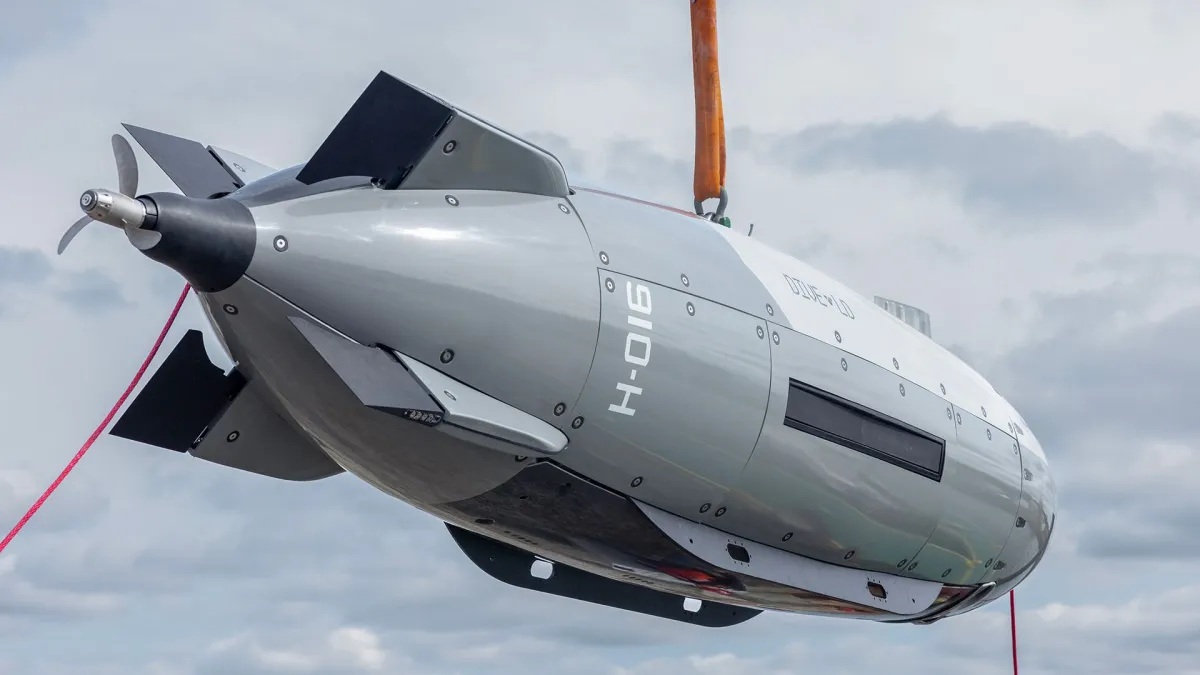


Alwaght- By capturing an American drone submarine near the Strait of Hormuz, Iran has entered one of the most critical layers of naval war with the US.
The Islamic Republic seems to have scored high in military and intelligence terms by this hunt, despite Washington's claims that the submarine system is old and malfunctioning. The War Zone website reported that seizing the system relatively intact gives Tehran a "considerable" privilege.
Hunting an advanced submarine system
The vessel described as an American unmanned submarine is a Dive-LD submersible built by the US company Anduril, an autonomous underwater vehicle roughly 5.8 meters long, weighing nearly 3 tons, and capable of operating at depths of about 6,000 meters. Depending on its configuration, the system can stay at sea for about 10 days and carries out much of its mission with a high degree of autonomy.
Crucially, the Dive-LD is no mere small reconnaissance sub. According to a report by The War Zone, it was designed for missions including intelligence gathering, surveillance and reconnaissance, preparing intelligence on the operating environment, mine warfare, and even the precise placement of equipment underwater.
Underwater eye of the US in the Strait of Hormuz
The stakes come into sharper focus when you consider that in recent months the US has deployed unmanned underwater systems for mine-clearing operations around the Strait of Hormuz. Using sonar, cameras and an array of sensors, these platforms can detect mines and log their positions, sparing American forces from having to venture directly into danger zones.
Seen in that light, the seizure of this submersible is hardly just the loss of a multi-million-dollar piece of hardware for Washington. A system like this can gather fine-grained intelligence on the seabed, shipping lanes, subsurface obstacles and the broader maritime environment.
American sources have also said that US forces route ships through corridors near the coast of Oman, making accurate, up-to-date maps of the seabed critical for moving large vessels safely. The submersible's mission, then, may well have extended beyond mine-hunting to include seabed mapping and subsurface reconnaissance.
The US important admission: The submarine suffered a failure
Washington, in response to Iran's announcement that it had captured valuable American maritime equipment, has sought to play down the operation's significance. An American official told The War Zone that the drone had suffered a technical failure more than a day before Iran's announcement and was surveying regional waters in support of US operations. The official also claimed the system was an older model and carried no sensitive intelligence or classified sonar and radar systems.
Anduril, for its part, has confirmed the loss of a vessel in the region and stressed that the system was designed from the outset to operate in high-risk environments, and even to be lost.
Yet those same American explanations raise a pointed question: if the system had genuinely been in the water for more than a day and its location was unknown to the US, how were Iranian forces able to find it and recover it nearly intact?
Some American sources also make clear that it remains unclear what effort the US made to recover the submarine drone, but its intact recovery suggests American forces at some point lost track of its position.
True value lies in data, not price
The value of such hunt should not be seen in the system itself. More important issue than its multi million dollars price is the data Iran can extract from its structure, sensors, communications, navigation system, and technical architecture.
American sources said that even if this system is not technologically secret and next-generation, it still is a modern and active system serving the US Navy, and getting information about its capabilities and limits is valuable to Iran and other rival countries. The source even raised the issue that Iran's international partners like Russia and China are likely to examine the submarine system.
Is is specially important to the US since the Americans are vastly developing submarine drones and the hunted drone submarine is part of this program. This system launch also played a role in developing bigger and more advanced generations of drone submarines by the US.
Strait of Hormuz, lab for subsurface warfare
From a military standpoint, Iran's latest successful operation carries a bigger message: the fight over Hormuz is not just a contest of missiles and ships. Beneath the surface, it has become an intelligence battleground of its own.
The US uses underwater vehicles for surveillance, mine-clearing, mapping and intelligence support, while Iran works to detect those systems and, where possible, seize them as spoils. Mastery of Hormuz's undersea environment, then, can matter to both sides as much as control of the water's surface.
Iran has seized American unmanned maritime equipment before, most notably in 2022, when Iranian forces briefly took two US unmanned vessels in the Red Sea. But the craft Iran has now captured represents a different order of technology in mission, operating depth and subsurface capability.
Intelligence win for Iran
Many experts have said that even if the US narrative about malfunction of the drone submarine is true, we cannot ignore the significance of the Iranian operation success. A modern drone system in an extremely sensitive region was captured by Iran and Tehran published images of it after the US lost its control.
At a time when Washington is leaning on unmanned technologies to keep human forces out of harm's way in surveillance and maritime missions, the seizure of this hardware shows that even systems built for high-risk environments can, once control is lost, become an intelligence windfall for the other side.
The real significance of capturing this submersible lies less in "sinking an American submarine" than in this: Iran has pulled a modern subsurface system out of American hands in the Hormuz operating theater, and gained the chance to study and a technology the US Navy uses in its operations.










