













Alwaght- These days nothing better than polls that have horrified the Likud party can display the fragility of the Israeli regime's political scene. What is happening in Netanyahu’s camp is not the casual, pre-election anxiety, but a real fear of losing the power and more dramatically, the real possibility that Religious Party Zionism, led by current Finance Minister Bezalel Smotrich, one of Netanyahu’s most hardline allies, may fail to cross the electoral threshold.
This prospect, rattling the Likud leadership, is not just a political humiliation, but a structural catastrophe that risks breakdown of all of the right-wing camp.
Each seat Smortrich and his backers lose is a precious one that, in close rivalry with the rival camp, can mean loss of power at the right-wing camp. Here, too, the supporters of the right-wing are counting on the art of Netanyahu to turn the tide all of the sudden in a sensitive moment. Netanyahu has started to mull options including re-allying with Smortrich, National Security Minister Itamar Ben-Gvir, or seeking more creative and challenging solutions.
Likud infighting
The "party court" of Likud is expected to issue its rulings on the contentious issues shaping the party's primary elections. This is not a formal judicial body but an internal committee of retired judges and senior lawyers who are party members. Its role is to adjudicate disputes over the interpretation of Likud's constitution. Its decisions are binding on all party members and can only be appealed to the regime's Supreme Court in rare instances.
So what are the fault lines within Likud? Four critical issues hang in the balance:
First, the voting mechanism: Will all 150,000 party members be eligible to vote, or will the right be restricted to the roughly 4,000 members of Likud's Central Committee? This is no mere technical disagreement; it is a struggle for the party's soul. Netanyahu favors broadening the electorate, while his rivals seek to narrow it to amplify their own relative influence.
Second, the timing of the primaries: Should they be held early, before the Knesset is formally dissolved, or postponed until two or three weeks before the general election? The calendar will largely determine candidates' ability to organize their campaigns, and Netanyahu's chances of cutting deals with prominent figures outside the direct contest.
Third, the number of reserved slots, or shiryonim: Guaranteed positions on the party list that the leader can award to specific individuals without a primary vote. The burning question: How many such seats is Netanyahu entitled to offer?
In this regard, the party court has already ruled, accepting Netanyahu's appeal of an initial decision by a razor-thin margin of just two votes. In this crucial electoral battle, Netanyahu got his way. According to Yedioth Ahronoth, he secured party approval for eight reserved slots, at a time when current polls give Likud only about 23 seats overall. That leaves roughly just 16 seats for the rest of the party's candidates to fight over.
This means that least half of Likud's current Knesset members will have to compete anew in the upcoming primaries.
Fourth, the mechanism for final list adjustment: After the primaries conclude and each candidate has a vote tally, will seats be allocated strictly by the numbers, or does the party leader retain the authority to reshuffle the list according to his political calculus?
These four issues will not be settled by an internal vote. The divisions run too deep. Instead, the party court will decide, weighing petitions from various factions. Whatever rulings emerge will serve as the "rules of the game" governing the battle for real seats on the list.
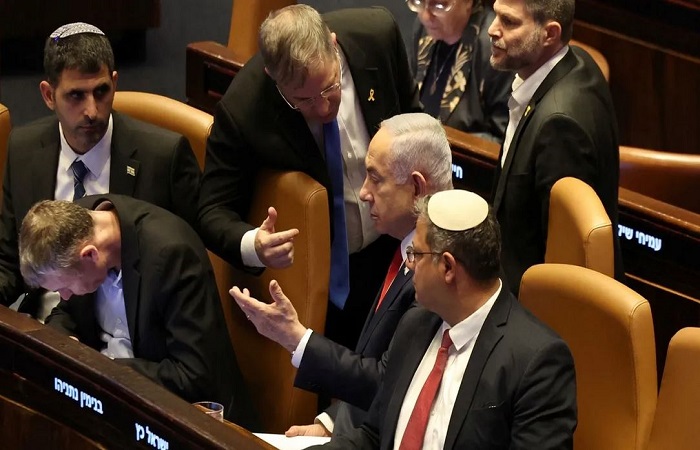
Notably, Netanyahu is not waiting around for the court's decisions. Behind the scenes, he is working to strike understandings with power centers inside the party; figures like David Bitan, the Knesset Economics Committee chairman, known as a dissenting voice in Likud and unafraid to criticize government policy, and Haim Katz, the housing minister, a longtime Netanyahu loyalist with deep party connections.
In Netanyahu's inner circle, the name Deddi Shmachi, a former security official and Netanyahu confidant, has surfaced as a potential recipient of a guaranteed slot. That means sitting Knesset members would either be entirely sidelined or at least lose the realistic seats that would ensure their continued presence in the next parliament.
This difficult equation has generated what Israeli observers describe as "enormous pressure" inside Likud. Notably, some embattled Knesset members have quietly begun exploring alternatives, with some even reaching out to supporters of Itamar Ben-Gvir to explore merging with the "Jewish Power" list.
Netanyahu's decisions, which have landed like a grenade in a crowded room, have been dubbed by the media as a dark comedy: Likud lawmakers seeking refuge in a party that until very recently was considered too hardline even by Israeli right-wing standards.
Netanyahu trial between judiciary and politics
While Netanyahu was busy with internal arrangements and organizing a coalition for elections on the right-wing front, he was also busy with another fight that is as much serious: Court.
Since 2020, the Israeli prime minister has faced charges of bribery, fraud, and breach of trust across three separate cases, since consolidated by judicial authorities into a single indictment.
Case 1000, which Netanyahu sarcastically dubs the "cigars and champagne affair," involves the receipt of lavish gifts worth hundreds of thousands of shekels from foreign businessmen, including billionaire Arnon Milchan, in exchange for political favors and special treatment. Case 2000 centers on his conversations with Arnon Mozes, publisher of Yedioth Ahronoth, in which Netanyahu is suspected of trying to cut an illegal deal: favorable media coverage in return for legislation aimed at weakening a rival newspaper, Israel Hayom. Then there is Case 4000, the most serious and complex, which accuses Netanyahu of bribery during his tenure as communications minister. He allegedly abused his government position to issue regulatory decisions worth hundreds of millions of shekels to the telecom giant Bezeq, in exchange for positive coverage on the Walla news site, owned by Bezeq shareholder Shaul Elovitch.
But Netanyahu refuses to play the role of defendant. Instead of submitting to interrogation in the courtroom, he has consistently tried to flip the script, casting himself as a politician fighting for democracy and press freedom. In his testimony, he speaks not of bribes or illicit deals, but of "pointless conversations" with a "powerful political rival."
According to analyses in Israeli papers like Israel Hayom and Yedioth Ahronoth, Netanyahu is pursuing a deliberate strategy of turning the courtroom into a thoroughly political arena. He uses open hearings to burnish his "political witch hunt" narrative, a label he has embraced, ignoring prosecutors' questions to speak directly to the cameras and his supporters. The latest manifestation of this approach was his surprise request for a presidential pardon at the end of 2025, arguing that "continuing the trial is tearing us apart from within."
This narrative is amplified relentlessly by his television mouthpiece, Channel 14, which Israeli newspapers have dubbed a "poison machine." The channel does not simply cover the trial, but it promotes a sprawling conspiracy theory linking law enforcement, the judiciary, and mainstream media as part of a "deep state" determined to unseat democratically elected Netanyahu. In this telling, Netanyahu emerges not as a defendant in corruption cases, but as a victim of elites desperate to silence him, transforming the trial from a legal proceeding into a raw political showdown between a corrupt establishment and the will of the people.
Netanyahu's rivals for filling the PM post
On the other side of the political spectrum, Avigdor Lieberman, a towering opposition figure and head of the Yisrael Beiteinu party, has positioned himself as a brash, outspoken alternative for prime minister. His recent remarks leave no room for misinterpretation: "I want to be prime minister," and "even if the world turns upside down, I will not sit with Netanyahu." This is not mere election campaign rhetoric; it is a calibrated reading of the current political dynamics within the right-wing camp.
Lieberman has laid down clear conditions for any future coalition, the most significant being a full military conscription law that would compel ultra-Orthodox Haredi men to serve in the army. This demand, as everyone knows, is a ticking time bomb in any future coalition, it touches one of the most sensitive red lines in Israeli domestic politics.
On the possibility of working with Gadi Eizenkot, a former army chief of staff and a candidate for prime minister in the 2026 elections, Lieberman insists that "fundamental gaps" remain between their views, particularly on the conscription law. Yet he leaves the door open to any alliance that serves his dual purpose: "toppling the evil Netanyahu government and becoming prime minister himself."
In contrast, Naftali Bennett, the former prime minister, is playing a more cautious game. Lieberman described him as a "serious and responsible partner" who "puts the country above himself", a characterization that reflects a clear strategy: keep the coalition option open without rushing into anything. Bennett knows his reputation has taken hits, but he also knows that no alternative government will be formed without him, Lieberman, or both.
So Netanyahu finds himself fighting on three fronts at once:
1. The legal front; one that could send him to prison.
2. The political front; one that could keep him from power.
3. The personal survival front; one that drives him toward maneuvers that may only deepen his troubles.
Future scenarios
First scenario: Right continues ruling underunder Netanyahu
Despite the fractures in the right-wing coalition and polls suggesting that Netanyahu's bloc is struggling to reach the 61-seat majority, many observers caution against writing him off. He remains the most dominant figure on Israel's political stage, and his tactical agility in political gamesmanship is undiminished. Yet any such scenario hinges on one precarious variable: Religious Zionism Party crossing the electoral threshold after months of polling perilously close to oblivion. To pull that off, Netanyahu will likely have to broker a reunion between Smotrich and Ben-Gvir even though Ben Gvir himself has rejected the merger. And if he succeeds, the price will be steep: significant concessions to his hardline partners on issues like settlement expansion and weakening the reach of secular law over the Haredi population.
Second scenario: government of change led by Lieberman-Bennet coalition
This scenario rests on formation of a bloc of opposition parties including Yisrael Beiteinu, Yashar, and Together. Polls suggest that such a coalition bears the potentials to win the majority.
Third scenario: Collapse and political stalemate
Given Israel's fractured political landscape and deep social rifts, many analysts see gridlock and repeat elections as the most likely outcome. In this scenario, neither Netanyahu's bloc nor the change camp secures a 61-seat majority, and the Arab parties cannot serve as kingmakers, as both camps have explicitly ruled out relying on their support. Analysts warn that three or even more elections within a single year would expose a structural weakness in the Israeli system. A paralyzed government, consumed by its own unresolved internal disputes, would be far less capable of making big decisions, whether launching new wars or pursuing controversial annexation and large-scale settlement expansion.
Taken together, what is unfolding on Israel's political stage today is more than just an election. It is a structural realignment, one that signals the unraveling of the traditional right-wing model of governance that has dominated the political scene for a full decade. The right, once built on the triad of "security—settlement—strong leadership," now finds itself caught between the ambitions of its rising leaders, the fear of its base fracturing, and Netanyahu's personal terror of prison and the loss of immunity.