

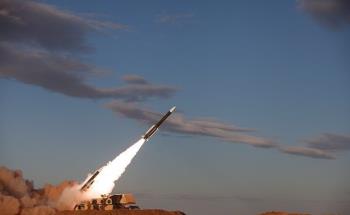













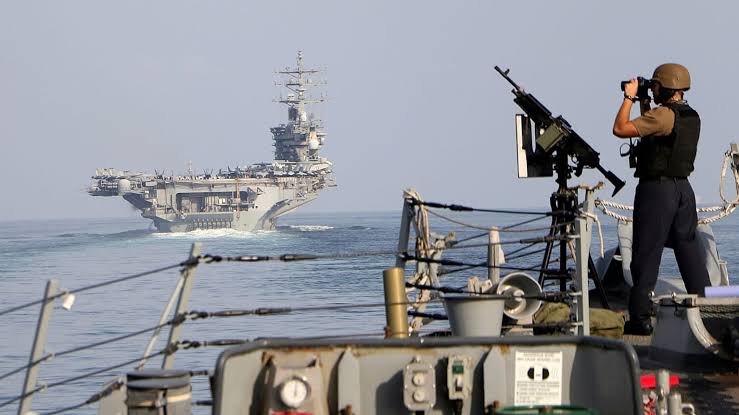


Alwaght- Iran's New attacks on the American naval vessels around the Strait of Hormuz in recent days should not be read merely as an action to destroy the enemy equipment. Rather, the true significance of these attacks lies in the fact that Tehran has managed to force a change to the formation of the American forces and push the blockade line away from its operational area.
In naval warfare, distance is not just a geographical fact, it is a component of combat power. The farther an aircraft carrier and its escort fleet operate from their area of interest, the longer their response times, the more complex their air cover becomes, the greater their refueling demands, and the steeper the cost of sustaining a continuous presence. So if Iranian pressure forces US carriers to pull back from the waters closer to the Strait of Hormuz in order to protect themselves, Tehran will have achieved a significant operational objective, even without sinking a single vessel.
Seen this way, Iran’s graduated strikes should not necessarily be read as an attempt to sink American warships. Rather, they are an effort to force them shift position and push the forward line of contact backward. The logic of such a strategy is straightforward: first generate a threat, then raise the risk of operating in the area, next compel the fleet to alter its formation, and ultimately widen the distance between American forces and the very zone Washington wants to choke off.
If reports of the USS George H.W. Bush shifting position after the recent attacks prove accurate, that is precisely where the significance lies. The value of such a move is not in the carrier’s withdrawal per se, but in what it signals; that the maritime blockade line may have been forced to step back a pace.
And this distinction matters greatly. In an asymmetric confrontation, the weaker side is not necessarily aiming to destroy the other’s main vessels. Sometimes the objective is to reshape the geometry of the battlefield. If an American carrier has to pull out of range to reduce its risk, the distance between that carrier and the operational theater grows. US assets remain in place, but projecting that power now comes at a higher price.
In such a scenario, Iran is in effect trying to expand the high-risk zone outward, shrinking the area where US ships can operate freely and increasing their safe standoff distance from the Strait of Hormuz. The greater that distance, the more aircraft, tankers, surveillance systems, escort destroyers, and support equipment the US will need to sustain the same level of pressure.
To put it simply, the Iranian aim can be forcing the naval vessels away not necessarily destroying them.
And here is the broader strategic weight of this dynamic. With US failure to force Iran's submission in a 40-day war, the core logic of the conflict has shifted to a contest of endurance. Washington is trying to strangle Iran's main economic arteries through a tightening naval blockade, hoping to trigger internal collapse. Tehran, in turn, is focused on evading sanctions and the blockade while grinding out a war of attrition through economic resilience. So if US warships are gradually pushed farther back without suffering catastrophic damage, Washington faces a harder question: how does it sustain that same blockade from a greater distance without escalating into a larger war?
In effect, Iran can focus not on directly destroying US power, but on constraining its freedom of maneuver.
This is where the logic of graduated pressure comes into its own. A single strike may not yield a decisive result. But if repeated attacks consistently force US commanders to readjust their defensive posture, pushing warships farther out, stretching supply lines longer, the cumulative effect can matter far more than the outcome of any one engagement.
Seen from this lens, the main battleground is no longer over the warships themselves, but the distance between them and the strait.
The crucial point is that every meter or kilometer, that the US fleet is forced to pull back may not break the blockade outright, but if this trend continues, it will steadily erode the blockade’s effectiveness. America may still retain its strike capability, but it will have to project that same pressure from a greater distance.
Iran, by contrast, enjoys a geographical advantage in the waters close to its shores and the Strait. The farther US forces are pushed out, the more that relative advantage grows, because Iran can leverage its land-based depth, coastal defense systems, surveillance networks, missiles, and drones to raise the cost of any American attempt to move back in.
That is why, if Tehran’s goal is to break the blockade, it does not have to destroy it all at once. It only has to push it back, step by step.
In this scenario, the blockade line, initially positioned at close range, must gradually relocate to a more distant perimeter. But to compensate for that added distance, America will have to introduce more long-range aircraft and systems into the equation. It can redesign its formation, bring in additional carriers, deploy longer-range air assets, or shift more operations to land-based facilities. Yet all of this drives up cost and operational complexity.
From here on, the main battle will be over which side can lock in the geometry of the battlefield to its own advantage.
If Washington can keep its warships at a greater distance while still maintaining effective pressure, the blockade holds. But if Iran, through steadily escalating pressure, can push the safe standoff distance even farther out, the blockade will gradually morph from a close-in, high-leverage operation into a distant, costly, and complicated one.
In that case, even without sinking a single vessel, a major shift will have occurred: the US can no longer apply the same level of pressure with its original formation.
Which is why Iran’s success should not be measured solely by the number of missiles fired or the damage inflicted on US warships. The more telling indicator is this: after each round of attacks, have the American warships been forced to increase their distance?
If the answer is yes, then Iran’s strategy can be said to be carving out an operational buffer zone around the Strait of Hormuz, a zone where US entry and sustained presence come with rising, prohibitive risk.
Finally, this battle is more about pushing the American naval vessels back and less about sinking them.
In such a context, each retreat of the warships marks a tactical success for Iran, and if the retreats are turned into a constant process, then a combination of tactical successes can force a strategic alteration in the US blockade geometry.










