















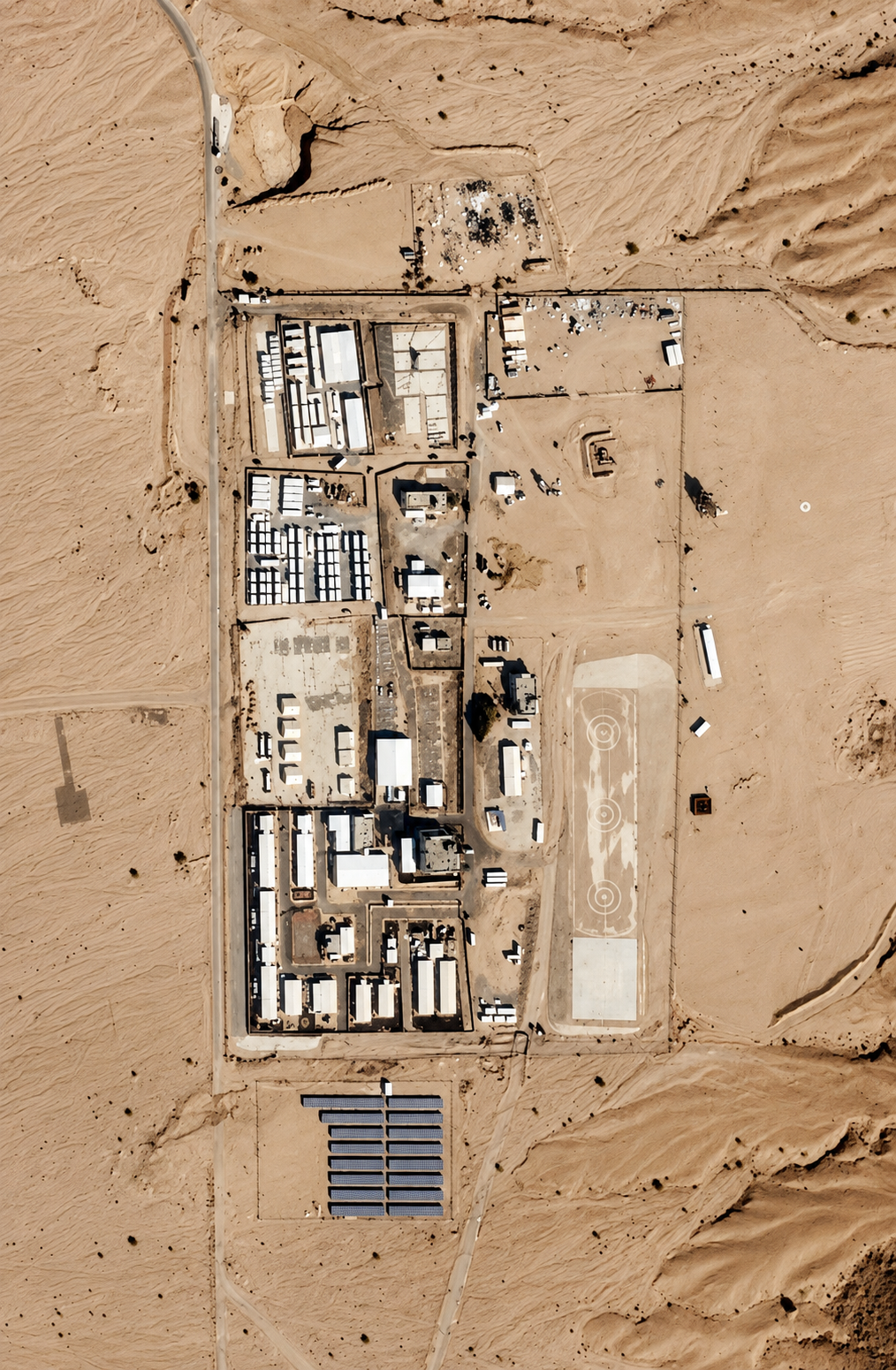


Alwaght- Iran's missile strike on US's Camp Titin in Jordan should not be analysed within framework of a limited retaliatory operation.
The main significance of this attack lies in the shift of the geography of the conflict, namely the expansion of the clash theater from the traditional regions of the Persian Gulf and the Eastern Mediterranean to a point near the borders of the Israeli regime and one of the most important chains of the US military logistics in the region.
According to the reports, the attack came in reaction to recent American attacks against Iranian positions, showing that Tehran is poised to transfer the costs of military confrontation from Iranian territory to the network of the US deployment and facilities across the region.
Breaking the geographical taboo
Camp Titin's significance lies more in its position in the US security architecture than the scale of physical damage to it.
This attack signals that if the war expands, the US operational depth will no longer necessarily be confined to its Persian Gulf bases. Jordan, Iraq, Kuwait, Bahrain, any country hosting US troops or infrastructure, could become part of the battlefield.
Titin is positioned at a sensitive juncture, close to the borders of occupied Palestine and Saudi Arabia. That is precisely why Iran's choice of this target carries a strategic message: If Iran's own depths are struck, Tehran's response can materialize far beyond the main theater of war, right on the doorstep of the US's key allies and the Israeli regime.
From crisis management to transferring the cost of war
One of the key features of this development is the shift of the logic of deterrence.
Under the old US playbook, Washington could strike anywhere in the region while keeping the direct costs largely contained to that specific battlefield. Iran is now trying to blow up that calculus.
Any strike on Iran can now exact a price across US regional network.
This is what might be called cost transference, which means Tehran's attempt to shift the cost of a US military decision from a single pinpoint inside Iran to a sprawling web of American bases and infrastructure across the entire region.
In that light, the strike on Titin was not just an attack on one facility. It was an effort to recalibrate the cost-benefit equation inside Washington's decision rooms.
Along those same lines, over the past few weeks, independent reports in US media have exposed the Pentagon's stonewalling on the true extent of damage to its regional bases, and the cascading breakdown of the US military logistics chain in the Persian Gulf has triggered a firestorm of criticism against the White House's hawkish Iran policy and its official narrative on the campaign's progress and outcomes.
For example, Military Times acknowledged the extensive damage to the American naval support facility in Bahrain and called Washington's failure to protect its Fifth Fleet headquarters from Iranian strikes "stunning." Separately, NBC News reported that US intelligence and surveillance infrastructure across the Middle East has sustained billions of dollars in damage as a result of Iranian missile and drone strikes.
Why is Jordan especially important?
Geographically, Jordan is not a country separate from this crisis.
The country seats at a linkage point of a number of sensitive regions: Israeli regime, West Bank, Syria, Iraq, Saudi Arabia, and Gulf of Aqaba.
That is why the US military presence in Jordan is part of a broader network that facilitates logistical support, training, intelligence gathering, mobility of forces, and rapid reaction.
In this new reality, Jordan's transformation from a "supportive depth " into "vulnerable depth" carries major implications for US operational planning.
If American commanders are now forced to factor in the risk of missile strikes on Jordanian facilities as well, the complexity of the war escalates significantly.
From indirect to direct confrontation
Another shift is the change in the level of activism.
In recent years, the lion's share of military pressure on US interests in the region came through non-state actors or Iran's regional allies. But this time, Tehran is openly claiming responsibility for the missile strikes.
That changes the nature of the crisis entirely.
This is no longer simply a war between America and a constellation of regional players. What's taking shape is a direct confrontation between two states with strategic military capabilities, and the battlefield now spans multiple countries.
In that framework, the decision to strike Titin as a military target mattered more than the damage done to the base itself.
In modern warfare, the value of a strike is not always measured by physical destruction.
Sometimes an operation with limited material damage can generate a far larger strategic effect, if it forces the other side to rethink its force posture, deployment patterns, alert levels, and security calculations.
If, after this strike, the US is compelled to tighten protection around its Jordanian bases, reposition troops and equipment, activate additional air-defense systems, or scale back its air and logistics operations, then even without inflicting major damage on Camp Titin, the operation will have achieved a significant operational impact.
Bond of Titin strike with Persian Gulf war
The more important issue is the coincidence of the attack with the escalation of clashes in the Persian Gulf.
In such a context, the geography of war is transforming to an interwoven network.
In the eyes of Iran, the US base in Jordan, Iraq, Persian Gulf, and the naval presence in the region are components of a unified military architecture, and so reaction in one point can draw responses in another point. This is what has turned the war from limited series of operations to a multilayered regional equation.
Most important message for Washington
Based on everything laid out here, the core message of the Titin strike is not necessarily that Iran can destroy every US base, but it is that Iran can force the cost of American operations across its entire military footprint.
That matters enormously to Washington, because US military power in West Asia rests on a sprawling network of bases, airfields, command centers, logistics hubs, and regional allies. The more vulnerable nodes there are, the higher the price tag for protecting them.
Jordan, meanwhile, faces a difficult equation of its own.
The missile strike on Titin was not just a message for the US. It was a strategic warning for the Jordanian government as well.
Amman is caught in a contradiction:
On one hand, security cooperation with the US remains vital to Jordan's defense and security architecture. On the other, the more entrenched American military presence becomes on Jordanian soil, the greater the risk that Jordan itself gets drawn into the war.
That is why a prolonged conflict could intensify pressure on Amman to recalibrate the scope of its military partnership with Washington.
Finally, it should be said that Titin is not about a single base. The significance of the strike should not be measured by missile counts or damage to base infrastructure.
The real issue is the shifting geometry of the war.
In the past, Washington could operate on the assumption that the battlefield could be largely cordoned off from the strategic depth of its allies and its own infrastructure. But the expansion of strikes across multiple points in the region now calls that premise into question.
If this trend continues, the region will cease to be a collection of separate fronts and become a single, contiguous operational theater, one where geographic distance no longer guarantees the safety of US bases.
Seen through that lens, Titin strike could mark a turning point in the logic of military calculation and it is that the war is being transferred from the front lines to the depths of the US military network.
And that is precisely where the deterrence equation enters a new phase.
The question is no longer just where the US can strike Iran. The new question is that which part of the American regional network Iran will bring into the fight in response.










