
















Alwaght- While the world public opinion and rights organizations call for the world to stop arming the Israeli war machine amid its increasing crimes in Gaza and other parts of West Asia, reports suggest that some countries are turning a deaf ear to this demand by boosting Tel Aviv’s military strength.
For decades, the US and European allies of the Israeli regime have been the main arms providers of Tel Aviv, but in recent years new players have come on board.
Meanwhile, India as a new partner to Israeli regime has upped its military and industrial cooperation with Tel Aviv to unprecedented levels, gradually departing from an arms buyer to one of the active partners in production and provision of arms and ammunition to this regime.
In this regard, Amnesty International said in a report on Thursday that despite awareness that its arms are used in Gaza attacks, India still provides ammunition, spare parts, and arms to Israeli regime.
The organization said that continued issuing of licenses for arms exports to Israel expose India to the risk of complicity in war crimes against humanity and genocide in Gaza, calling New Delhi to immediately halt all direct and indirect military exports to this regime.
Strategic military partnership
India’s military ties with Israeli regime entered a new phase in the 1990s, but over the past two decades, defense cooperation has become a cornerstone of their bilateral relationship. New Delhi, long the world’s largest arms importer, has turned to Tel Aviv as one of its most vital defense partners, drawn by rapid access to advanced military technology, drones, missile defense systems, and intelligence gear.
According to data from the Stockholm International Peace Research Institute (SIPRI), India has been Israel’s biggest defense customer in recent years, accounting for roughly one-third of its arms exports.
Military contracts between the two countries since the early 2000s have reached tens of billions of dollars. Between 2020 and 2024 alone, they signed more than $20 billion in defense agreements, representing about 34 percent of Israel’s total weapons exports. This period has seen cooperation move well beyond off-the-shelf purchases, shifting toward joint production and technology transfer, a trend that has only deepened Tel Aviv’s role in New Delhi’s military strategy.
Israeli firms such as Rafael, Elbit Systems, and Israel Aerospace Industries have also launched extensive partnerships with India’s defense industry.
According to data shared on Reddit, a key pillar of their military cooperation has been Rafael’s Spike anti-tank missiles. India has signed multiple deals in recent years to buy and produce these missiles, with some manufacturing now taking place domestically. The expanding collaboration on guided missiles has gradually integrated India’s defense industry into Israeli supply chains, a development that analysts say transcends the traditional seller-buyer dynamic.
Another face of this partnership is the joint venture of Barak 8 air defense system, developed jointly by Israel Aerospace Industries and Indian Defense Research and Development Organization. Used by the Indian navy, air force, and army, this system is worth billions of dollars and is recognized as the joint military project of the two sides. Cooperation in this project is not limited to purchase of equipment, but involves technology transfer and joint production.
Prime Minister Narendra Modi unveiled a sweeping national plan on India’s Independence Day, August 15, 2025, called “Mission Sudarshan Chakra”, a multi-layered air defense, ballistic missile shield, and offensive air capabilities program aimed at full operational readiness by 2035.
Billed under the motto “Shield and Sword,” the initiative has quickly become the driving force behind a fresh wave of Indian-Israeli arms deals. The project draws directly on Israel’s layered defense architecture, Iron Dome, David’s Sling, and the Arrow system, but with a distinctly Indian twist: some components will be developed by domestic industries, others purchased from Tel Aviv, and a significant portion produced jointly.
Drone cooperation
Drone technology has become one of the key pillars of their military relations. Currently, India is one of the biggest buyers of Israeli drones in the world, using Heron, Searcher, and Harop drones.
According to SIPRI, over the past two decades, Israel has been one of the leading providers of drone technology to India, and a considerable part of Indian military's reconnaissance and surveillance capabilities now rely on Israeli-made equipment. Elbit Systems has begun producing Hermes 900-family drones in India through its joint venture, Adani-Elbit Advanced Systems India.
Israel Aerospace Industries (IAI), meanwhile, is working with Indian firms to upgrade Heron drones and develop next-generation unmanned systems. Reuters has reported that during India’s May 2025 conflict with Pakistan, New Delhi deployed Harop loitering munitions to strike military targets and suppress Pakistani air-defense systems.
Gaza war and surge of New Delhi-Tel Aviv military cooperation
When the Gaza war erupted in October 2023, expectations ran high that global outcry and legal pressure would force a rethink of military ties with Tel Aviv. The opposite happened, however.
Amnesty International documented at least 2,596 military shipments from India to Israel between October 7, 2023 and November 2025. The consignments included over 390,000 small arms parts, nearly 565,000 explosive ordnance components, including 155mm artillery shells, warheads for loitering munitions, and components for armored vehicles, delivered to major Israeli defense contractors like Elbit Systems, Rafael, and Israel Aerospace Industries.
Amnesty warned that, given the International Court of Justice's provisional ruling recognizing a plausible risk of genocide in Gaza, India risks complicity in serious violations of international law.
Reports indicate New Delhi and Tel Aviv have negotiated billions in new contracts for 2025–2026, including a roughly $3.7 billion package for missile defense systems. On November 4, 2025, the two countries signed a defense cooperation memorandum of understanding during the 17th Joint Working Group meeting in Tel Aviv, covering R&D, industrial collaboration, and equipment procurement.
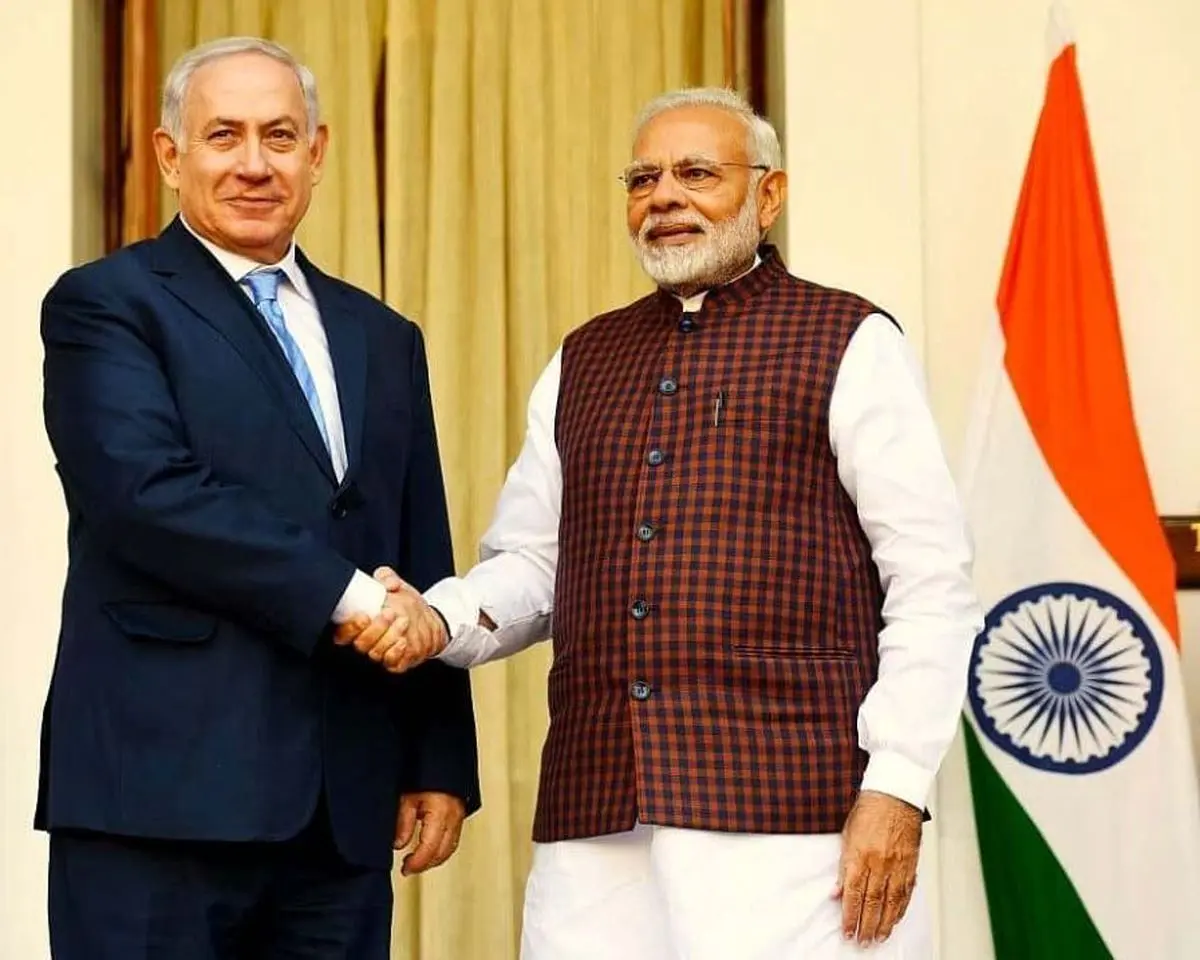
This agreement paves the way for upgrading their relations to "special strategic partnership" during Moodi's visit to Tel Aviv in February this year. In the common statement of Netanyahu and Moodi, a road map for joint development of advanced military technologies was drawn, departing from merely export contracts.
Reports have also emerged of a potential new agreement valued between $8 billion and $10 billion. If finalized, it would mark a turning point: India would no longer be merely a customer but a technology partner in Israel's military industries.
What makes this shift particularly significant is the changing nature of the defense relationship itself. Where India was once largely an importer of Israeli weapons, it is now integrating into the supply chain of Israel's arms industry. That gives Tel Aviv a way to cut production costs while sourcing part of its wartime needs from Indian industrial capacity.
Taken together, the deepening defense partnership between New Delhi and Tel Aviv, even as international pressure mounts on Benjamin Netanyahu's government, suggests that strategic and security calculations continue to override human rights criticisms. And continuation of this relationship not only cements their military partnership but also bolsters Israeli regime’s capacity to sustain conflict across the region.










