















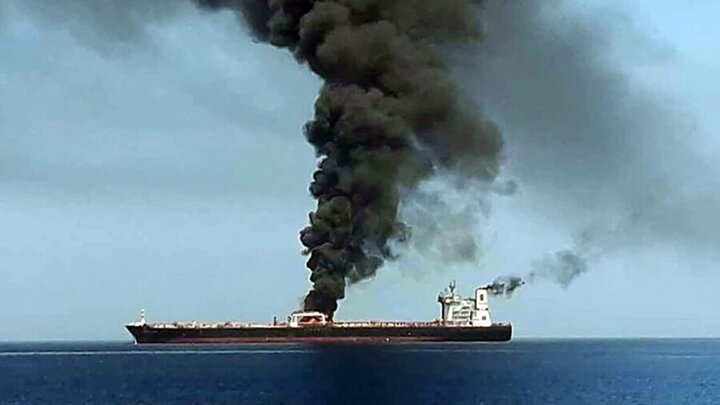


Alwaght- The attack on an Iranian commercial cargo vessel in the Caspian Sea on Saturday could mark the opening of a new chapter in the broadening conflict between Iran and the US-Israeli coalition and the emerging coalitions forming around it.
Just as the strategic Bab-el-Mandeb Strait was injected into the war calculus in recent days, following the Yemeni Ansarullah movement's declaration of a naval blockade against Saudi ports, the activation of the Caspian Sea front against Iranian maritime trade appears to be a US-directed maneuver executed by Ukraine.
On Saturday, President Volodymyr Zelensky took responsibility for the strike in a post on X, stating that Kiev had achieved "very significant results" with long-range attacks in the Caspian, "including against ships used to transport military cargo linked to Iran."
That unsubstantiated claim clashes with reports from Iran's ISNA news agency, which quoted the governor of Gilan province as saying the vessel was carrying an iron shipment en route from the port of Astrakhan to Anzali, a route that for years had served as a secure and reliable corridor for trade between the two ports.
After months of stalemate and diplomatic mediation efforts pushed by the White House, the Russia-Ukraine war has reignited in recent weeks, with both sides now targeting economic infrastructure, particularly ports and maritime commerce.
That phase of the conflict began when Ukraine first struck Russian commercial ships and associated maritime transport infrastructure. Using unmanned attack systems, Kiev launched operations aimed at crippling Russia's ability to use its sea lanes. The next escalation extended those strikes to vessels sailing under neutral flags in the Black Sea, a signal that the risks of navigation were no longer confined to Russian-flagged ships.
But Zelensky’s own words aside, the strike on the Iranian commercial vessel was almost certainly carried out with full awareness of its consequences, and well beyond the narrow scope of economic blows against Moscow. One of its primary aims was plainly to hit Iran's maritime trade in the Caspian, a waterway that has taken on growing strategic importance for Tehran as the US tightens a naval blockade in the Persian Gulf, offering Iran a critical breathing space.
Caspian Sea's significance in Iran and Russia trade
The strike on the commercial vessel at the outer anchorage of the Volga River was never just about sinking a cargo ship. It was a direct assault on one of the region's most secure trade corridors, a route that, over the years, had become the main economic artery between Iran and Russia precisely because it sat far from the region's security flashpoints. If this lane, too, gets dragged into the cycle of insecurity, then effectively the last relatively safe passage for Iran's maritime trade will be under threat.
The stakes come into sharper focus when you consider the Caspian's role in the International North-South Transport Corridor.
This corridor, linking India, Iran, Russia, and Central Asia, has in recent years become the most consequential geopolitical project for bypassing Western-controlled shipping routes and reducing reliance on the Suez Canal. Its maritime leg begins at the Russian ports of Astrakhan, Makhachkala, and Olya, then connects through Iran's Anzali, Amirabad, and Caspian ports to the country's rail and road network, a system that ultimately gives Russia access to the open waters of the Indian Ocean.
Against this backdrop, even amid war and intensifying Western sanctions, Tehran and Moscow have seen their economic ties surge.
Bilateral trade crossed the $5 billion mark in 2025, and the two sides have inked agreements targeting $10 billion in annual exchanges, expanding trade in national currencies, linking alternative banking networks to bypass SWIFT, scaling up barter arrangements, and co-investing in transport and energy.
What this trajectory makes clear is that the Caspian is no longer merely a shipping lane. It has become a pillar of the Iran-Russia strategic economic infrastructure, designed to blunt the impact of Western sanctions and build an independent financial and commercial system. That is why any bid to destabilize this route amounts to far more than a limited military act; it is an attempt to disrupt one of the region's most vital anti-sanction geopolitical projects.
Ukraine's play in the US-designed plot
Zelensky's formal assumption of responsibility for the strike pushes this incident well beyond the narrow confines of the Russia-Ukraine war. If the sole objective were to inflict damage on Moscow, targeting an Iranian commercial vessel plying its routine route between Astrakhan and Anzali would make little strategic sense. That very fact bolsters the case that Kiev is playing a role that extends far beyond the Eastern European battlefield, one closely calibrated to align with Washington's broader strategy toward Tehran.
In recent months, Washington has apparently concluded that neither economic sanctions, nor maximum pressure, nor even a naval blockade in the Persian Gulf has succeeded in fully crippling Iran's foreign trade. Thanks to its extensive land borders with neighbors and the activation of northern routes through the Caspian Sea, Tehran has managed to neutralize a significant portion of the economic stranglehold. Under these circumstances, it is only natural that the pressure would shift to these alternative corridors, particularly given that in recent weeks, some port infrastructure and rail lines linked to Iran-Russia trade have also come under attack.
Ukraine, for its part, has its own incentives for falling in line with such a strategy. After a turbulent stretch in its relationship with the White House, the Zelensky government is eager to cement its standing as a reliable US security partner, ensuring that the flow of Western military and financial aid continues. At the same time, expanding the theater of tensions to areas well beyond Ukraine's battlefields could complicate Russia's calculations and disrupt any ceasefire or imposed settlement that Kiev fears.
Zelensky's concurrent remarks following the strike, in which he accused Moscow of sharing satellite imagery with Tehran, fit squarely into this framework. He claimed that Russia had photographed US military bases in Bahrain, Jordan, and Kuwait, and passed that intelligence to Iran. No independent evidence has surfaced to back that assertion, but it reads as a transparent bid to tether the Ukraine war to West Asian conflicts and project the image that Kiev's actions are, in fact, part of a broader defense of Western security interests in the region.
Ukraine seizing the opportunity to move closer to Arab monarchies
As regional tensions have escalated, Kiev has sought to leverage the Persian Gulf Arab states' anxieties over potential Iranian retaliation as an opening to deepen its political and security ties. With a significant portion of Western air-defense systems already tied up in the Ukraine war, Ukraine is now trying to turn its years of combat experience against drones and missiles into a strategic export commodity.
In this relation, reports have emerged of Ukrainian cooperation with several (Persian) Gulf Cooperation Council countries, including technology for drone interception, deployment of electronic-warfare specialists, and air-defense consulting for nations such as Qatar, the UAE, Saudi Arabia, and Kuwait. Beyond the economic returns, these partnerships carry clear political dividends for Kiev. Actually, they could bolster support from wealthy Arab states in international forums and potentially unlock investment for Ukraine's postwar reconstruction.
Seen through this lens, the strike on the Iranian vessel also reads as a political signal from Ukraine to the region's Arab players, a message that Kiev stands ready to play a more active role in their military and security cooperation. In practice, such a posture elevates Ukraine from a purely Eastern European actor into a component of a new Western security architecture in the region, one that seeks to extend the pressure fronts against Iran from the Red Sea and the Persian Gulf all the way to the Caspian.
Bab-el-Mandeb and Ukraine involvement in "eye-for-eye" equation
Iran's initial response to the incident followed familiar diplomatic protocols including summoning Ukraine's chargé d'affaires, issuing an official condemnation, Foreign Minister Abbas Araghchi's phone conversation with the EU's foreign policy chief, and a request for the US Security Council to react.
Yet the language of the foreign ministry's statements, along with the posture of Iranian military officials, makes clear that Tehran does not view this as a mere bilateral spat. It is seen as a hostile act with far-reaching security implications.
In recent months, Tehran's declared policy has rested on a strategy of "an eye for an eye", a doctrine repeatedly invoked during the recent war. On that basis, if attacks on Iranian commercial interests in the Caspian continue, Tehran's response is unlikely to remain confined to diplomatic protest.
Ukraine, for its part, has its own acute vulnerability: maritime trade and agricultural exports. Wheat, corn, sunflower oil, and soybeans account for more than $22.5 billion, roughly 56 percent of the country's total exports and nearly 17 percent of its GDP. A significant slice of that, about 40 percent, heads to markets in West Asia and North Africa, making the security of shipping lanes through the Red Sea, the Bab-el-Mandeb, and the Indian Ocean absolutely critical.
If Tehran officials conclude that Kiev has effectively entered into direct confrontation with Iranian interests, they could leverage their geopolitical assets and influence in the Red Sea and Bab-el-Mandeb equations to raise the costs of that approach for Ukraine.
Iran's principal policy thus far has been one of neutrality in the Russia-Ukraine war. Hostile acts by Kiev could certainly prompt a reassessment of that stance in Tehran.
Moreover, just as Iran recently warned Britain over its cooperation with US military operations, calling it an entry into the war, continued Ukrainian actions could be evaluated in the same framework, widening the scope of Iran's reciprocal responses. In such a scenario, the strike on a single commercial vessel may prove to be merely the opening act in drawing the Caspian Sea into a chain of retaliatory exchanges in a conflict that no longer is limited to any particular geography.










