













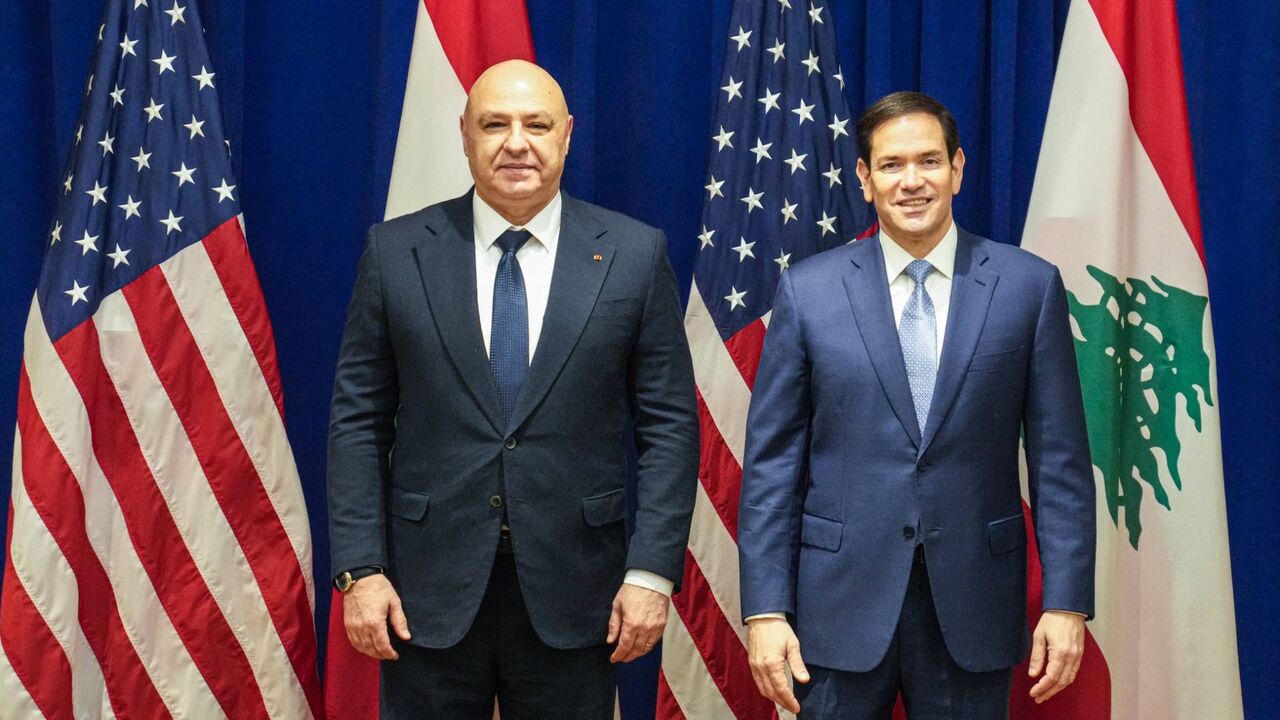


Alwaght- Lebanese President Joseph Aoun has visited Washington at the US President Donald Trump's invitation and is planned to meet him at the White House today, only a few weeks after signing the US-brokerded deal with Israel.
Office of the Lebanese president said that the trip's core aims are cementing the ceasefire deal, withdrawal of the Israeli forces from southern Lebanon, implementing the deal, and strengthening Lebanon’s sovereignty.
Before leaving for Washington, Aoun held multiple phone calls with Lebanese figures, chiefly Parliament Speaker Nabih Berri. During their conversation, Berri stressed that a full Israeli withdrawal from Lebanese soil is non-negotiable, and made clear it is a prerequisite for any subsequent political or security process.
Reuters, citing a senior Lebanese source, reported that Aoun will present US officials with a detailed written framework for disarming Hezbollah during his Washington visit.
This marks the first time in nine years that a senior Lebanese official has been formally received at the White House by a US president, the last being former Prime Minister Saad Hariri, who met with Trump in July 2017.
Yet the significance of this trip goes far beyond the stated agenda. Coming amid ongoing Israeli strikes on southern Lebanon, a deadlock in implementing the ceasefire agreement, and mounting US pressure to reshape Lebanon's security landscape, the meeting has become one of the most consequential political events in recent months.
Still, the history of Beirut-Washington relations shows that such high-level meetings have always taken place at critical security and political junctures, and have frequently come hand-in-hand with US efforts to redraw Lebanon's internal power dynamics.
Record of fruitless meetings at the White House
Over the past four decades, various Lebanese PMs and presidents from Amine Pierre Gemayel, Ilyas al-Harawi to Rafik Hariri, Fouad Siniora, and Michel Suleiman visited the White House and the common agenda of all these visits was a demand from Washington to play as a mediator to settle home crises. But gradually, these meeting showed that their practical outcomes were very limited and in many cases, field developments went against the promises.
A glaring example is the May 17, 1983 agreement. Gemayel, having excessive trust in the US mediation and in President Ronald Reagan's government to force Tel Aviv to act on its obligations, signed an agreement with Israeli regime.
Under that agreement, the Israeli occupation army was supposed to withdraw from Lebanon incrementally, with the Lebanese state taking over control of the south. But the outcome was the exact opposite: Israel not only failed to honor its commitments, it extended its occupation of southern Lebanon for years, and the deal effectively collapsed.
Today, striking parallels emerge between that accord and the recent one. Both envision a phased Israeli withdrawal in tandem with the Lebanese army's deployment in the south. Yet what's unfolding on the ground bears little resemblance to the text on paper. Israel continues its strikes, refuses to pull back, and uses security pretexts to entrench its military presence, behavior that makes clear Tel Aviv has no genuine intention of upholding its obligations.
Under these circumstances, Aoun's expectation that Washington can pressure Tel Aviv into withdrawing looks far from realistic.
The track record of US policy shows that whenever Lebanese interests have clashed with those of Israel, Washington has sided with its strategic ally. So it is highly unlikely that Aoun's meeting with Trump will produce any fundamental shift in Israel's conduct.
The US-Israeli trap of disarming Hezbollah
The central issue that will dominate the US-Israeli talks with the Lebanese delegation in Washington is advancing the plan to disarm Hezbollah. And unfortunately, the Aoun government has over recent months shown its commitment to that agenda through its hostile posture toward the resistance move that is a key factor to national defense—to the point where, by prioritizing factional and partisan interests over the national interest, it accepted in the so-called ceasefire agreement that the occupying army's withdrawal from the south would be conditional on Israeli confirmation of the Hezbollah's disarmament.
For Tel Aviv, eliminating Hezbollah's military capacity is a non-negotiable prerequisite for any new security arrangements along its northern border, a condition that has drawn fierce opposition from the resistance camp and a large segment of Lebanese society. Given this treacherous clause in the agreement, the Lebanese delegation's talks in Washington are all but certain to become a trap, one designed to shatter internal stability and exploit the Aoun-Trump meeting as a pretext for meddling, rather than a genuine dialogue.
A scenario to drag Syria's al-Jolani into southern Lebanon
Perhaps the most significant and perilous dimension of Aoun's Washington visit is the issue not officially discussed.
In recent weeks, Trump has claimed that Syria's interim government, led by Ahmad al-Sharaa, better known for his nom de guerre Abu Mohammed al-Jolani, will play a role in reining in Hezbollah. Meanwhile, An-Nahar newspaper reported that Trump, during his meeting with Aoun, will not only press for implementation of the ceasefire with Israel but also urge him to travel to Damascus for coordination with the Syrian government, and to declare Lebanon's readiness to join the Abraham Accords.
If these reports hold true, Aoun's trip is far more than a ceasefire file. It is part of a broader US project to redraw the region's security order, with weakening Hezbollah ranking as a primary objective.
In this framework, it would not be surprising if Washington tries to leverage Syria's new administration to pile more pressure on Hezbollah, tightening the political and security noose around the movement through coordinated moves between Beirut and Damascus, a scenario that, if realized, could simultaneously reshape the security dynamics along Lebanon's borders.
Though reports indicate that al-Jolani has informed Iraqi government he rejected requests to take action against Hezbollah, the possibility remains that political pressure or economic incentives from the Trump administration could push Damascus's rulers to reconsider their stance.
All of this suggests that Joseph Aoun's Washington visit is far more than ceremonial, but it is a big test for Lebanon's future. If the trip becomes a vehicle for pressuring Hezbollah and advancing US-Israeli security plots, it will not only fail to resolve the crisis in southern Lebanon, but also will set the stage for fresh turmoil. Experience of past four decades suggests that agreements not built on a genuine balance of power rarely endure.
Finally, what determines southern Lebanon’s fate is not a photo at the White House with Trump but the realities on the ground and the extent of commitment of the sides to their obligations. And as long as Tel Aviv pursues its occupational policies and tie any agreement to new conditions, it is unlikely diplomatic visits can restore sustainable security and stability to Lebanon.










