










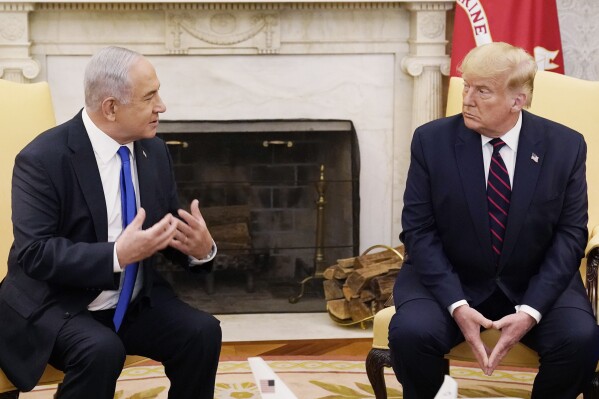


Alwaght- Having opened several cases in recent years and having made no considerable gains in each of them, the Israeli Prime Minister Benjamin Netanyahu has once again visited the US to seek a way out of the current security impasse.
To this end, Netanyahu and his staunch backer President Donald Trump have met on Monday in California. One of the key points raised in this meeting was the Lebanese developments and Tel Aviv’s central demand from Beirut under the deal, namely Hezbollah disarming. Though no details have been leaked to the media of the bilateral, Trump in a joint press conference made claims against Hezbollah, saying: " We will see what results the Lebanese government's efforts to disarm this group will yield."
This meeting was held while over the past year, Washington has made several proposals to the Lebanese government to pave the way for a ceasefire between the two sides. In all of initiatives, Hezbollah resistance movement disarming has been one of the main and most controversial terms, one that given the Lebanese political and security realities and Hezbollah's position in the country has faced major opposition and has failed to yield a specific outcome.
Significance of Netanyahu’s US visit
The importance of Netanyahu's meeting with US officials is amplified by Tel Aviv's prior declaration that the end of December is the final deadline for disarming Hezbollah. Israeli leaders have warned that if this objective is not met, they will place a large-scale military attack on Lebanese soil on their agenda. Such threats have significantly impacted Lebanon's political and security landscape, heightening concerns about escalating tensions along the country's southern border.
Lebanese officials are closely monitoring developments related to this trip. They are waiting to see what approach Netanyahu will adopt towards Lebanon upon his return from the US. Past experience shows Netanyahu's visits to Washington have often coincided with escalatory moves and new crises in the region. This time, it would not be surprising if the military option in Lebanon or Gaza is again presented as a serious scenario.
Despite the efforts of Netanyahu's extremist cabinet to ignite a war in Lebanon and achieve its stated goals, evidence suggests Trump has little desire to resort to military action against Lebanon. Although his statements emphasized support for the Israeli regime's actions in the region, he appears to have serious concerns about Israel becoming entangled in a protracted war in Lebanon, especially given the current critical and unstable conditions in West Asia region.
According to reports from some Israeli media, a primary reason for this concern is the potential for an expanded conflict and the possibility of Iran entering any direct war between Hezbollah and the Israeli regime. Such a scenario could fundamentally alter the region's security equations, imposing heavy political, military, and economic costs on the Israeli regime and its supporters. Therefore, it seems Trump wishes to prevent the situation from spiraling into a widespread, uncontrollable confrontation in Lebanon.
Disarming not mentioned directly in ceasefire deal
The Hezbollah disarming Tel Aviv and Netanyahu are working towards is essentially not mentioned on the December 2024 truce deal. The deal only highlights halt of the clashes between the two sides and the Israeli occupation forces' withdrawal from southern Lebanon. On the other side, Hezbollah forces were to withdraw from South Litani region to be replaced by the Lebanese army. The Lebanese government has been committed to this agreement and has taken measures towards its execution.
However, Israeli officials, making new claims, have claimed that Hezbollah's forces have not fully retreated from their position and so Tel Aviv has used this ruse to launch nearly regular attacks on Lebanon. This comes while it has presented no credible document to prove its claims and its behavior is more perceived as driven by an intention to impose political and security pressure on Beirut than commit to the terms of the deal.
Furthermore, Tel Aviv has now introduced new demands, claiming that Hezbollah forces should not be present even north of the Litani River, an assertion that falls completely outside the framework of the ceasefire agreement. The Israelis are attempting, by imposing these new demands and promoting the narrative that their objectives in Lebanon have not been met, to lay the groundwork for a fresh crisis and legitimize a large-scale attack.
Lebanese officials, to avoid giving the enemy leverage, have stated that disarming Hezbollah is an internal matter that must be resolved within the framework of an agreement among the country's political factions, and that Tel Aviv's interference in it is unwarranted. Nevertheless, Netanyahu's cabinet is trying to exploit the current regional opportunity and the presence of a powerful supporter like Trump at the helm of the White House to advance its ambitious plans against the resistance groups and achieve its long-standing goals.
Hezbollah will not yield to pressures
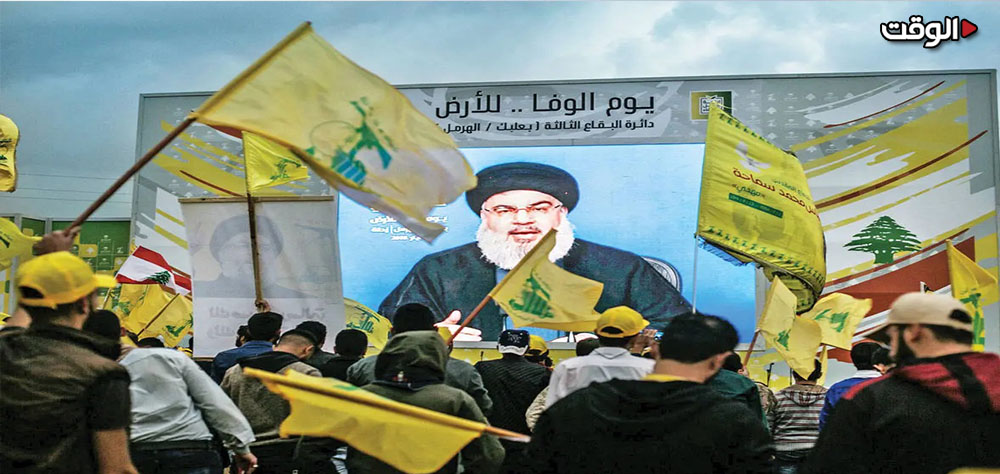
Despite the extensive Israeli pressures using military force and recurrent attacks with the aim of disarming Hezbollah, the resistance movement's leaders have more than once asserted that they will not give in to the enemy. Its chief Sheikh Naim Qassem in his latest comments reiterated this stance, saying that the disarming project is a common Israeli-American plan and Hezbollah will not yield to it.
"We are at a critical juncture: either we submit to the demands of America and Israel, which amounts to accepting complete trusteeship over Lebanon, or we will have a national uprising, reclaim our sovereignty and our lands, and rebuild our country," Qassem maintained.
He added:" To speak of monopolizing weapons while Tel Aviv's attacks continue means you are not acting for Lebanon, but for this [Israeli] regime. Disarmament is part of a project to create strife between the resistance and the people, and to perpetuate the occupation of five points in southern Lebanon by the occupiers, allowing them to continue their killings and aggressions."
To show that Israeli regime is unreliable and that disarming cannot settle home challenges, Qassem said that over a year has gone and Lebanon is making concessions, but Israel is not stopped and it does not quit its actions."
Hezbollah's leaders have repeatedly stressed that the movement's weapons are a red line and will never be handed over to any external or internal party. In their view, disarming the resistance means unconditional surrender to the Israeli enemy, a scenario that would leave Lebanon defenseless against the enemy's aggressions and allow the Israeli regime to pursue its expansionist policies unchecked.
Over the past two decades, Hezbollah has proven it is not a threat to Lebanon's territorial integrity but plays a crucial role in guaranteeing the country's security and defense. Today, the movement stands as a source of strength for all Lebanese and is the only actor with the capability and capacity to deter the enemy and force its retreat. The recent municipal election results, which saw victories for candidates aligned with the resistance, further demonstrated that the Lebanese people continue to stand with Hezbollah and support its positions, a public backing that plays a key role in maintaining the country's stability and security.
Over the past year, Hezbollah has shown flexibility and strategic acumen by allowing the Lebanese government room to negotiate with the US and the Israeli regime, so as not to give enemies a pretext. However, the course of these negotiations has shown that Lebanese statesmen have limited capacity to protect national interests and counter Israeli aggression, and some positions taken by Beirut's political figures reveal they are largely operating within the framework of a joint Tel Aviv-Washington plan.
It is for this reason that Qassem, in part of his remarks criticizing the Lebanese government's performance in confronting the Israeli regime's aggression and violations of national sovereignty, stressed: "It is unacceptable for the Lebanese government to act as Israel's gendarme. No further actions should be demanded of Lebanon unless the Zionist enemy first fulfills its own commitments."
These resolute stances by Hezbollah leader show that no foreign or home power is capable of disarming Hezbollah. Hezbollah's military strength not only blocks Israeli occupation of the south, but also bolsters the government's bargaining power in the face of Israeli and American pressures. Indeed, without these weapons, Lebanon would likely have already been forced to accept many unjust and imposed security commitments, and the country's standing in the region would have been severely damaged. Therefore, Hezbollah's weapons remain a non-negotiable red line, serving as a pillar of national security and a crucial deterrent.
All in all, given Netanyahu’s behavioral record, it seems that he, after getting the US green light and for fleeing the political and security pressures, will once again resort to military adventures in Lebanon. However, many agree, such actions no only will fail to win the Israeli PM his goals, but also Israeli regime will see its security at a great risk as a powerful and coordinated front of Axis of Resistance is expected to form in the face of any renewed Israeli aggression, making the situation tougher than before for Tel Aviv. This reality bears a message to the Israelis: Any unilateral military action will cost Tel Aviv heavy political and security costs.