









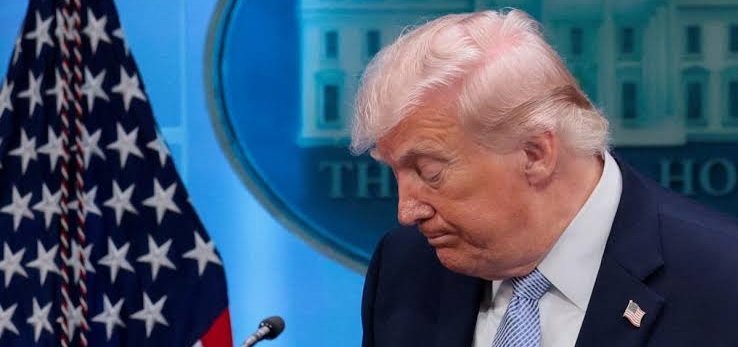


Alwaght- An American official has announced that the Theodore Roosevelt Carrier Strike Group entered CENTCOM's area of operations on Sunday, bringing the number of American aircraft carriers in the region to three. Some experts have cited the buildup of US strike groups as a sign of heightened odds that Trump intends to resume war against Iran.
Against this backdrop, analysts argue that the US President Donald Trump faces two difficult options on Iran. The first is a return to war and the resumption of military strikes, which could exact steep economic, military and political costs on the US. The second is to sustain the economic and naval siege of Iran, aimed at eroding its economic capacity and forcing Tehran to back down, a strategy that offers no guarantee of changing the Tehran's behavior either.
Option One: Return to war and a reprise of heavy costs
Trump's first option is resuming military operations against Iran, one that, while it could degrade parts of Iran's infrastructure militarily, offers no guarantee of achieving America's political objective. A November 9 New York Times report, republished by The Irish Times, described deliberations over a scenario involving a multi-day, intense operation against Iran's energy and nuclear facilities and its missile and drone arsenals. American officials, however, told the paper they do not expect a few days of strikes to bring about the collapse of the Iranian government.
That means even in Washington's own military calculus, a renewed attack alone is not judged sufficient to alter Iran's political structure, and America would still need prolonged economic pressure. A return to war would therefore mean re-entering a cycle of attack, counterattack, mounting military costs and regional instability.
The costs of this option extend beyond the military budget. Reuters reported on November 14 that 55 percent of Americans believed, ahead of the midterm elections, that war with Iran was not worth the cost. The American intelligence assessments likewise indicate that renewed strikes would probably not significantly change Iran's position at the negotiating table. Reuters has also reported that some of America's stockpiles of long-range precision munitions have fallen to alarming levels and have yet to be fully replenished.
At the regional level, Washington's allies are equally reluctant to see a return to war. Reuters reported that Saudi Crown Prince Mohammed bin Salman and Turkish President Recep Tayyip Erdogan, in separate calls with Trump, urged him not to resume military strikes on Iran. Trump himself has said he decided against new strikes at the request of countries neighboring Iran. Their concern is the widening of the war, damage to energy infrastructure, disruption of shipping and rising regional instability. A US resumption of war could thus even strain Washington's ties with its regional allies.
Second option: sustaining blockade and war of attrition
Trump's second option is to maintain the naval blockade and intensify economic pressure on Iran, a strategy the Washington hopes will squeeze Iran's economy and force Tehran to accept Washington's demands without paying the price of a full-scale war. Under this scenario, Washington seeks to erode Iran's economic capacity and stoke domestic pressure by choking off oil exports, imposing new sanctions and restricting trade and financial channels.
The strategy's core problem, however, is the vast distance between damaging Iran's economy and toppling the Islamic Republic's political system. Historical experience shows that sanctions and economic siege, even in their most severe form, do not necessarily bring about the collapse of a country's political structure. The Washington Post reported on November 13 that CIA assessments indicate Iran holds several months' worth of food and fuel reserves to weather the effects of a blockade.
In this regard, Bilal Y. Saab, a senior fellow in Chatham House's Middle East and North Africa program, warned in a November 9 analysis that a US naval blockade, while capable of severely squeezing Iran's finances, is unlikely to achieve Washington's strategic goal of forcing the Islamic Republic to accept fundamental concessions. He argues that excessive pressure could push Tehran toward a military response and plunge the crisis back to square one.
From this dimension, sustaining the siege will not come cheap for Trump either. First, maintaining a large US military presence in the region, deploying aircraft carriers and securing shipping lanes demands considerable financial and weapons resources. The Washington Post estimates the cost of sustaining this military presence at tens of billions of dollars extra, writing that the US would be forced to divert carriers and interceptor missiles needed elsewhere in the world to maintain the posture. Second, a prolonged blockade heightens the risk of the conflict spreading to the region's energy infrastructure and shipping lanes, a scenario that would also hurt the Persian Gulf Arab states.
So, it seems that Trump, at present, finds himself in a strategic tight spot in confronting Iran, with no exit known to him.