










Alwaght- Comparison of the Saudi military strength with that of Yemen's Ansarullah resistance movement reveals a considerable gap in the weaponry power and the power to win in the war. Enjoying advanced warplanes supplied by the US and Europe, modern tanks, air defenses, and multibillon military budget, the Arab kingdom has the superiority when it comes to conventional military equipment, but years of Yemen war have shown that air superiority and expensive arms necessarily do not mean certainly realizing political and military goals.
First part: Saudi Arabia enjoys well-equipped and modern army
Saudi Arabia ranks among the world's largest arms buyers, sourcing a critical share of its military muscle from American and European suppliers. By 2026 estimates, its defense budget sits at roughly $83 billion, a figure that dwarfs the financial and industrial capacity of Ansarullah.
1. The air force : A stark advantage in fighter jets
Saudi Arabian air force is built around advanced multirole fighters. Global Military's 2026 database pegs the kingdom's military aircraft inventory at about 915 air frames, spanning combat aircraft, helicopters, transports and trainers, with roughly 384 listed as combat aircraft.
Its most consequential air assets are its American F-15s, European Eurofighter Typhoons and Tornados. The F-15 forms the backbone of its air combat power, deployed for air-superiority missions and ground strikes. The Typhoon is an advanced multirole fighter engineered for both air and strike missions.
Beyond fighters, Riyadh fields combat and transport helicopters, reconnaissance aircraft and aerial support systems. Advanced radars, guided munitions and foreign technical support further sharpen the force's operational reach.
2. The army: Nearly a thousand main battle tanks
According to 2026 Global Firepower data, Saudi Arabia holds about 1,085 tanks. Global Military, a specialized database, puts the number of active tanks at roughly 945, placing the kingdom's inventory at somewhere between 950 and 1,100.
American M1 Abrams tanks anchor Saudi armor. Riyadh also operates armored fighting vehicles, personnel carriers, self-propelled artillery, multiple rocket launchers and military support vehicles.
The website estimates about 22,000 vehicles across a broad equipment classification, a diverse range of armored, support and logistics vehicles that should not be conflated with tank or heavy combat vehicle counts.
3. Artillery and rocket launchers
Estimates of Saudi Arabia's ground arsenal include about 380 self-propelled artillery pieces, more than 400 towed artillery pieces and roughly 250 to 330 multiple rocket launcher systems.
4. Missiles and air defense: A costly shield
Saudi Arabia shields its cities, military bases, airports and oil facilities with a network of air defense systems. The American Patriot system is a cornerstone of that network, and Riyadh is also building out its high-altitude defense capability with the THAAD system.
No single reliable public figure exists for the kingdom's ready-to-fire interceptors, air-to-air missiles and offensive munitions. Despite its advanced systems, defending against simultaneous, massed attacks by ballistic missiles, cruise missiles and drones can prove difficult.
Second part: Yemen's military power
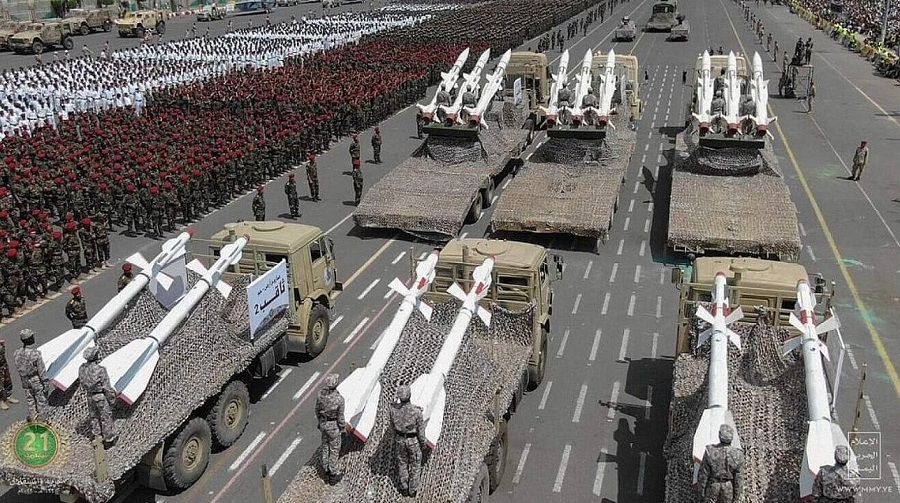
Ansarullah's army is nothing like that of Saudi Arabia with conventional structure and equipment. Rather, it fights using a combination of old weapons of the previous armed forces, war spoils, offensive drones and missiles, and the capacity for domestic production and assembling. In its report on Ansarullah's missile and drone power, Reuters says that this movement has become an influential player in the regional security equations.
1. Manpower: Advantage of massive mobilization and war experience
Estimates of Ansarullah's troop strength vary widely. The Middle East Institute has put the group's fighters at roughly 350,000 in recent assessments, while some media reports cite official figures from Sanaa pointing to more than 200,000 personnel tied to the Ansarullah's military structure.
What matters is that years of war have given Ansarullah hard-earned expertise in mountain defense, ground operations, drone and missile strikes, and countering forces backed by advanced air power, an experience that can matter on the battlefield as much as hardware.
2. Ballistic missiles: The main long-range strike tool
Over the past years, the resistance movement has deployed short- and medium-range ballistic missiles of various types. Known systems in the group's arsenal include the Burkan, Hatem, Palestine and Tufan missile families.
Some of these missiles are designed to hit distant targets, and its military statements tout them as part of the group's deterrent capability.
The International Institute for Strategic Studies, examining the Ansarullah's arsenal, notes that some short-range missiles are likely produced or assembled inside Yemen, while more sophisticated medium-range systems depend more heavily on foreign technology and components. The precise number of intact, operational, ready-to-fire Yemeni missiles is not known from independent public sources.
3. Drones: A cheaper weapon against a better-equipped enemy
Drones are one of the most important components of Yemeni military power. The movement has used reconnaissance and attack drones in ground operations, long-range strikes and threats to shipping.
Known systems include the Samad, Qasef and Wa'id families. Some are designed for one-way attacks on targets, while others fly reconnaissance and support missions. A number of the more advanced systems rely on foreign technology and components.
Reporting by Al Jazeera and the International Institute for Strategic Studies on Ansarullah's military capabilities shows the movement has gained significant operational experience with drones over the war years.
The drone advantage in this confrontation is not merely destructive power: the relatively low cost of some models, their ability to be used in repeated attacks and the need to detect and intercept every target can drive up the cost of defense for the other side.
4. Tanks, armored vehicles and artillery
No comprehensive, independent data exists on the Ansarullah's operational tanks, personnel carriers and heavy artillery. The force uses equipment left behind by the Yemeni army, captured armored vehicles, and light vehicles and armed pickup trucks.
Field reports from operations have noted the presence of tanks, artillery, anti-armor weapons, heavy machine guns and military vehicles.
5. An Asymmetric navy: A threat to vital routes
Ansarullah has no conventional fleet rivaling Saudi Arabia's, but its naval power is not limited to warships. Anti-ship missiles, naval drones, fast boats, explosive vessels and sea mines are among the tools cited in reporting on the movement's power.
The significance of this equipment stems from Yemen's geography. Access to the Red Sea, the Gulf of Aden and Bab-el-Mandeb lets Sana'a pressure shipping security and part of the region's trade and energy export routes.
The Wall Street Journal and other international media outlets, examining Yemeni maritime attacks, have pointed to the role of anti-ship missiles, drones and attack boats in upending Red Sea security calculations. Still, the precise number and operational status of this equipment remain publicly unknown.
Third part: Why has Saudi Arabia failed to make gains despite noticeable arms superiority over Yemen?
To answer this question, several points need to be taken into account:
1. Yemen's geography: Defense advantage of mountains
Parts of Yemen's north and west have rugged and mountainous regions. This geography makes ground operations complicated, allowing the defenders to use terrain, comflouge, and dispersal to reduce effects of the enemy's air superiority.
Advanced fighter jets can bomb specific targets, but destroying sporadic and moving targets or controlling mountainous regions for a long time requires ground operations, precise military data, and constant boots on the ground. An analysis of Al Jazeera data about Yemen war describes the mountainous terrain of Ansarullah-controlled regions as one of the factors giving the movement a defense superiority.
2. Missiles and drones: imposing costs on advanced air defense systems
Saudi Arabia relies on costly Patriot systems and other defenses against air threats, but shielding against multiple, simultaneous attacks demands enough interceptors, active radars, trained personnel and wide geographic coverage. The kingdom's sheer size, its long border with Yemen and the scattered placement of oil facilities, airports and sensitive infrastructure make protecting every point at once difficult. Under such conditions, even an advanced air defense system cannot indefinitely shield every target from every kind of attack.
3. A War of attrition
Ansarullah has fought for years, gaining operational experience in using weapons, moving forces and countering air attacks. Saudi Arabia, for its part, must manage financial costs, munitions consumption, equipment maintenance and the security fallout from strikes on its soil. The longer the war drags on, the higher the price of a decisive victory climbs.
The International Institute for Strategic Studies, examining the Yemeni arsenal, has shown that beyond imported weapons, the group has developed some domestic production and assembly capacity for drones and simpler missiles.
4. The vulnerability of Saudi economic infrastructure
Saudi Arabia's dependence on oil exports, energy infrastructure and maritime transport routes leaves it exposed to missile and drone threats. By threatening that infrastructure, Ansarullah can impose significant security and economic costs on Riyadh, even without a conventional air force.
To wrap up, comparison of Saudi Arabia and Ansarullah shows that arms superiority in the war matters, but it is far from being a sole determining factor. The kingdom has the upper hand in terms of jets, tanks, armored vehicles, air defenses, and military spending, but Ansarullah, in the opposite side, with its reliance on missiles, drones, asymmetrical warfare, operational experience, and rugged regions has become a hard counterweight for the Saudis. In other words, Ansarullah and the Yemeni army have made Saudi conventional superiority impossible to convert into a decisive, low-cost victory.