



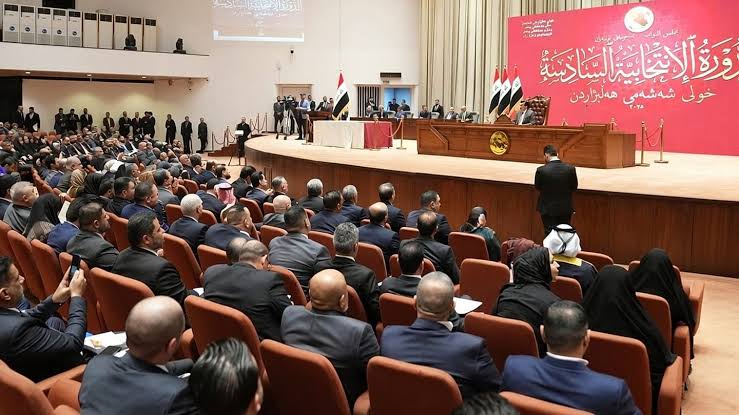


Alwaght- Completion of the cabinet of Iraqi Prime Minister Ali al-Zaidi on October 15 after about five months of debating over distribution of ministries and executive posts in the shadow of home division and foreign pressures, including the interventionist policies of the US, mark a turning point in the Iraqi political process.
The parliament voted yes to three deputy prime ministers and a number of ministers, filling part of the vacuum in the government structure. However, the official completion of the cabinet should not be regarded an end to political rifts and formation of a government independent of the influence and will of the parties.
The ministry of migration remains headless yet and voting on the fourth deputy prime minister is delayed for now. So, the current condition more than being indicative of the end of the crisis demonstrates the transition of bargaining from the stage of determining the composition of the cabinet to the competition over control of executive posts and swaying government orientation.
Prime Minister Ali al-Zaidi, whose nomination was announced on April 27 by the ruling Shiite Coordination Framework (SCF), on May 14 managed to win vote of confidence of the lawmakers for the government plan and 14 ministers. However, gaps between political parties over the remaining vacant posts and brazen American interference, and Trump in person, in the home affairs of Iraq have left the government facing a stalemate in completing the cabinet in some key posts for months.
The delay showed that agreeing on a prime minister, who, by Trump's account, took office through his management, did not necessarily mean agreeing on how to run the government. To break the deadlock, al-Zaidi had to balance the demands of Shiite parties, the share-seeking of Sunni forces, the rivalries between Kurdistan's two main parties, and Washington's sensitivities over the presence of figures tied to resistance groups.
From this dimension, al-Zaidi's position must be examined through the gap between legal legitimacy and real political power. Parliament's vote of confidence grants him formal authority to run the government, but his ability to carry out policy hinges on the breadth of parliamentary coalition support, the cooperation of security and administrative apparatuses, control over financial resources, and his capacity to manage external pressures. In such circumstances, a prime minister must simultaneously keep political backers satisfied and absorb outside pressure.
1. Cabinet's official status
In the first stage, the parliament approved 14 ministers, but a number of key ministries, including defense, interior, planning and higher education remained without official ministers. In the October 15 session, the parliament voted for three deputy prime ministers and 11 ministers.
Lawmakers confirmed Mohsen Ali Akbar al-Mandlawi, Laith Hadi al-Khazali and Mohammed Ali Tamim as deputy prime ministers. Yasser al-Maliki takes the Interior Ministry and Naif al-Shammari the Defense Ministry, the two portfolios at the core of internal security, the police forces and the defense establishment. Qutaiba Ghazi Majid was named planning minister, a post central to coordinating public investment and allocating development resources. Haider Bahaa al-Husseini will lead Higher Education and Scientific Research, Yassin al-Aithawi Culture, Rebaz Hamlan Construction and Housing, Mohammed Raad al-Mousawi Labor and Social Affairs, Safaa al-Kanani Youth and Sports, Mohammed Saheb al-Darraji Digital Economy, Governance, Science and Technology, Ali Abdullah Hadi al-Dakhili Tourism, and Mohammed Sam'an Agha the Ministry of State for Minority Affairs.
The creation of a digital economy and governance ministry signals an effort to expand the executive apparatus into digital transformation—but it will only improve governance if its mandate does not overlap with existing ministries and agencies.
In his parliament appearance, al-Zaidi said the deputy prime ministers will draw no salaries, financial benefits or offices with independent staffing, and that their work must be field-based, grounded in expertise and driven by citizens' needs. He also pledged to cut the number of government advisers, an attempt to answer criticism over rising administrative costs. Whether that commitment holds will depend on how it is implemented and on the powers delegated to the deputies.
Two issues remain open. The Ministry of Migration and Displacement is still unfilled, with political disputes over its nominee blocking a final decision. And the fourth deputy premiership, sought by the Kurdistan Democratic Party, remains in limbo after a vote on the party's nominee was postponed. Reports point to friction between the KDP and the Patriotic Union of Kurdistan over coordination. The cabinet is largely complete, but a comprehensive political agreement on all posts has yet to materialize.
2. Party quotas and distribution of power among Shiite factions
A major part of al-Zaidi's cabinet formation logic should be sought in continuation of the system distributing posts among parties and political coalitions. This system which is called "quota system" practically rests on a combination of religious, sectarian, parliamentary weight, organizational power, and agreements of political leaders. The outcome is that ministries are not distributed based on the government plans or expertise of nominees, but on the instruments to maintain the ruling coalition, settling the differences, and creating a balance among power centers of the factions.
Among Shiite factions, Nouri al-Maliki's State of Law coalition remains a pivotal player in shaping the government's final lineup. Despite the failure of al-Maliki's bid to return as prime minister, which was blocked by an explicit Trump veto, his bloc secured footholds at the interior ministry, the higher education ministry and the health ministry. Yasser al-Maliki took interior, Haider Bahaa al-Husseini higher education, and Abdul Hussein al-Mousawi of the Fadila Party health ministries, appointments that matter politically because the two fields touch internal security management, specialized manpower and the government's administrative networks.
State of Law's weight extends beyond those ministries. Allies of the bloc at the Central Bank of Iraq and in the national security adviser's post also attest to al-Maliki's standing in current Iraqi politics. Put plainly, State of Law may have lost the premiership, but it retains the capacity to influence swaths of the executive apparatus.
The Reconstruction and Development coalition tied to previous Prime Minister Mohammed Shia al-Sudani has likewise preserved its share in economic and service portfolios. Oil, electricity and agriculture are among the ministries attributed to this camp in the initial government lineup. Yet coalition cohesion and the ability to hold allies are a separate matter from the number of ministries held. The departure or distancing of some allies, Faleh al-Fayyad and Ahmed al-Asadi among them, and the formation of the Bayan coalition could erode this bloc's bargaining power, even with several key ministries in hand.
The Sadiqoun movement and Asa'ib Ahl al-Haq emerged with prominent places in the final government. The selection of Laith al-Khazali as deputy prime minister, Mohammed Raad al-Mousawi at Labor and Social Affairs, and Adnan Faihan al-Dulaimi as first deputy speaker of parliament matters for the internal balance of power within the Coordination Framework. These appointments show that Asa'ib, among Iraq's senior resistance factions, has not been pushed out of the formal power structure despite external pressure.
Laith al-Khazali's appointment is especially sensitive since he is the brother of Qais al-Khazali, leader of anti-American Asa'ib Ahl al-Haq resistance movement, and was sanctioned by the US Treasury in 2019 over his leadership role in the group and allegations tied to human rights abuses and the 2007 attack on American forces. His elevation to the deputy premiership, a post that had previously run into an American veto, raises the question of what significant concession Asa'ib Ahl al-Haq made to the foreign side to secure this position.
Some reports and figures close to the resistance, among them people tied to Kataib Hezbollah and the Nujaba Movement, have cast Qais al-Khazali outside the fold of Iraq's Islamic resistance, citing Asa'ib Ahl al-Haq's recent posture represented by staying out of the US-Israeli war with Iran and taking no practical positions in defense of the Iran-led Axis of Resistance.
The Wisedom Movement under Ammar al-Hakim is another effective player in this equation. In the initial cabinet division, the finance ministry and the youth and sports ministry were attributed to this camp; Faleh al-Sari took Finance in the first stage, and Safaa al-Kanani was appointed to Youth and Sports as the cabinet was completed. Finance, given its role in drafting the budget, managing liquidity, paying salaries and financing the government's obligations, ranks among the most important executive levers and is considered a sovereign ministry.
The Badr Organization secured a more limited share of ministries than some other factions. Reports on the initial division had floated ministries such as Interior for the group, but in the final lineup the Ministry of Water Resources, Roads and some other areas gained importance in the quota calculations.
Kataib Sayyid al-Shuhada, with the Muntasiroun bloc, took the newly created tourism ministry, and Mohammed al-Darraji of the Imam Ali Battalions' Services Alliance won the newly created Digital Economy Ministry.
All told, the Shiite arrangement in al-Zaidi's government is neither a complete victory for one party nor a sign that others have been excluded. State of Law remains embedded deep in the executive apparatus, Sadiqoun has gained a more prominent formal standing, and Hikma and currents close to al-Sudani are also present in parts of the government.
3. Status of Sunni camp
Among the Sunni factions, Progress Coalition led by former parliament speaker Mohammad al-Halbousi, has remained one of the key Sunni actors in the calculus of government formation. Parliament's speakership sits with the Haybat al-Halbousi and Mohamed Tamim has been appointed a deputy prime minister. Progress Coalition also took the education and industry ministries. Holding the speakership while seated in the government strengthens this camp's capacity to shape both legislative and executive decisions. Proggres Coalition has actually been the leading Sunni actor in the cabinet of al-Zaidi.
The Hasm Coalition, meanwhile, landed a key post with Naif al-Shammari at the defense ministry. The weight of that appointment must be read through defense ministry's ties to the armed forces structure. In quota system terms, it matters because a political faction can, by holding a strategic ministry, exert more influence over government calculations than its parliamentary seat count alone would suggest. Put precisely: among the losers in the cabinet lineup is the Sovereignty Coalition led by Khamis al-Khanjar, which, despite holding nine seats, came away with the Trade Ministry, while Hasm Coalition, working with Progress Coalition and holding five seats in total, captured the key defense portfolio.
The Azm Coalition also reached areas such as culture and planning ministries in the division of posts. Qutaiba Ghazi Majid's appointment to planning ministry and Yassin al-Aithawi's to culture ministry were finalized while the movement's leader, Muthanna al-Samarrai, sits in detention in the Adnan al-Jumaili case and on wide-ranging financial corruption charges.
4. Status of Kurdish camp
Among the Kurdish parties, the Kurdistan Democratic Party (KDP) and the Patriotic Union of Kurdistan (PUK) remain the two main players in dividing central government posts. Fuad Hussein has stayed on at the foreign ministry, and Rebaz Hamlan was appointed to the housing ministry, the PUK had earlier also secured the second deputy speakership of parliament. The PUK, keeping Khaled Shawani at the justice ministry and holding the presidency, continues its presence in the cabinet. The environment ministry, meanwhile, went to the New Generation Movement of Shaswar Abdulwahid—a sign that the Kurdish share-out, unlike in the past, is no longer confined to competition between the two traditional parties.
Even so, the KDP could not secure all its demands as the cabinet was completed. A vote on the party's nominee for the fourth deputy premiership was postponed, and the ministry of migration and displacement remains unsettled amid continued disagreement between the Sawyana bloc backed by the KDP and the Babilon bloc backed by the Shiite Coordination Framework. This, together with reported friction between the KDP and PUK over coordinating nominees, shows that disputes among Kurdish parties remain a determining variable in the Erbil-Baghdad relationship.
5. Opposition to expansion of government: Protesting the new ministries and deputy PMs
Beside the partisan disputes, part of the parliament rose against the very creation of new ministries and deputy PM posts. Reports from October 15 session suggested that a number of members of Ishraqat Kanoon, Rights, Abshir Ya Iraq, some of Badr Organization lawmakers and independents voiced the opposition to adding new ministries and deputy PM posts to the government, skipping the voting. They argued that amid economic pressure and the need to handle public spending, increasing political posts and expanding executive structures is unnecessary.
Critics warn that if the deputy premierships lack precise, measurable powers, they could turn into parallel decision-making centers, ones that raise coordination costs while blurring accountability for ministers and the prime minister. Al-Zaidi's announcement that his deputies will forgo salaries and benefits may ease some of the financial concern, but on its own it does not resolve overlapping jurisdictions, indirect administrative costs or the question of who owns decisions.
In Iraq's quota system, new posts can serve as a means of placating factions that came away with a smaller share in the initial division of ministries.
6. Winners and losers of the cabinet
In terms of power balance, the State of Law must be named one of the highest gainers of the new cabinet for retaining its place in part of the executive posts. Despite losing the chance of premiership and distancing from the helm of power, it maintains its ministries and executive network, something enabling its high capacity to influence decisions.
Sadiqoun and Asa'ib Ahl al-Haq are among the biggest beneficiaries of the final government lineup. Laith al-Khazali's appointment as deputy prime minister elevates this current's formal standing. Hikma and factions tied to al-Sudani also secured a substantial share by taking sovereign ministries. Among Sunni forces, Tahaddum, with the speakership, two ministries and possibly a deputy presidency, is seen as the Sunni winner. Hasm, for its part, reached an important position by taking the defense ministry. Among the Kurds, the KDP fell short of realizing all its demands, but the notable point is a third power in the region, the New Generation Movement, securing a ministry.
The Sadrist movement must be assessed separately from the direct division of government posts. The absence of its representatives or affiliated figures from the cabinet does not mean it lacks political influence. Conditional support for the government, a demand to fight corruption and an emphasis on confining weapons to the state can give Sadr a means of applying pressure from outside the formal structure. If that approach continues, the movement could become a determining factor in preserving or weakening the government's stability at political junctures.
Conclusion
Finally, the cabinet was completed against a backdrop of an Iraqi economy acutely exposed to oil revenues, the state's current spending, financial obligations and regional developments. In such conditions, forming a full cabinet after five months is only the first step.
The central question is whether the government can deliver measurable improvement in public services and Iraqis' living standards through its economic ministries, coherent planning, spending control and a fight against corruption.
Completing the cabinet marks the end of one phase of Iraq's political crisis, but the government's success will hinge on its ability to convert quota deals into coherent decision-making, public accountability and the exercise of legal authority free from the overt interference of regional and extra-regional powers, the US among them.