











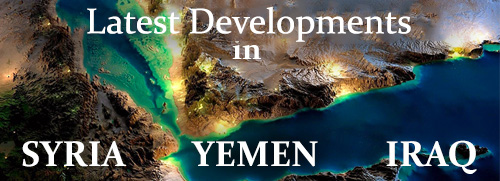

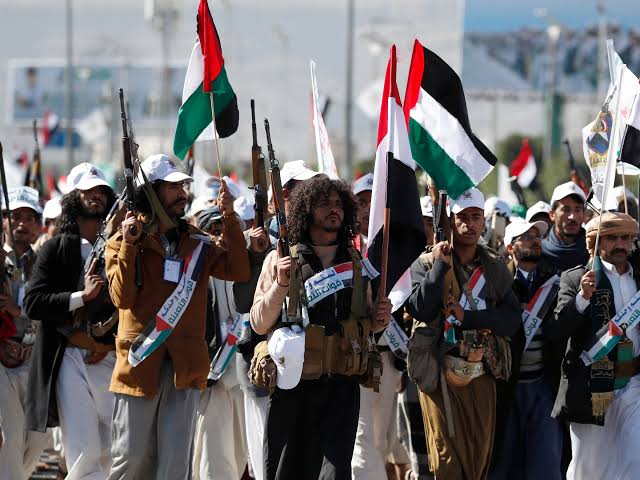


Alwaght- Consolidation of Yemeni Ansarullah movement's control over Bab-el-Mandeb Strait and strategic islands in the Red Sea is a geopolitical development whose reverberations will go far beyond Yemen's borders. For the Israeli regime, such a development can stor changes to security and economic equations on one of the most sensitive sea fronts around the occupied territories.
The significance of Bab-el-Mandeb lies not solely in its geographical location. The strait is located in the linking point of the Red Sea, Gulf of Aden, and Indian Ocean and each actor that can influence its security and navigation would actually have a key geopolitical leverage for pressure. So, for the Israeli regime whose foreign trade is dependent on a considerable part of the maritime routes, consolidation of Ansarullah's gains in this region will pose a strategic threat.
Israeli vital arteries within Ansarullah's fire range
The first and perhaps the most immediate source of Israeli concern is the economic dimension of the new dynamic. Sea transport is one of the key trade pillars of Tel Aviv and the southern entrance of the Red Sea is crucial to access to the Indian Ocean and Asian markets.
The strategic stakes of this route snapped into sharp focus when Ansarullah, responding to the Israeli genocidal war on Gaza, began targeting ships linked to Israeli occupation and imposing restrictions on vessels tied to the Israeli regime. Those developments made one thing clear: geographic distance between Yemen and the occupied Palestinian territories does not necessarily translate into strategic distance.
The Bab-el-Mandeb Strait, a 20-mile-wide chokepoint between Yemen and Djibouti, ranks among the most critical arteries of global trade. Roughly 12 to 15 percent of all world commerce passes through it, including 12 percent of global oil and 30 percent of containerized goods. About 60 percent of Israel's GDP derives from trade, and 99.6 percent of that trade by weight, 65 percent by volume, moves by sea. Three ports, Haifa, Ashdod and Eilat, handle 80 percent of Israeli regime's maritime traffic.
For Israel, then, any advance along Yemen's western coast translates directly into pressure on its own economic chokepoint. As the resistance forces tighten their grip on Yemen's Red Sea coastline and the strategic islands surrounding the strait, Israel may no longer face a mere temporary disruption to its shipping lanes, but a sustained strategic constraint on one of its most vital trade corridors.
Israeli officials say the alternative to the Red Sea route is sailing around the southern tip of Africa, a detour that would add two to three weeks to Mediterranean shipping times. Such a scenario would drive up insurance, freight and vessel security costs.
Strategically, the upshot is an Israeli economy made increasingly vulnerable to regional developments unfolding thousands of miles from the occupied territories.
Ansarullah's backing to Palestinian resistance: Escalation of pressure in the Bab-el-Mandeb
The second Israeli concern has to do directly with the Palestinian developments. Earlier, during Gaza war, Ansarullah, through announcing a ban on the Israeli ships and ports, proved it is prepared to link Yemen dynamics to those of Gaza. So, position cementing of this movement around Bab-el-Mandeb can enhance its capability to upgrade the political support to Palestinian struggle against Israeli occupation to a strategic and constant pressure lever.
The stakes rise further still given that Israel, beyond obstructing the implementation of the Gaza ceasefire and pressing ahead with its policy of pressure, military occupation and daily killing of Palestinians in the strip, has in recent weeks escalated its crackdown aimed at displacing Palestinians from the West Bank. Under such conditions, the emergence of another enduring pressure point in the Red Sea could further complicate the regime's security calculus.
Israel's core concern is not necessarily the opening of a conventional war front, but the prospect of a permanent strategic pressure mechanism taking shape, one in which shipping lanes, ports, islands and coastal infrastructure become part of a broader equation of Yemeni support for the Palestinians.
Ansarullah's new position within Yemen's geography allows them to shape the security environment of one of the most vital maritime routes leading to the occupied territories, while continuing their political and military backing for the Palestinian cause.
Expansion of the architecture of Iran's asymmetrical warfare
Israel's third worry centers on Iran and the regional network of resistance groups. Strengthening the Ansarullah's position at Bab-el-Mandeb could offer yet another example of how geography can be converted into a military and political instrument within the framework of Iran's asymmetric warfare strategy.
To raise the costs of confrontation with its adversaries, Iran does not necessarily need conventional military superiority. Building interconnected capabilities across allied groups can create a web of pressure points across multiple geographic theaters.
Seen this way, the Houthis' position at Bab-el-Mandeb is not solely a Yemeni matter; it can become part of a far broader network of strategic leverage stretching from the Persian Gulf to the Red Sea and the eastern Mediterranean.
For Israeli regime, this dynamic fuels a deeper concern: that a future confrontation with Iran would no longer be confined to Iranian territory or a single battlefield. Shipping lanes, energy facilities, ports and commercial vessels could all find themselves exposed to disruption from dispersed, geographically scattered asymmetric capabilities.
The strengthening of Ansarullah, therefore, is not merely the military rise of one Yemeni actor. In Israel's eyes, it could signal an expansion of the strategic depth available to Iran and its regional allies.
East Africa: A concern beyond Bab-el-Mandeb
Another worry of the Israeli regime is the potential of Ansarullah's foothold expansion to East Africa and the countries surrounding the Red Sea.
Bab-el-Mandeb is not merely a lying between Yemen and the occupied Palestinian territories; it is a strategic linking point between the Arabian Peninsula and the Horn of Africa. Any actor that can get a major sway over the dynamics of the Strait will potentially hold the stronger political leverage in the dymdmics on the two sides of the Red Sea.
In recent years, regional and international powers have poured vast investments into ports, military installations and political relationships around the Red Sea and the Horn of Africa. The UAE, in particular, has worked to build a network of influence around strategic ports and shipping lanes.
For Israeli regime, too, the Horn of Africa has emerged in recent years as a central arena in its foreign policy thinking, especially in its rivalry with Turkey, as seen, for example, in the early May 2025 trip by Gideon Saar, the regime's foreign minister, to Ethiopia, and in the recognition of Somaliland's independence in 2026.
The Ansarullah's rise as a dominant power on the Yemeni side of Bab-el-Mandeb could upend the very balance those investments were designed to cement. Growing Sana'a influence could turn Ansarullah into a more consequential player in the political affairs of countries around the Red Sea and the Horn of Africa, including Eritrea, Djibouti and Somalia.
As a result, the Red Sea may shift from a space largely under the sway of foreign powers into one where Ansarullah, too, are a decisive actor.
Ansarullah's regional power upgrade
The fifth aspect of recent developments is political. Gaining control over strategic islands, ports, and littoral cities can give Ansarullah power boost not only at home but also regionally and internationally.
This matters all the more if Ansarullah's status shifts from a de facto, unrecognized authority to a durable reality embedded in international logic and state-to-state relations. Under such conditions, the movement could transform from a powerful actor in Yemen's war into a regional player within the Axis of Resistance, wielding influence over one of the world's most vital chokepoints and maritime trade corridors.
As a result, Ansarullah's bargaining power would no longer be confined to Yemen's internal negotiations. Red Sea security, international shipping and relations with neighboring states could all become part of the movement's broader equation of power.
Defeat of project to contain Ansarullah
Seen in this light, recent developments can also be read as a major defeat for Israel's strategy in southern Yemen.
Over the past several years, Israel, working alongside Emirates and through forces loyal to the now-dissolved Southern Transitional Council, sought to expand its political and military presence and influence in southern Yemen and around Bab-el-Mandeb. Since the Saudi-Emirati coalition's assault on Yemen began in 2015, Tel Aviv was one of the principal players on the war's stage, and the core aim of that involvement was to remove the threat to the regime's security and economy in the Red Sea and the Bab-el-Mandeb, and to erect a barrier to contain Ansarullah.
That cooperation continued in the years that followed. In late 2025, Israeli media reported that Tel Aviv, in coordination with Abu Dhabi, had moved to establish a network of new airports on Yemen's strategic islands and coastlines, sites such as Abd al-Kuri, Perim, Zuqar, Mokha and Samha.
But in recent developments, Ansarullah's advances neutralized that entire airport trap, built to create aerial encirclement over the ports of Hudaydah, Salif and Ras Isa, and those areas, particularly Perim, and the city of Mokha, fell under Ansarullah's control. The consolidation of Ansarullah's position thus produced precisely the opposite result.
Instead of being kept away from this maritime chokepoint, the movement is moving to entrench its control over the areas surrounding the Bab-el-Mandeb. And instead of southern Yemen becoming a platform for containing Ansarullah, the region may become part of the movement's strategic depth.
This is precisely where the stakes lie for Israeli regime. The concern is not merely the loss of a military position or a political ally; it is the prospect that a broad regional strategy, pursued for years with the aim of controlling the maritime geography around the southern entrance to the Red Sea, has failed.
Finally, if these developments translate into a lasting reality, they will mean for the Israeli regime that years of investment and push to check Ansarullah have delivered the reverse. In other words, instead of restricting this resistance movement, the recent years dynamics have paved the way for its emergence as one of the momentous actors in the Red Sea region.