













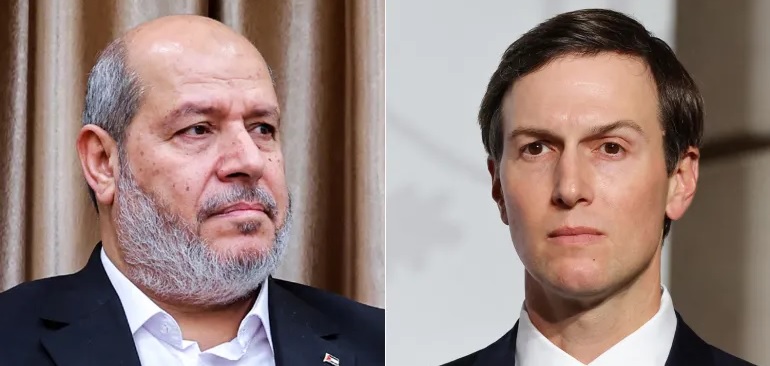


Alwaght- Trump's advisor and son-in-law Jared Kushner recently met Hamas in Cairo. This unprecedented meeting of Kushner, as a Trump's envoy to the Middle East, with the leaders of the Palestinian resistance movement should be seen as one of the signs of a shifting approach of the US government to the Palestinian resistance. The meeting shows that just contrary to the stated policy for elimination of Hamas from the Gaza political future, Washington now finds no way but to directly engage in talks with one of the key players of the Palestinian equation.
From elimination of Hamas to direct talks
The Trump administration has laid out a 15-point plan for Gaza’s future, calling for Hamas’s disarmament, a new governing structure, and a phased withdrawal of Israeli occupation forces. But implementing it without Hamas’s approval is effectively impossible. That’s why, in a striking move, Kushner appears to have bypassed the usual Arab intermediaries and met directly with Khalil al-Hayya, the militant group’s political chief.
Politically, this is a significant moment. It signals that Washington has effectively conceded that it cannot shape Gaza’s future without talking to the very force that still wields significant influence and organizational muscle on the ground.
In other words, what the Trump administration once framed as “eliminating Hamas” from the Gaza equation has now become negotiations with Hamas to reach a deal.
Hamas now the party Washington talking to
The more important issue now is that the US talks with Hamas come at a time Tel Aviv has rejected Washington-designed initiative. The Israeli Prime Minister Benjamin is against the US initiative and still insists on fully disarming Hamas before any decision to withdraw from Gaza. On the opposite side, Hamas insists on withdrawal of the Israeli occupation forces and has established a connection between disarming and the future Palestinian political arrangements.
So, Washington is now in a situation that on the one hand should persuade Hamas to accept its initiative and on the other hand press Netanyahu for a green light. This amounts to one thing: Hamas now holds the initiative in Gaza, not Washington.
Kushner’s outreach looks less like a diplomatic gambit and more like reluctant realism, the belated recognition that no viable political or security framework for Gaza can be built without Hamas’s cooperation, or at least its tacit consent.
Even the leaked accounts of the negotiations make clear that Hamas is no bit player. It is setting the terms on Gaza’s governance, on its weapons, on the occupiers' withdrawal, and on the broader political future of the Palestinians. Reuters has reported that Hamas has agreed in principle to disarmament, but only within a defined framework, and crucially, it has tied that concession to an Israeli pullout and future political arrangements. That linkage is where Washington’s retreat before the reality of Palestinian resistance becomes unmistakable.
US retreat or facing the fact?
Yet Kushner's meeting with Hamas leaders should not be mistaken for routine diplomacy. It signals a fundamental pivot in Washington's policy calculus.
The US is no longer dictating terms to Hamas. It is now negotiating with the resistance movement over weapons, over Gaza's political future, over the withdrawal of occupation forces, and over how a deal would actually be implemented. Even if the ultimate American goal remains Hamas's disarmament, the path has shifted from unilateral pressure to direct bargaining.
At the same time, Trump has pressed the Israelis to halt their strikes on Gaza, a move that underscores a growing rift between Washington's priorities and the Netanyahu government's stance.
None of this means the Trump administration has abandoned its disarmament objective. Kushner continues to insist that Gaza's reconstruction hinges on Hamas giving up its arms, and that Washington expects the territory to be demilitarized.
But the real shift lies elsewhere: Washington has accepted that even to achieve that goal, it must sit across the table from Hamas, and factor the group's demands into its own calculations.
That is why the Kushner–al-Hayya meeting stands as one of the clearest signs yet that the balance of power in the Gaza war is shifting. Palestinian resistance has gone from being a "security problem" that the US sought to eliminate, to a negotiating partner.
And perhaps the most consequential takeaway for the region is this: to execute its own vision for Gaza, the Trump administration has ultimately been forced to talk to the very force it once vowed to erase from the equation.
Ball in the Israeli court
Wissam Afifeh, a political analyst and writer for the Shahab news agency, summed up the meeting in a single, cutting line: "Hamas told Kushner: We've agreed. Now it's your turn to deal with Netanyahu."
According to Afifeh, the Hamas delegation entered the room with a firm stance: no reopening the debate on the 15-point plan put forward by UN peace coordinator Nickolay Mladenov. That framework had been thrashed out for months, and Hamas had already signed off on it. The time for negotiation, they insisted, was over. What was needed now was not backtracking, but compelling the Israeli regime to follow through.
The delegation also reminded Kushner of Washington's earlier pledge: if Hamas agreed, the US would secure Israel's buy-in. And throughout, Afifeh said, the Hamas team adhered to the principle of "reciprocal steps", no unilateral moves, every Palestinian action matched by an Israeli one at the same moment.
Netanyahu, the obstacle to Trump's initiative
The deeper irony for the Trump administration is this: to salvage its own plan, Washington has been forced to negotiate with Hamas.
After meeting with the militant group, Kushner headed straight to Tel Aviv to try to bring Netanyahu on board with the American road map. But three hours of talks between the two sides ended without a breakthrough.
In effect, the Trump administration now finds itself squeezed between Palestinian resistance on one side and Netanyahu's intransigence on the other, with its own Gaza blueprint caught in the middle.
It is a far cry from the image Trump projected at the outset: that of a president who could simply impose a new order on Gaza.