













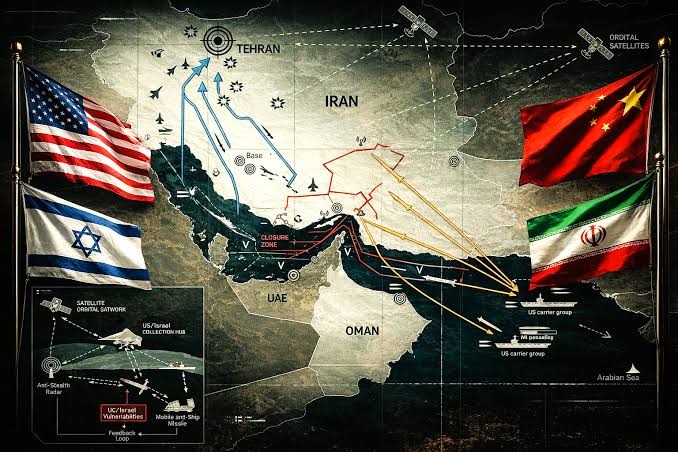


Alwaght- At first glance, American-Israeli bloc's aggression against Iran looks like a confrontation over deterrence, nuclear program, or the balance of power in West Asia region, but in its lower layers, this war can be considered as part of a competition over redefining the international economic and political geography whose main scene is not West Asia skies or Persian Gulf waters, but the network of transportation, ports, railways, and trade corridors in Eurasia.
What is going on today is not a war over territories or political influence, rather, it is a war between China and the US over determining the global trade routes and redrawing the map of East-West link.
Since the onset of the Ukraine war in 2022 and the wave of sweeping, unilateral sanctions that followed, Eurasia’s trade architecture has undergone a profound overhaul. The Northern Corridor, for years the premier rail artery moving Chinese goods into Europe via Russia and Belarus, lost much of its allure because of sanctions, mounting military risks, and dwindling confidence among shipping companies and insurers.
That vacuum catalyzed a strategic pivot. China, Russia, and notably Iran accelerated planning and investment in alternative routes, corridors designed to loosen their dependence on Western-leaning infrastructure and stitch together a new, self-sufficient network for global logistics and commerce.
In this realignment, Iran has emerged as one of the most geopolitically pivotal nodes of the new network. Its geography now anchors the convergence of the International North-South Transport Corridor (INSTC) and what is known as China’s Southern Corridor.
The North-South route links Russian Baltic ports through the Caucasus and the Caspian Sea to Iran’s Bandar Abbas and Chabahar, slashing both transit time and costs for goods moving between Russia, Central Asia, the Persian Gulf, and the Indian Ocean, compared with traditional chokepoints like the Suez Canal.
Meanwhile, the Southern Corridor, part of China’s Road and Belt Initiative (RBI) traverses Central Asia, cuts through Iran, and pushes on via Turkey into Europe. Their intersection has recast Iran from a mere energy exporter into a transit linchpin of strategic consequence for both Moscow and Beijing.
That status has been bolstered in the past decade by concrete operational projects. Moscow and Tehran have pursued multibillion-dollar investment plans to expand rail links and waterways connecting St. Petersburg to Bandar Abbas and Chabahar. The first direct freight train from Iran to China has also rolled out under the Iran-China-Europe rail corridor framework.
These projects are pieces of a broader three-country push to weave a web of trade routes less vulnerable to Western sanctions and pressure.
Seen through this lens, the ongoing war against Iran is not simply a military confrontation over Iran. Rather, it is part of a competition over the future of these transit networks. Any instability inside Iran, disruption of transportation, or increased risk of investment directly hits the efficiency of the corridors China and Russia recognize as the backbone of the emerging economic order.
The US,on the opposite side, has been busy drafting its own alternative plan. The India-Middle East-Europe Economic Corridor—or IMEC, rolled out with Washington, the EU, India, Saudi Arabia, the UAE, Jordan, Israel, and Greece on board, stands as Washington's most ambitious geoeconomic counterweight to China's RBI.
The corridor is slated to funnel Indian goods through Persian Gulf ports, across Saudi and Jordanian rail networks, into Israel's Haifa port, and onward across the Mediterranean to Europe. The route effectively bypasses Iran while dialing down dependence on China-backed corridors. But war has thrown a wrench into those calculations. Insecurity in the Strait of Hormuz, Yemeni attacks on Red Sea shipping, volatility in the eastern Mediterranean, the suspension of Arab-Israeli normalization talks, and mounting threats to regional infrastructure have all undercut the political and security assumptions that IMEC was built upon.
Paradoxically, however, the very same turmoil has pushed Persian Gulf Arab states to think harder, not less, about forging a tighter security and logistics partnership with Washington. In the long run, that dynamic could end up amplifying the corridor's political heft even more than its economic promise.
At the same time, US officials are advancing other initiatives with a common thread: shrinking the roles that Iran and Russia play in Eurasia's and Central Asia's transit maps. The Zangezur Corridor in the Caucasus, designed to connect Azerbaijan through Armenian territory to Nakhchivan and then on to Turkey, is widely read by analysts as an attempt to carve out a path that loosens the region's reliance on Iranian transit routes.
In East Asia, Luzon Economic Corridor in the Phillipines with joint American-Japanese investment is part of the Western strategy to check China in the Pacific Ocean. This tells us something: The American attacks on railways and ports, and routes infrastructure in Iran should not be seen as a offensive and tactical moves but symbolic ones to shatter Chinese and Russian plans and at worst, if not dissuade Moscow and Beijing from constructing parallel corridors, will help to separate Iran from their corridor development programs.
Finally, it can be said that today's rivalry of the big powers is no longer on who controls West Asia, but on who controls the connective choke points of the world economy. Each port, railway, or transit corridor can be as strategically significant as a military base of naval fleet. From this point, the aggression against Iran should be seen as going beyond a regional crisis. This war is ongoing at the heart of a broader competition that will determine the future of world trade routes, Eurasia geoeconomic order, and the balance of power among the US, China, and Russia.










