















Alwaght- Egypt which has as one of the most powerful African and Arab world armies has jumped in a new stage of military modernization by inaugurating "The Octagon" as its strategic command headquarters. The project is seen by Egyptian officials as the symbol of its future military. In the view of regional and international analysts, the project goes beyond military area and has broader geopolitical dimensions.
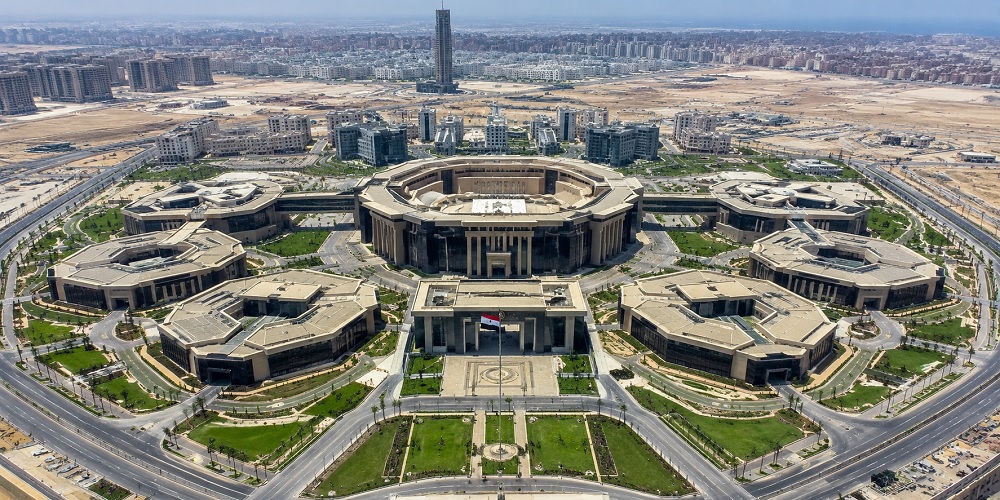
The military complex built in Egypt's new administrative capital will serve as the new headquarters for the defense ministry and the strategic command of the armed forces. Egyptian state media, including the State Information Service and Al-Ahram newspaper, have billed the facility as one of the largest military command centers in the world, designed to unify all branches of the armed forces, command systems, crisis management, and joint operations under a single, integrated network.
An inauguration wth political messages
President Abdul Fatah el-Sisi personally joined the opening ceremony, where he showed up with military uniform, grabbing attention of Arab and international media. Egyptian media outlets reported that this was the first time in eight years the general-turned-president showed up with military uniform. For many analysts, the move bore a message about strategic significance of this project for the Egyptian army.
Egyptian government supporters cast The Octagon's inauguration as a cornerstone of el-Sisi's "New Republic" vision, a major leap toward modernizing military command structures, speeding up decision-making, and sharpening the armed forces' combat readiness.
But critics see it differently. Economists and opposition analysts, including experts speaking to Al Jazeera and Middle East Eye, point out that greenlighting a mega-project of this scale, while Egypt is drowning in foreign debt, grappling with runaway inflation, watching its currency plummet, and staggering under mounting economic pressure, raises questions about budget priorities. Their take is that however vital defense upgrades may be, the staggering price tag on such ventures only piles more pain onto an already struggling economy.
The Octagon, the new heart of the Egyptian military command
The Octagon sprawls across roughly 92 square kilometers and comprises 13 operational, administrative, and service zones. According to Egyptian government data, the complex's eight main buildings feature an octagonal design, hence the name.
Beyond housing the defense ministry, the facility hosts joint operations rooms, command centers, communications systems, intelligence hubs, support and logistics units, crisis management sections, and advanced communications infrastructure. Egyptian officials say the layout is purpose-built to create an integrated command-and-control network spanning all branches, land, air, naval, and air defense forces.
Why did Egypt build The Octagon?
Investigations by Al-Ahram, Al Jazeera, and analyses published by Arab think tanks show that Cairo is following four main objectives behind building this complex.
First: Unifying armed forces command. Military experts argue that consolidating all command hubs into a single complex will dramatically speed up intelligence sharing across branches, and give top brass the edge they need to make faster, more cohesive calls in the heat of a crisis.
Second: Gearing up for next-gen security threats. Cairo insists the Octagon is not just another military headquarter, it is a national crisis nerve center. The facility is wired to handle cyberattacks, hybrid warfare, terrorist strikes, fourth- and fifth-generation conflicts, and full-blown emergencies.
Third: Overhauling the military's chain of command. Egyptian think-tank analysts see the project as a cornerstone of a broader armed forces tech upgrade. The Octagon comes packed with C4I command-and-control systems, encrypted communications, intelligence networks, AI-driven tools, and advanced data analytics, all designed to slash reaction times and sharpen operational coordination.
And fourth: Flexing regional muscle. Egyptian media frame the launch as a clear deterrent signal. Many Arab analysts read the opening as more than logisticsp. It is a political message to regional players that Egypt intends to hold its ground as a top-tier military power in the Arab world and North Africa.
Geopolitical objectives
With 450,000 active-duty personnel, hundreds of thousands of reserve forces, and one of the most diversified military arsenal in the region, Egypt is still one of the most important powers in the Middie East and North Africa. According to 2026 ranking of the Global Firepower, Egypt is the world's 19th most powerful armies.
However, many Arab think tanks believe that The Octagon is not merely for military operations management, but is part of Cairo's new geopolitical strategy.
Egypt's state-run Al-Ahram daily, citing security experts, frames the project as a bid to cement Cairo's role as the Arab world's security linchpin. Retired Brigadier General Adel al-Omda, a military advisor at Egypt's Academy for Strategic Studies, called the inauguration "a stark message of power and deterrence", insisting Cairo intends to prove it remains the decisive player in Middle Eastern and Eastern Mediterranean security equations.
Analysts at Al-Ahram's Center for Political and Strategic Studies (ACPSS) see the move as a direct response to a ring of crises closing in. From Sudan's civil war and Libya's chaos to Red Sea turbulence, Eastern Mediterranean energy rivalries, and Sinai-based terrorist threats—all have pushed Egypt toward building a centralized, rapid-response command structure.
Doha-based Al Jazeera Research Center echoes that view, arguing The Octagon must be read as part of Cairo's broader strategy to bulk up multi-front crisis management. Their take: Egypt has faced converging threats along its western, southern, eastern, and maritime frontiers in recent years, and the integrated command hub is designed to tackle them simultaneously.
But many regional analysts detect a subtext, a quiet rivalry with Turkey. The two powers have clashed over Libya, Eastern Mediterranean gas exploration, and influence across North Africa, fueling an intense geopolitical competition. In that light, the Octagon, with its upgraded command capabilities and joint-operations management, reads as part of Egypt's push to up its deterrence and lock in its status as a top-tier security force in both the Eastern Mediterranean and the Arab world.
Some Western analysts, however, strike a more cautious note. The Carnegie Middle East Center argues that while modernizing the military's command structure may boost Egypt's operational edge, the project, alongside the sprawling new administrative capital, also fits squarely into el-Sisi's broader power-centralization play. In their view, relocating political, security, and military institutions to a brand-new district is not just about defense; it is equally about governance and internal security consolidation.
Experts at the International Institute for Strategic Studies (IISS) believe The Octagon as a signal of deeper shifts within Egypt's military, a transition from a conventional heavy-armor force toward network-centric command and joint operations. It is a trend mirrored in modern militaries worldwide, they maintain, hinging on cutting-edge tech, secure communications, and split-second decision-making.










