















Alwaght- Hard-leaked information from the Israeli regime suggest that the retaliatory missile strikes by Iran and the allied resistance groups have dealt heavy blows on Israeli regime. Israel’s Channel 7 reports that since war began eleven days ago, there have been 9,115 claims for compensation in Israel. The report adds that the largest number of claims is in Tel Aviv, 4,609. Ashkelon comes next with 3,664 claims.
Additionally, 181 claims have been filed in Al-Quds (Jerusalem), 494 in Akko, and 167 in Tiberias. The broadcaster reports that these claims pertain solely to damages incurred during missile and drone attacks since the onset of the war against Iran, excluding other incidents and events.
On the other hand, despite the severe censorship surrounding casualty and injury statistics in Tel Aviv and other cities resulting from Iranian missile attacks, the Israeli Health Ministry has been compelled, under public pressure, to announce that 2,339 Israelis have been hospitalized since the beginning of the war against Iran. According to this report, 95 of the injured are still receiving treatment in medical facilities.
At the same time, the Israeli regime has not disclosed the number of its casualties, maintaining strict censorship in this regard. Reports indicate that alongside the Iranian attacks, the Israeli regime has imposed tight surveillance and censorship over the dissemination of information related to the damages caused by Iranian missiles and drones, along with those from Hezbollah, and the release of images and videos connected to the destruction and consequences of these attacks is also heavily restricted.
Despite strict censorship, a video made its way to the social media showing a number of Israelis are complaining about power blackout in the shelters during Iranian missile strikes.
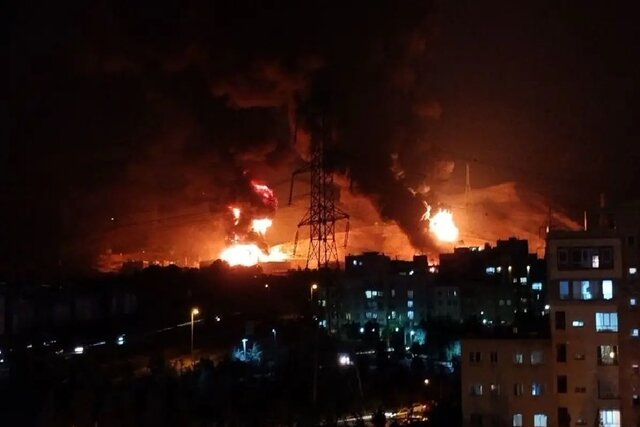
Also, images emerged to show destruction of space and satellite communication center of Israel. Media have complained about censorship regarding this center. The images have caused a wave of fury among reporters across the occupied territories, with some directing strong criticism at the censorship and media watch institutions. These images came a day after Iran’s IRGC in a report said it struck and destroyed in southern Tel Aviv the Israeli center for satellite reception and communication. Images emanating from the site show its full destruction.
Yesterday, Indian journalist Brag Mohan Singh, who recently returned from the occupied territories, revealed that the shelters are not entirely secure, with some individuals reportedly being killed inside them. In a video shared on social media, Singh stated that missiles sometimes hit without any prior warning. He also emphasized that Tel Aviv officials are obstructing free access to hospitals, concealing the true casualty figures, and preventing the media from documenting the impact sites and the extent of damage. According to him, authorities have barred media visits to hospitals where the bodies of the deceased are kept and have restricted the recording of images from affected areas.
Even American journalists have acknowledged the severe censorship in Israel. A Fox News reporter in Tel Aviv mentioned during a live broadcast amidst Iranian missile attacks: “Right now, a missile interceptor is being launched behind me as Iran fires its missiles. We can’t show it to you because we’re not allowed to do so. What’s really changed over the past few days is Iran’s use of cluster munitions; the missile warhead breaks down into several smaller bomblets. This is significant because it not only expands the scope of destruction but also makes it much harder to defend against.”
Israelis’ difficult job of fighting on two fronts
The ongoing Iran-Hezbollah attacks against Israel have put significant pressure on Tel Aviv. Ma’ariv newspaper has reported that the Israeli army is currently struggling to manage two fronts simultaneously, while attacks from Iran and Lebanon persist.
The newspaper noted that around two million settlers have been under fire from Lebanon and Iran in recent days. The newspaper adds that the military power of Israel does not match that of the US. According to the report, a large portion of the Israeli regime’s aerial capabilities is engaged in operations against Iran, which has impacted the scale of operations in Lebanon.
Ma’ariv added that operations in Lebanon are primarily focused on targeting senior figures and attacking the southern suburbs of Beirut to apply pressure on the Lebanese government. The newspaper also pointed out that only a limited portion of the remaining aerial capacity is being used to support ground forces on the new clash line, and this amount is insufficient to counter Hezbollah effectively.
$10 billion, the war bill on day eleven
On the eleventh day of war, estimates published by the Department of War suggest that the war costs have exceeded $10 billion. This is according to the primary estimation of the Pentagon
Opposition to the war against Iran within the US is also significant. Notably, American media personality Tucker Carlson, in his program, referenced the killing of Iranian schoolgirls on the first day of the war by American missiles, stating: “A country that kills innocent girls is not worth fighting for.” Carlson elaborated on this by saying, “You can’t start a war unless you believe, on the deepest level, that you are superior to the people you’re fighting against. If you wake up in the morning and live in a country that thinks it’s right to kill not just the enemy’s military officers but also their girls, that country is not worth fighting for.”
Repeating Iraq war mistake in Iran this time?
In the US, many are drawing parallels between the anti-Iranian aggression and the 2003 war against Iraq. For example, The Conversation website, in a report citing Farah N. John, an international affairs researcher, with an alarming tone says that the Iraq war consequences were catastrophic and the war against Iran is moving in the same path. According to this researcher, Iran with 92 million population has a web of regional loyalty and access to nuclear material and can cause a crisis way more complex, costly, and dangerous than that of Iraq. The expert adds that history has already issued its warning, but it seems not being heard.
A war doomed to fail
Many, including members of the Congress, have already declared Washington’s impending defeat in the war.
“Trump’s illegal war against Iran is doomed to fail. Even now, Iran’s leadership is emerging, which has a strong enmity toward the US, and there’s no way to eliminate Iran’s nuclear program with a bombing campaign; this entire war is pointless,” Senator Chris Murphy, in a CNN interview, said.
John Bolton, former National Security Advisor under Trump, has also remarked that Trump will blame Netanyahu for any failures in Iran.
“As the situation deteriorates in the Iran war, I can guarantee you that Trump will pin the blame on Netanyahu because in Trump’s world, he is the winner, not the loser. Therefore, if this action against Iran leads to failure, it will be someone else’s fault, and that is what will happen,” Bolton said.
These statements highlight a growing concern among US lawmakers regarding the effectiveness and consequences of military actions in the region, as well as the shifting blame dynamics in political narratives.
Americans preparing for $4 per gallon gasoline
According to Yahoo Finance, as the Strait of Hormuz remains shut down by Iran, the gasoline in the US is expected to rise to $4 per gallon across the country. The report adds that Indiana with 24 percent has the highest rate of gasoline price increase. California with $5.20 per gallon sells the most expensive gasoline in the US.
The Oil Price website has reported on the current fuel supply situation in the United States, highlighting that despite producing approximately 13.5 million barrels of oil per day, the US still imports about 700,000 barrels per day from Saudi Arabia and Iraq. Due to the lack of access to internal oil pipelines, much of California’s oil supply comes from imports from the Persian Gulf.
Disruptions in oil supply caused by the blockade of the Strait of Hormuz have led to soaring fuel prices in California, reaching a high of $5.3 per gallon, with predictions that it could rise to $8, a price not seen since the 1970s crisis.
Additionally, a report from The Economist indicates that the sharp decline in oil exports from the Strait of Hormuz has placed Southeast and East Asian countries in a tight spot regarding fuel supply. The Persian Gulf accounts for 40 to 80 percent of the crude oil imports of China, India, Japan, and South Korea, putting these nations at risk of fuel shortages. In recent days, governments in Thailand, Vietnam, Pakistan, and Bangladesh have resorted to implementing shutdowns or announcing remote work for employees to manage fuel consumption.
The US newspaper adds that the current crisis has cut over 6 million of the Persian Gulf oil output. Saudi Arabia had cut oil production 2 to 2.3 million barrels per day. Iraq has reduced production about 2.9 million barrels. The UAE and Kuwait together cut about 1 million barrels per day. The Saudi oil giant Aramco CEO has recently warned about long-term consequences of war, suggesting that to this moment of war, over 180 million oil barrels for export in the region have been affected by war.










