








Alwaght- Months after the ostensible end of the war in Gaza, the coastal enclave's reality keeps to be a far cry from the post-war revival promised under the Sharm el-Sheikh agreement and reconstruction, return to pre-war normalcy, and economic renewal remain elusive. Against that backdrop, Hamas’s announcement that it is dissolving its government in Gaza has ushered the territory’s political dynamics into a new historical phase. The move appears directly tied to the stalled progress of the Sharm el-Sheikh deal.
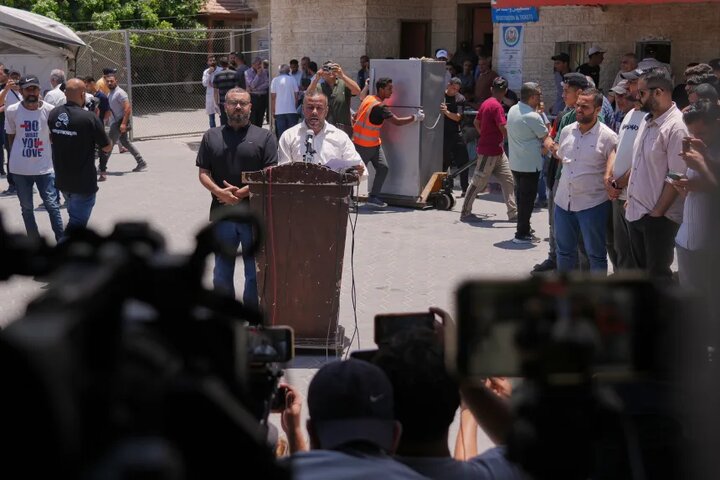
The resistance movement's press office announced on July 6 that it dissolved the government, paving the way for work of a technocratic committee for administration of the Palestinian enclave.
Meanwhile, the deputy head of the government action follow-up committee and head of the state emergency committee in Gaza formally submitted his resignation, a move aimed at smoothing the administrative transition and paving the way for a Palestinian technocratic committee to take over civilian governance.
Many observers initially framed the decision as a major political concession to halt the war. But events on the ground tell a different story: the Israeli war machine has kept grinding on. Strikes on residential areas and displacement camps in Khan Younis and Rafah have continued, with dozens of Palestinians killed by occupation forces in the period since.
UN and human rights reports further indicate that the humanitarian crisis in Gaza has not eased in the wake of these developments. Shortages of food, medicine, and fuel remain among the most crushing challenges facing residents.
Under roadmaps put forward by the so-called peace councils, Gaza’s governance during a transitional phase would be handed to a technocratic government or an independent executive committee, tasked with reconstruction, the full reopening of the Rafah crossing, and the gradual restoration of normal life to the strip.
In this connection, Bassem Naim, a member of Hamas’s political bureau, stressed: “Hamas is not seeking to rule. Our priority is protecting the Palestinian people and ending the war. If national consensus is reached on Gaza’s administration, the movement will back it.”
Hazem Qassem, a spokesman for the movement, called the decision “a positive step toward implementing the ceasefire agreement,” adding that it demonstrates the group’s flexibility in advancing the political process and rebuilding Gaza.
In their official statements and public positions, Hamas officials have insisted the movement is acting in the best interests of the Palestinian people and remains flexible over how Gaza is run, but they also made clear they will not bargain away fundamental Palestinian national principles.
Israeli obstructions ahead of implementing the deal
Despite Hamas's move to leave rule of Gaza to a technocratic government, the Israeli officials have not changed their positions.
Israeli Foreign Minister Gideon Sa'ar dismissed Hamas's dissolution of its government as a cosmetic change, arguing that as long as the movement retains its weapons and military capability, any civilian administration would effectively remain under its sway. He made clear that Israel would only consider the move meaningful if Hamas fully disarms.
For its part, the Tel Aviv cabinet stated it not only rejects any return of Hamas to governing Gaza but also opposes handing the strip to the Palestinian Authority under current conditions, and continues to pursue an alternative framework for administering the territory.
Israeli media, ever eager to cast doubt, claimed the resignations and dissolution were little more than a "show" move.
Despite Hamas's show of flexibility, the Israelis have no intention of pulling out of Gaza. On the contrary, they are working to entrench their foothold in the strip.
Latest reports say that the Israeli military now occupies roughly 70 percent of Gaza, including vast swaths of the north and south, strategic corridors, and buffer zones that Tel Aviv intends to preserve as permanent security belts.
These Israeli positions make it clear that the dissolution of Hamas's government, contrary to Tel Aviv's earlier rhetoric, has not satisfied the regime's demands, and it has merely taken one stated condition off the table.
Why have Israeli not felt victorious?
In political terms, dissolution of Gaza government can be seen as a gesture of good will to a peace process followed by the Arab and Islamic countries.
With this move. Hamas tried to show that it can show flexibility to ease concerns regarding the future of Gaza administration and that it is ready to hand over executive management to a mechanism approved of by all Palestinian groups.
This approach aligns with the frameworks floated at the Sharm el-Sheikh talks for forming an executive committee or technocratic government, and could potentially open the door to launching reconstruction and reopening the Rafah crossing.
Yet the striking point is that neither Israeli regime nor Hamas's internal Palestinian rivals have interpreted the move as a victory over the resistance movement, because the resistance's political structure and its military structure are two very different things. Dissolving the government does not mean the end of Hamas as an organization or the collapse of its operational capacity, a point Israeli officials themselves have repeatedly underscored, insisting their real target is "disarmament."
From Tel Aviv's viewpoint, as long as Hamas's military wing, its weapons stockpiles, and its command network remain intact, the movement will continue to be Gaza's dominant player.
Netanyahu has stated time and again that dismantling both Hamas's military and governing capabilities is a core war objective, and that Tel Aviv will not halt operations until that goal is achieved. Any agreement on Gaza's future, he insists, is contingent on the full disarmament of Hamas and other armed Palestinian factions.
Hamas's opponents, meanwhile, argue that ceding civilian management does not equate to ceding real power. Hamas, they contend, can shed the burdens of day-to-day governance while preserving its political and security influence.
Within that same context, Israeli analysts and media have acknowledged that the prolonged military campaign has failed to eliminate the the movements overall capacity.
These assessments suggest that even inside the Israeli regime, the dissolution of Gaza's government is not being read as the end of the resistance, because what Tel Aviv is really after is dismantling the military infrastructure and securing a weapons handover, not merely a change in administrative paperwork.
Given the record of the Israeli treachery and disloyalty in the past, the dissolution of Hamas government is more about removing one of the most important excuses of Israeli regime and its backers and less about a political retreat. Before this Hamas move, Israel had argued that the movement's administrative presence makes an obstacle ahead of implementing the post-war agreements, and now this excuse is largely eliminated and all eyes are on how Israel will commit to its obligations.
In this relation, a senior Hamas official said at the announcement of the government's dissolution that the move was meant to signal to the world that the movement is placing no obstacles in the way of ending the war. From here on, he added, responsibility for aid entry, reconstruction, and easing the suffering of Gaza's people would fall to the relevant parties and the technocratic committee.
Therefore, the step could actually strengthen the resistance's standing in global public opinion. Hamas can now argue that it has shown flexibility agreeing to a ceasefire, a technocratic government, handing over Gaza's executive management, and preparing the ground for reconstruction, while the other side continues to withhold full implementation of its commitments: refusing to end military operations, withdraw from Gaza, or lift the blockade.
Under these circumstances, if the war drags on, political and media pressure will increasingly mount on the Israeli regime, because one of its central justifications for continuing military operations in Gaza has effectively lost its relevance. Any further attempt to impose new political arrangements without stopping the war and ending the occupation will now face even deeper skepticism from international public opinion and institutions.
Arms, Hamas's red line
Despite efforts by Tel Aviv leaders to disarm Palestinian resistance groups, the Palestinians have announced repeatedly that arms are unnegotiable and that they will not talk about their arms under American and Israeli pressures.
Qassam Brigades have repeatedly in their official statements stressed that resistance will live on as long as occupation exists. Khalil al-Hayya, a senior leader of Hamas said more than once that this movement agrees with every mechanism approved by Palestinian groups and leads to reconstruction of Gaza and end of the siege, but no side can decide on the arms of resistance since they are a legitimate right as long as Palestine is occupied by the Israeli regime.
Other Palestinian groups, including Islamic Jihad, have taken similar stances, asserting that disarming is a red line.
From the Palestinian perspective, the resistance's weapons remain the single most significant obstacle to Israeli advances in Gaza. Remove that arsenal, they argue, and the regime would pursue its occupation plans with far freer hands. They insist that if Tel Aviv has so far failed to achieve all its objectives in Gaza, the primary reason is the armed struggle and the heavy costs that resistance fighters have inflicted on the Israeli military.
Finally, what will shape Gaza's future today is not the dissolution of Hamas's government, but the deeper deadlock over ending the occupation and the fate of the resistance's weapons. Until those two issues are resolved, an end to the war and the onset of stability in Gaza will remain a distant prospect.