















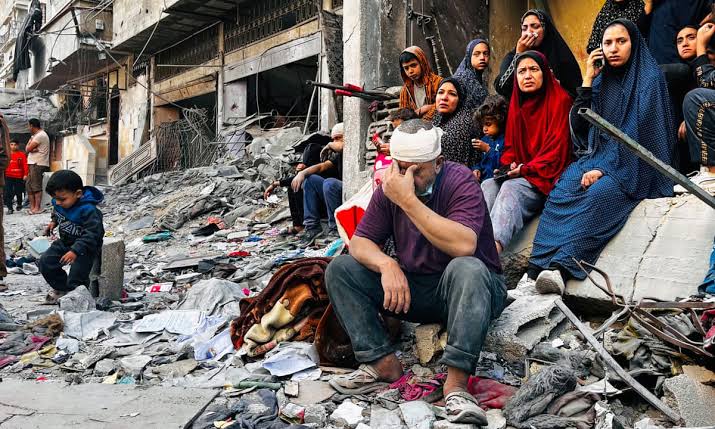


Alwaght- Two months after Gaza ceasefire deal, hopes of people of this war-ravaged Palestinian enclave for return to peace are fading away day by day.
In the first hours after the ceasefire was declared, sweeping scenes of displaced families returning home showcased the people’s steadfast and glorious resilience against the occupiers’ pressure for forced displacement. Now, weeks after the war, observing the Israeli regime’s actions, as global pressure to fully implement the truce has eased, reveals that Tel Aviv has not quitted the plan to expel Gazans from their homes and is still pursuing this criminal project.
Failing to diplomatically persuade Egypt to take in Gazans for settlement in Sinai Peninsula, the cabinet of Prime Minister Benjamin Netanyahu is these days quietly advancing plans for forced migration of Palestinians from Gaza.
Forced migration under the guise of NGOs
Tel Aviv has just embarked on a set of new initiatives to realize its old aim of displacing the Palestinians from their lands. It is now using non-governmental organizations. An investigation by Al Jazeera, citing field evidence, data, and media reports, suggests existence of a complex and organized network that stands behind transfer of hundreds of Palestinians from Gaza to three countries in Africa and Asia.
According to the report, key roles in this process are being played by entities including the so-called MAJED Association and Israel’s Voluntary Migration Office. Published information indicates that MAJED Association Europe serves as the primary actor carrying out this operation, framing its activities under the guise of humanitarian aid and support for war victims. In its official description, the association claims its goal is to support Muslim communities and victims of conflict.
However, technical reviews and analyses of the group’s website and digital accounts reveal alarming signs: a meticulously crafted digital identity, a lack of transparent legal registration, the absence of a clear physical address, and the use of WhatsApp numbers to collect sensitive information. These details cast serious doubt on the organization’s true nature and strengthen the hypothesis that this is a deceptive digital front, not a genuine charity.
Investigations by the newspaper Haaretz further reveal that an Israeli-Estonian individual named “Tamer Lind” is behind the MAJED Association. He has founded companies that often have no registered employees, offer vague services, and whose scale of financial activity is inconsistent with their declared capital. These are issues that further deepen suspicions about the real objectives of this network.
Denying humanitarian aid to Gaza
Preventing aid from delivery to Gaza is one of the main parts of the Israeli policies for all-out pressure against the people of Gaza.
This policy is not only a collective punishment instrument but is part of a broader strategy aimed at forcing Gazans to leave their lands.
According to the ceasefire deal, 600 trucks of aid were to enter Gaza daily to provide food, medicine, and fuel to meet minimum needs but reports by the UN and rights groups show that Tel Aviv is practically reneging on its obligations by setting up various roadblocks, allowing only around 100 trucks in.
This level of assistance is nowhere near sufficient to meet the needs of more than two million Palestinians. The UN says around 1.5 million people in Gaza are enduring the worst humanitarian conditions, facing acute malnutrition. Shortages of food, drinking water, medicine, and fuel have turned daily life into a constant crisis and pushed the health system to the brink of collapse.
A UN special rapporteur also issued a sharp rebuke of Israel, stressing that there is effectively no ceasefire in Gaza. Tel Aviv, the rapporteur said, continues its bombardment while simultaneously blocking the entry of life-saving aid.
Under these conditions, the systematic deprivation of basic necessities has become a tool to break social resilience and force Palestinians into displacement. By rendering Gaza unlivable, the Israeli occupation seeks to convince Palestinians that their only path to survival is to abandon their homeland, a policy that constitutes a clear violation of human rights and an attempt to alter the demographic makeup through coercion and starvation.
Ongoing daily attacks
Though attacks on Gaza was the most important part of ceasefire, over the past two months, daily attacks of the Israeli forces on various parts of Gaza, especially its south, have continued, killing over 400 civilians.
These attacks, carried out with direct support of the US, are part of the Israeli campaign to make Gaza an insecure place for life to ensure psychological pressure on its residents. After all, daily bombing can persuade some civilians to leave their land in hope of peace.
With the ceasefire’s status unclear and no definitive path to a second phase of the deal, Israeli forces are pushing their agenda through limited but sustained attacks. Hamas leaders have recently stated that the Netanyahu government shows no willingness to proceed to the second phase, a point confirmed by mediators.
Egyptian Foreign Minister Badr Abdelatty, noting his country’s collaborative efforts with other friendly nations to immediately move to phase two, described achieving this goal as difficult.
While mediation efforts continue, extremist ministers in Tel Aviv are working to keep the fires of war burning in Gaza. Eyal Zamir, Chief of Staff of the Israeli military, recently announced the army is preparing for extensive operations against Gaza.
Continuing the war is crucial to preventing the collapse of Netanyahu’s cabinet, and the regime is seeking various pretexts, including Hamas’s unwillingness to disarm, to launch a new round of war.
Furthermore, despite the ceasefire agreement stipulating a gradual withdrawal of occupation forces from Gaza, evidence indicates that Israeli troops have not retreated. Instead, they are incrementally seizing more territory day by day.
Residents of Gaza recently reported that Zionist military forces have moved the concrete blocks marking the so-called “Yellow Line” in Gaza, expanding their occupied zone in Bani Suheila, east of Khan Younis. This development underscores the deepening crisis and threats to the daily lives of Gazans, representing a clear violation of the ceasefire agreement.
Through these actions, Israel is attempting to tighten the noose around the Palestinians, gradually pressuring Gaza’s residents, who now concentrated in southern areas near the Egyptian border, to leave the strip.
Addiction of Palestinians as an Israel project
In addition to all its criminal actions, the Israeli military has recently pushed a new choice to destroy the Palestinians or force them out of their homes. Local sources on Sunday told Arabi 21 that the Israeli army in recent months has meaningfully stepped up trafficking of all types of drugs to Gaza.
This operation is carried out by an organized network of agents, collaborators, and armed militants inside and outside the occupied territories, with the primary goal of weakening the Palestinian spirit of resistance.
According to the report, drug trafficking is conducted under various covers, the most significant being humanitarian aid convoys entering Gaza and commercial trucks passing through crossings controlled by the occupation army. Security sources emphasize that drugs are intentionally hidden among civilian goods, especially food products, canned goods, and packages placed in metal boxes or thick cardboard, making them difficult to trace.
Israel’s objective through this action is to addict Palestinian youth and weaken their spirit of resistance and defiance. By eroding the will and defensive capacity of the youth, the path is paved for forced displacement from Gaza. The occupation army hopes that by creating this psychological and social condition, it can advance its long-term plans for demographic change and control over Gaza without direct and widespread confrontation. This policy is another example of systematic pressure and psychological warfare against the Palestinian people, which, alongside the siege, bombardment, and restriction of humanitarian aid, constitutes a clear effort to disarm and coerce the people into abandoning their homeland.
In general, despite all the Israeli struggles for forced displacement of the Gazans, the Palestinians have shown they never yield to the pressures and the heavier the Israeli occupation pressures grow, the stronger the Palestinian spirit of resistance grows, setting up a firm barrier against the Israeli occupational policies.










