













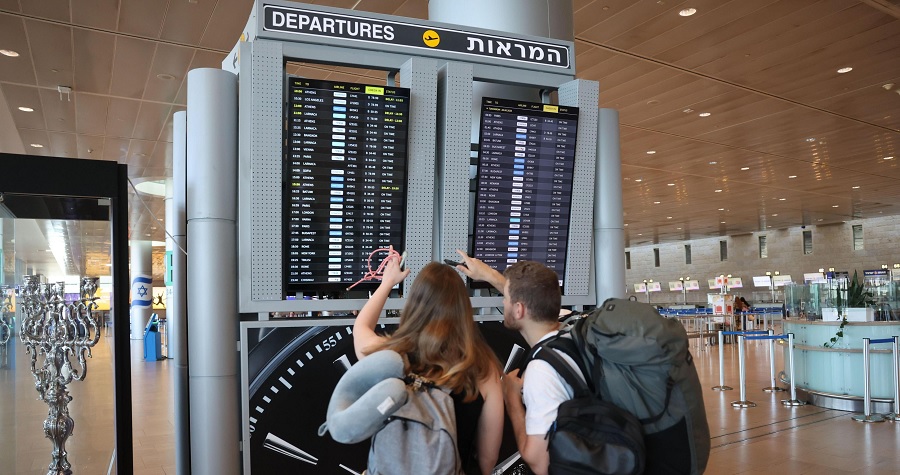


Alwaght- The Israeli regime after October 7, 2023 was way different from what it was before this date. Israeli regime was involved in six fronts, on top of them Gaza war due to Tel Aviv’s warmongering. From west Bank and Gaza Strip to Lebanon, Syria, Yemen, and Iran have made a united front against the Israelis, targeting its existence. That may be the reason why the Israeli reverse migration is on the rise.
Israel’s Haaretz newspaper in a new report said that the willingness to the migration out of the occupied territories among various layers of the Israeli society is growing at an unprecedented rate. According to the report, 19 percent of the Haredis (ultra-Orthodox Jews) are considering migration. This rate is 40 percent among the secular Israelis. According to the published data, people with high income and education and the center-right voters are more leaning to leaving the occupied territories than others. On the opposite side, religious people with lower education think less about migration.
Haaretz identifies the soaring cost of living, a bleak outlook for children’s future, security concerns, and poor government performance as the main drivers behind a growing desire to migrate.
Ayalah Eliahu, a researcher at the Knesset’s Research and Information Center, has warned about Israelis fleeing from Israel. “Since 2022, we have seen a clear rise in the number of Israelis deciding to leave Israel for good and emigrate,” Eliahu stated. “At the same time, we are seeing a drop in the number of people deciding to return to Israel. In 2022, Israel’s population decreased by 30,000. In 2023, it decreased by 59,000, and this declining trend has continued through 2024 and 2025.”
Danny Zaken from a Tel Aviv insurance institute provided even more striking figures, revealing a surge in Israelis formally renouncing their residency. From 2015 to 2021, we averaged about 2,500 requests per year to cancel Israeli residency. But in 2022, that number jumped to 3,700. In 2023, requests soared to roughly 6,300, and in 2024 we recorded over 8,400 requests to cancel residency in Israel.
Return to Europe
Reports indicate that a reverse migration flow among Israeli residents is intensifying. Many who once migrated from Europe to the occupied territories are now returning to Europe and other Western destinations. Citing official Tel Aviv statistics, The Guardian newspaper identifies the driving factors behind this exodus as political polarization, skyrocketing living costs, the repercussions of the wars in Gaza and Lebanon, and deep-seated security concerns following Hamas’s October 2023 attacks and then Iranian attacks in response to the Israeli aggression in July.
According to the report, while the US remains the primary destination for Jewish migrants, Jewish populations in many European countries are also seeing a noticeable increase.
Experts from the London-based Institute for Jewish Policy Research estimate that in the current calendar year alone, approximately 630,000 Israeli-born Jews or those who have lived there for a significant period have emigrated to other parts of the world.
Jonathan Boyd, a Jewish studies expert, noted that the influx of new Jewish immigrants to Europe has significantly impacted the accelerating trend of departure from Israel. In Britain, around 23,000 Israeli-born individuals now reside, nearly double the figure from twenty years ago. The report states that the total Jewish population in Britain is estimated at about 313,000 and continues to grow.
It has also been reported that nearly 12,000 Israelis and their children currently live in the Netherlands.
Avishar Lev, who moved from Tel Aviv to Berlin in 2012, told The Guardian: “Until a year ago, I identified as Israeli, but lately I feel my Jewish identity more strongly than my Israeli one.”
Many of the new arrivals from Israel to Europe are educated, relatively young, and have children in their new homes.
Impacts of reverse migration
Official Israeli statistics shows that the Israeli popular growth rate dropped to 1.1 percent from 1.6 percent. This population drop, driven by growing reverse migration, has caused concerns in the occupied territories. A recent Yedioth Ahronoth and other Israeli media reports have set off the alarm bells about “brain drain.” Professor Aaron Ciechanover, a prominent Jewish scientist, has seen measures by the Israeli cabinet as the main motivation behind migration. He told Th Guardian that those of leave Israel want to live in a free country, not one where the government has taken power forcefully.
Capital flight
In a fresh report, Calcalist economic newspaper has given a negative picture of the growing wave of migration from Israel. Citing a new research by the University of Tel Aviv, the newspaper suggests that the reverse migration from the occupied territories is becoming a “structural phenomenon” with vast economic and social consequences.
Calcalist adds that the research describes this new migration wave as a “qualitative shift,” as a significant portion of the emigrants includes high-income earners, young people, and professionals such as doctors, engineers, and high-tech industry workers, groups considered the backbone of Israel’s labor market.
According to the report, the departure of these groups translates to a loss of 1.5 billion shekels (approximately $395 million) in tax revenue over the mentioned period; an amount that would have been deposited annually into the regime’s treasury had these individuals stayed. The newspaper notes that this damage is not limited to income tax alone but also includes value-added tax, corporate taxes, and other payments that are now lost.
Calcalist states that the research, using a new methodology, distinguishes between “permanent emigrants” and “temporary travelers,” refuting the regime’s claims that a large part of this exodus consisted of immigrants from former Soviet countries.
The newspaper reports that the proportion of high-income individuals among emigrants has risen from one-quarter to over one-third, a development indicating that Israel is losing pivotal forces of its economy, including engineers, high-tech specialists, freelancers, and senior managers.
The newspaper as a conclusion warns that this is a “big strategic danger” for the Israeli future. This newspaper adds that “for the systems to collapse, there is no need to migration of millions; the concentrated exit of doctors, engineers, and researchers can make a cycle of collapse that is irreversible.”
Researchers have warned that continuation of this trends takes the Israeli economy to a point of no-return, a point where the structural damage is irreparable and will lead to erosion of the power of production and innovation.
Strengthening of hardliners
Since the current migration involves the middle class and academia, it boosts the position of the hardline groups in the elections. Actually, the current migration wave, which means in the future years, we would see the power gain of the radicals in the coalition cabinets.
Crisis of shortage of soldiers
On the other hand, the Israeli military is grappling with a manpower shortage, and the refusal of ultra-Orthodox seminary students to enlist has triggered growing pressure to draft Haredi students into military service. Reports indicate that the Israel Defense Forces are short by roughly 12,000 personnel, 9,000 combat troops and another 3,000 in support roles.
The dispute over Haredi conscription has been one of Israel’s most acute political and social flashpoints since the 2010s. The crisis is deeply rooted in Jewish religious tradition and history: the Haredi community has long insisted on maintaining its autonomous religious lifestyle and avoiding participation in the military. The situation escalated sharply after Israel’s exemption-extension law expired in June 2023. Following the outbreak of the Gaza war and the military’s urgent need for fresh recruits, the government has signaled that it is no longer willing to preserve sweeping exemptions. However, the parallel migration of middle-class Israelis and the emigration young people is likely to exacerbate the army’s manpower gap. Much of the current wave of emigration consists of young Israelis who otherwise would enter the draft, while many Haredim who remain in the occupied territories continue to avoid military service.