















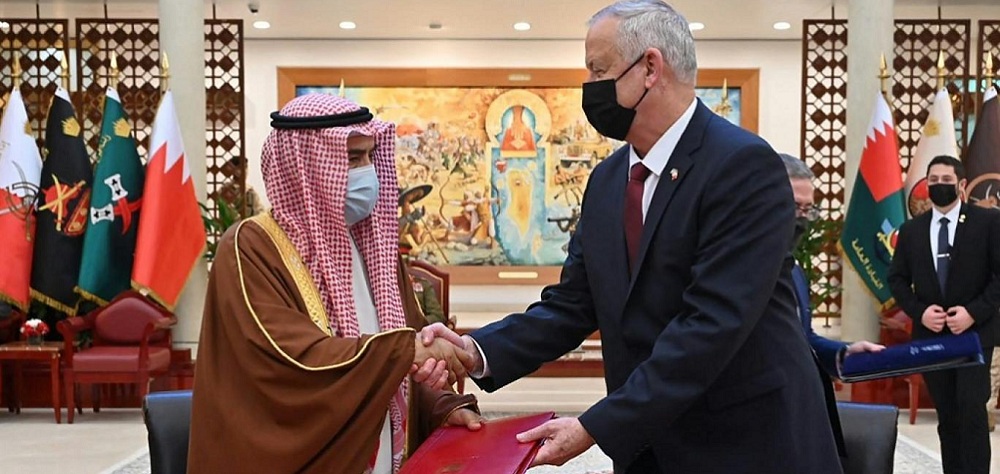


Alwaght- A forerunner in the normalization with the Israelis, Al Khalifa regime of Bahrain this time, too, overcame the other Arab states in security agreements with Tel Aviv to give Israeli spies a pass to Persian Gulf region.
In the past few days, Israeli military circles said that Tel Aviv agreed to provide drones and air defenses and training on their use to the Bahraini government. According to these circles, the Israeli leaders look at this agreement as a "long-term strategic step" towards integration into an expected Persian Gulf air defense shield meant to deter what the US and its regional subjects call threats from Iran.
An agreement to counter Iran
The Israeli regime has put security agreements with the Arab monarchies on its agenda as the plan to forge a regional coalition against Iran has already failed and therefore the Israelis are trying to strengthen their relations with the Arab states through bilateral agreements to facilitate stronger presence in these countries to deal with the so-called Iranian threats.
Having in mind that Bahrain has the closest borders with Iran, the Israelis are trying to closely monitor Iran's movements by deploying their drones in this country to obtain information. On the other hand, the Israelis are interested to test Iran's air defense capabilities with flying their UAVs near its borders. The presence of Mossad officers in Bahrain under the deal is not for the purpose of training the Bahraini forces but to monitor developments in Iran, and this is part of the strategy of "death by a thousand cuts", which is supposed to confront Iran on all fronts. In recent weeks, media broke the news about sale of Israeli defense systems to the UAE and Saudi Arabia in order to strengthen bilateral relations and diversify anti-Iranian fronts.
Israeli officials say boosting security relations with the Arab world contributes to the regional stability, but since these agreements are aimed against Iran, not only they do not help stabilize the region but also they can bring challenging as they provoke Iranian reactions. In recent weeks, Iranian officials have firmly said that if a coalition against Iran is formed in the region, which is referred to by the Americans as "Middle East Air Shield", Tehran will respond proportionately. Given the fact that all the adventures of the Israeli regime in the Persian Gulf are made with the aim of getting closer to Iran's borders and creating a balance with the threats of the Iran-led Axis of Resistance near the occupied Palestinian territories, not only the security of the Arabs will not be guaranteed but also it will be endangered because in a confrontation between Tehran and Tel Aviv it is the Arabs who suffer, and the defense systems that Israelis are going to provide to them will practically do nothing against Iranian missiles and drones.
Distancing the threats from occupied territories
Caught in an Axis of Resistance's encirclement from all fronts, Tel Aviv seeks a way out of this security entanglement with part of costs of this confrontation directed to the Persian Gulf monarchies. It intends to relatively secure its vicinity by distancing the threats from the occupied territories. By powerful presence in Bahrain, the UAE, and Saudi Arabia, the Israelis want to distract Iran from the Palestinian cause and retaliation inside the occupied territories and bring Iran face to face with Arabs. In recent months, Iran warned it will resolutely retaliate for Israeli assassination of its military officers and sabotage in its nuclear and military facilities, and this is pushing the Israelis to conclusion that they need to share with the Arabs the costs of countering Iran as they know that insecurity restricted to the occupied territories amid the political crisis puts them in dire straits.
The Al Khalifa regime, blindly following Saudi policy of confrontation with Iran, is facilitating entrenchment of Israeli spies in the region to raise Iranian security costs. The fact is that the Arab monarchies are shaped on shaky foundations and mistakenly see security and stability for their thrones through giving the Israelis a toeholds on their soil.
Given the old Israeli goal of weakening the Arab nations and bringing them to confrontation with Iran, the new security agreements are part of a destructive project to fuel the tensions in the Persian Gulf. Meanwhile, Arab countries are expected to see more instability as Iran is serious about making its enemies accountable.










