






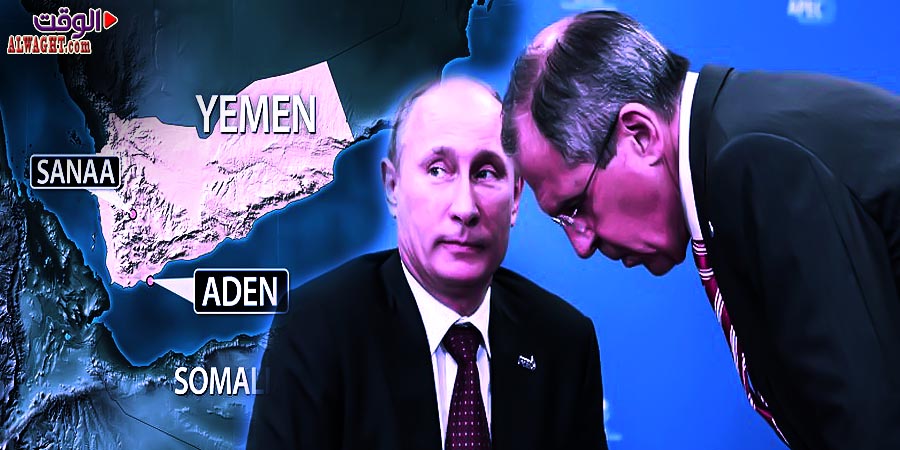


Alwaght- After Abd Rabbuh Mansur Hadi’s presence in Aden, Vladimir Dedushkin, Russian ambassador to Yemen stressed his country's support for legitimacy of Abd-Rabbu Mansour Hadi’s presidency. This was Russia's first public and official stance on recent developments in the country in its ambassador’s visit to Mansour Hadi in Aden. Dedushkin stressed that ‘Russian Federation has no doubt about the legitimacy of the President Mansour Hadi, as the recent resolution of the United Nations recognized the fact’. Considering Russia’s approaches to Yemen crisis, this news article examines the role of various factors in deciding Russia’s strategy towards Yemen.
History of Russia’s presence in the region: Russia has had a long-dated policy in the West Asia. In former Soviet Union, Moscow looked at the West Asia ideologically, and tried to establish links with quasi-socialist or National Socialism currents based on its Marxist notions. During the Cold War, Russia’s approach to Yemen was mainly focused on ideological issues and limiting the US position in the West Asia and improving its own status in regional interactions. Therefore, a significant part of Yemen’s military infrastructure was dependent on Soviet army. After the collapse of the Soviet Union, Moscow virtually experienced an era of absence and lack of interaction with pro-Soviet countries. The Islamic Awakening forced Russia to react. Over the past two decades, some regional and international factors made Russia not to pay so much attention to Yemen; however, Russia did not completely distance from Yemen.
Geopolitical significance of Yemen : In Libya, Russia tried to follow a pro- Western policy. As a result, Russia realized that such a policy is primarily in the framework of a security dilemma and geopolitical space of the West Asia rather than political changes in the region. Therefore, some Russian politicians believe that the future of security changes and East-West relations are defined in the West Asia. Furthermore, it should be noted that Russia essentially seeks to maintain its bases in Yemen, the Red Sea, Indian Ocean and the Strait of Bab el-Mandab, and this is particularly important for Russia’s presence in North Africa and also in international, trade and the security arenas.
Relations with Riyadh: Recently, Abdulrahman Ibrahim al-Rassi, the new Saudi ambassador to Moscow, presented his credentials to Russian President, Vladimir Putin. Saudi Arabia’s new ambassador to Russia said contacts with Russia continues and there has not been even a day off. Besides, if we look into King Salman bin Abdulaziz Al Saud’s talks with Vladimir Putin, the Saudi King and Russian president, we note that Salman assessed the Russian efforts to normalize the complicated situation in Yemen as excellent and expressed his gratitude for Russia’s support from the Resolution No. 2216, dated 14 April 2015. In return, Vladimir Putin invited the King Salman bin Abdulaziz Al Saud to visit Russia. It should be noted that the nature of Moscow-Riyadh relation has an important role in how Russia approaches Yemen issue. Therefore, Moscow knows that the significance of Russia's decision about Yemen depends on Saudi Arabia as an important actor. As to control the energy prices, especially oil, the presence of a pro-Russian government in Yemen, can put pressure on Saudi Arabia and refrain Saudi Arabia from using oil as a tool against Russia. On the other hands, as Takfiri-Salafi movements indirectly affect Caucasus, especially Chechnya, Russia can use its influence in Yemen, to put pressure on the supporters of the Salafi movements and Chechnya and make a deal with supporters of movements in this area who can create instability in Russia. In fact, in present situation, tools such as veto, the Russian actions in Yemen, etc., can encourage Russia to gain major concession and adjust Russia’s stance towards Yemen.
Idea of returning to the West Asia: In Russian foreign policy and in view of its foreign-policy makers, particularly Putin, the idea of ‘a great power’ has had the greatest effect on formulating the current policy of Russia on Syria. Indeed, the grief of missing the tsarist periods and the former Soviet Union are of common points of different political currents in Russia. This is the common feeling in conversion of Russia to ‘a great power’ and the idea is basis of the guidelines for taking measures in its foreign policy, and Moscow’s interpretation of its position in the international community as an independent and privileged identity. From this perspective, Russia will be respected only if it is powerful. Therefore, Putin's policy as opposed to that of the West on Syrian crisis and the West Asia is to challenge the Western Universalism. In this regard, the Kremlin has defined for itself certain political and geopolitical interests in the West Asia and views its powerful return as a prerequisite for restoration of Russia’s power. Currently, Yemen issue could be a great opportunity for such a return.
Comparative views on Yemen, Ukraine and Syria: Although Russia feels that it is restructuring its former sphere of influence with the support of anti-Western and anti-Saudi forces, at the same time tries not to incur significant costs and losses. In fact, Russia’s view on Yemen, is different from its view on Syria and Ukraine, and does not intend to resort to military confrontation to defend its interests, contrary to what it did in Ukraine. Making use of diplomatic, media and business tools, Russia makes attempts to maintain its relations. That is why Russia in another resolution that was much condemnatory than the current resolution, to be passed against Ansarullah, cast a blank vote. Russia’s sensitivity to Yemen is far less than that to Ukraine and Syria. Because those countries compared to Yemen, enjoyed higher strategic position, resources and economic power. However, Yemen’s importance is due to Bab el-Mandab strategic position. Russia shows minimum sensitivity and resistance against the West, and Saudi Arabia in Yemen crisis.
Relations with Iran: Although Russia seeks to play a significant role in trade and economy of rich Persian Gulf countries and keep them satisfied with Russia, it attempts to have a key role and still remain the first ally of Iran. For this purpose, Russia tries to play a mediating role in disputes and regional conflicts. The more the Iranian approach to Yemen is closer to Russia’s interests, the more support Russia will give to the approach.
Competition with the US and Yemen Axis : Russian’s current policy is to remain powerful enough to manage the current situation in the West Asia. However, Russia and the US do not seem to seek direct military confrontation with one another. In addition to increase its military power, Russia tries to display its active military presence, create a legal discourse and give timely responses to crisis management. Directly resisting against the expansionism of the West in the West Asia, Putin tries to show the West that Moscow can play a balancing role in the region. It is noteworthy that Russia’s doctrine of national security and foreign policy pursues a systematic pragmatism. If we look into Russian approach to the West, Yemen might serve a key role in regional crisis in striking a deal with the United States. Thus, as Russia has given up its former domineering and ideological trends, it makes efforts to bring into power an impartial and independent government in Yemen. Nevertheless, Russia will not allow establishing a government fully dependent, allied with the West.