
















Alwaght- As traditional power equations in West Asia undergo a shift and the race to shape the region’s future security architecture reaches a climactic point, several Islamic powers are seizing the moment. With a clear-eyed reading of the security vacuums left by wars and political crises, they are taking bold steps to expand their influence.
In such atmosphere, Pakistan, leveraging its military muscle, is steadily emerging as an active player in the Arab world’s security calculus. This trend has now reached Lebanon, potentially opening a new chapter in Pakistan’s regional role.
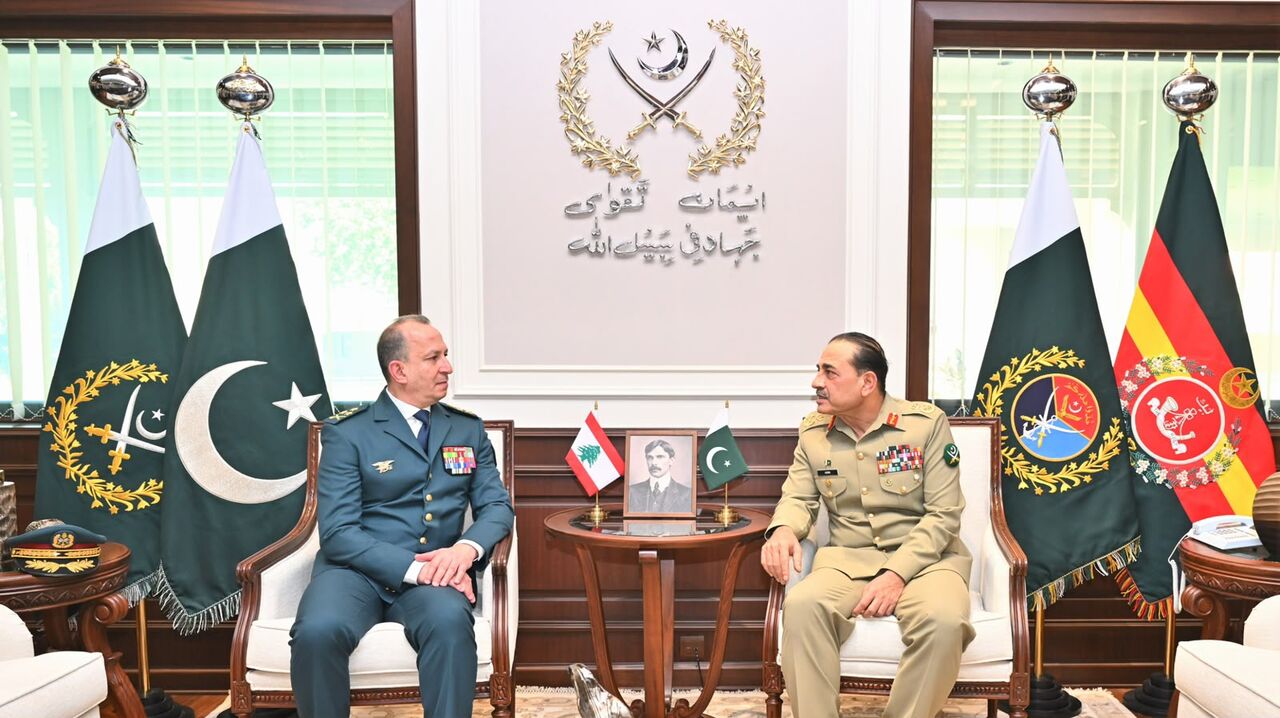
It is against this backdrop that Lebanese Army Commander General Rodolph Haykal’s visit to Pakistan and his meeting with his counterpart, General Asim Munir, should be seen as a clear sign that both nations are striving to upgrade defense cooperation amid the region’s sensitive circumstances. During their talks, the two sides exchanged views on mutual interests, regional security developments, defense collaboration, and prospects for deepening bilateral military ties.
The focus of their discussions, which was expanding training cooperation, sharing military expertise, strengthening institutional links between their armed forces, and reviewing regional security trends, demonstrates that Islamabad and Beirut are aiming to define an entirely new level of military relations.
General Munir’s emphasis on broadening cooperation with Lebanon’s armed forces, along with Beirut’s keen reception of the Pakistani military’s capabilities and experience, makes it clear: both sides are moving toward strategic security and defense partnership.
Growing military cooperation between Pakistan and Persian Gulf monarchies
Over the past decade, the Pakistani military has steadily evolved into a leading security player across the Muslim world. Armed with a nuclear arsenal, a massive Muslim population, a battle-hardened professional army, and extensive counterterrorism experience, Pakistan has earned the trust of many Arab nations as a reliable security partner.
The roots of Pakistan’s military expansion into the Arab world lie in its strategic relationship with Saudi Arabia. Defense cooperation between Islamabad and Riyadh has long surpassed traditional ties, maturing into a full-fledged strategic security partnership.
Training programs, the deployment of Pakistani military advisers to Saudi Arabia, joint exercises, and sweeping defense agreements all underscore the depth of their strategic relations. Some reports even suggest an increased presence of Pakistani forces in the Arab kingdom under bilateral defense pacts.
Saudi leaders, analysts say, view Pakistan as a trustworthy military partner against regional threats, one that possesses not only conventional military power but also nuclear deterrence. This very factor has gradually made Islamabad a cornerstone of the security architecture envisioned by several Arab states.
Bahrain is another Persian Gulf Arab nation deepening its security ties with Pakistan. On June 9, Bahrain National Guard chief Mohammed bin Isa Al Khalifa arrived in Islamabad for an official visit, meeting with senior military officials including Air Chief Marshal Zaheer Ahmed Babar Sidhu.
The two sides stressed expanding military and security cooperation and enhancing joint coordination. Bahrain’s National Guard commander praised the level of defense collaboration, while Pakistan’s air chief described the visit as a step toward stronger military relations.
This trend points to Pakistan weaving a web of security partnerships across the Persian Gulf, a network that could, in the future, boost Islamabad’s political and military clout throughout the Arab world.
One of the newest frontiers for Pakistan’s expanding regional influence: the unfolding situation in Yemen.
For much of the past decade, Islamabad steered clear of direct involvement in Yemen’s war. But recent developments suggest Pakistan’s role in the country’s security landscape is quietly expanding. What stands out most is its growing footprint in Saudi-backed security arrangements across the southern Arabian Peninsula.
Strategically, Yemen is no mere regional crisis for Islamabad. It is part of a much larger equation: the security of the Makran Sea, the Bab-el-Mandeb Strait, and the world’s vital energy shipping lanes. That explains why Pakistan, acting within the framework of its security agreement with Saudi Arabia, has recently positioned some of its forces in Yemen’s eastern Hadhramaut province, which is under Saudi-backed mercenaries.
One of the most telling dimensions of Pakistan’s regional push centers on Yemen. After a decade of caution and avoiding direct combat, Islamabad is now playing an increasingly active role in Yemen’s security dynamics. What is grabbing attention is Pakistan’s deeper involvement in Saudi-led security arrangements in the southern peninsula.
Islamabad expanding influence to the Mediterranean
As part of its regional expansion strategy, Pakistan has nit limited itself to the Persian Gulf. It is seeking a foothold in strategic hotspots further afield. In this regard, Lebanon, with its geopolitical weight in West Asia and access to the Mediterranean, is shaping up as a key pillar in Islamabad’s regional influence portfolio.
Lebanon has been battered by political, economic, and security crises in recent years. Repeated flare-ups with Israel have only added to the complexity of its security situation, turning the country into one of the region’s most volatile and sensitive flashpoints.
Pakistan has long been present in Lebanon under the UN flag. Its troops have a solid track record with UNIFIL missions, giving the Pakistani military a fairly precise understanding of Lebanon’s security environment.
Now, Islamabad seems to be aiming beyond its traditional peacekeeping role, toward becoming a strategic partner of the Lebanese army. The latest talks between the two countries’ military commanders, focused on expanding security cooperation, confirm exactly that ambition.
Pakistan eying Muslim world security leadership
Recent developments point to a clear reality: Pakistan is pursuing a long-term project to become a cornerstone of security across the Muslim world. Its expanding military cooperation with Arab nations should be read entirely in that light.
The Pakistani officials know full well that possessing the largest conventional military among Muslim countries, coupled with its unique status as the Islamic world’s sole nuclear power, gives Islamabad enormous potential to shape regional dynamics.
On the other side, military partnerships also offer Pakistan tangible benefits, including a boost for its defense economy, training opportunities for its forces, and greater political sway in the Arab world.
Given that the US, despite its massive military footprint and advanced hardware in Arab states, has largely failed to guarantee their security and territorial integrity against external threats, Islamabad is seizing the opportunity. It is positioning itself as a reliable alternative power, ready to defend Arab security.
At the same time, the growing diplomatic role of General Asim Munir in West Asian affairs signals that the Pakistani military is no longer just a fighting force, it is gradually assuming a broader political and security role in regional dynamics. Some observers now even speak of Islamabad quietly angling for a seat at the table where the region’s new security order is being shaped.
Overall, Pakistan’s military cooperation with Lebanon should be seen as the latest link in a much longer chain of strategic influence across the Arab world, a chain that began in the Persian Gulf, stretched to Yemen, and now reaches the Mediterranean coast. If this wave continues, Pakistan could well emerge in the coming years as one of the decisive military players shaping West Asia’s future.










