
















Alwaght- While the Israeli regime thought that with assassination of Hezbollah chief Sayyed Hassan Nasrallah it will suppress the resistance discourse in Lebanon, the passionate presence of the people on the second anniversary of martyrdom of Nasrallah showed that elimination of the leaders not only has not terminated a political and social current, but also the resistance as a deep-rooted and influential current continues to live on in Lebanon.
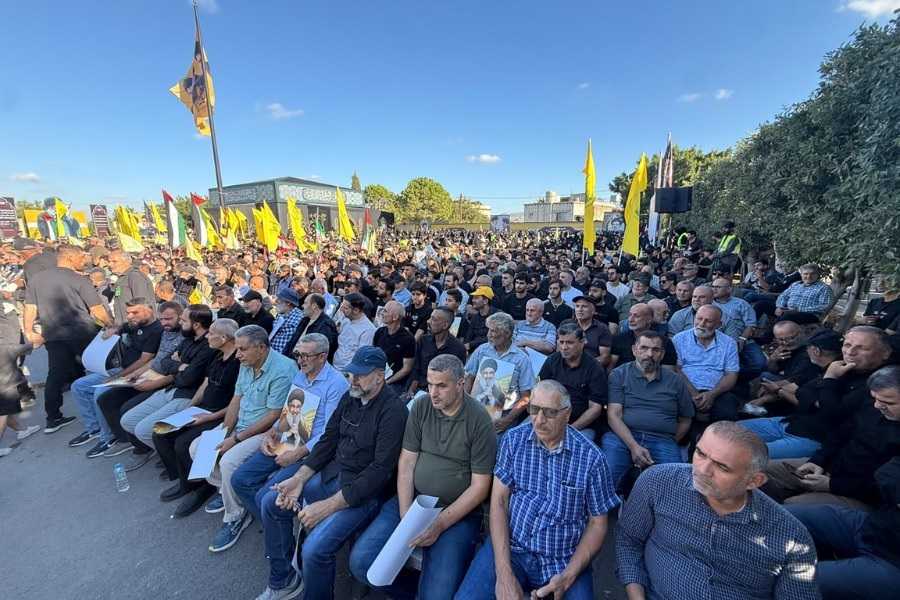
For the second year running, Lebanon marked the anniversary of Sayyed Hassan Nasrallah’s martyrdom with a massive show of popular force. Thousands gathered beside the tomb of Hezbollah’s former secretary-general in Beirut’s southern suburbs, waving the movement's yellow flags and portraits of the martyred leader, and chanting political and religious slogans to affirm that his memory and legacy live on.
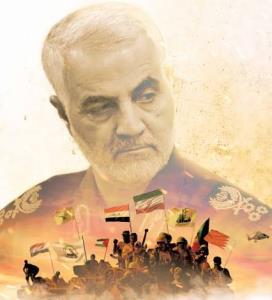
Hezbollah’s military press released an image to mark the second anniversary of the group’s martyred leaders, captioned: “We keep our pledge, O Nasrallah.”
Visitors converged on the site of his martyrdom to declare that, were life itself a gift to give, they would lay it at his feet.
“Today is a historic day,” said one Lebanese citizen who attended the ceremony. “Every year we mark this day to renew our pledge to Nasrallah that we will walk in his footsteps. The former leader lit the way for us, and God willing, we will carry on. This crowd is proof that we are continuing his path and keeping our promise.”
Another attendee called the commemoration "sacred.", saying "we lost someone dear to us, but thank God, Sheikh Naim and the others are here." "We will keep going down this road, even if all of us are martyred, we will not stop."
Political and religious leaders turn out
A large contingent of the movement's leaders, political figures and religious activists joined the crowds.
Hussein al-Nimr, Hezbollah’s official for the Bekaa region, invoked the virtues of Sayyed Nasrallah and his aide Sayyed Hashem Safieddine, maintaining: "The martyrs are the lamps that light our way and the architects of victory and dignity. Honoring their forebears is honoring the generosity that produced this generation of martyrs."
Former Lebanese President Emile Lahoud, recalling Nasrallah’s life and political career, said: "On the anniversary of the martyrdom of our dear brother, Sayyed Hassan Nasrallah, we cannot but remember his rich life and its historic, fateful chapters. He has always been, and remains, a source of dignity and pride. Though he had paths open to him to survive and stay away from his homeland, Nasrallah chose martyrdom alongside the resistance fighters."
Sheikh Ghazi Hanina, head of the board of trustees of the Muslim Scholars’ Gathering, underscored the resistance’s commitment to the covenant struck with the martyr of the nation and vowed to press on until Palestine is liberated and the Israeli occupiers are defeated.
"Despite the pain and grief filling their hearts, those gathered here remember Sayyed Nasrallah," Hanina said.
Naim Qassem’s address
The core of the ceremony was a televised speech by Hezbollah Secretary-General Naim Qassem, broadcast to the crowd. Qassem declared that Israeli regime had failed to achieve its goal of destroying Hezbollah and ending the resistance, and that the movement would not agree to disarm until Israeli occupation forces withdraw from occupied areas of southern Lebanon.
Addressing the martyred chief Nasrallah directly, Qassem said: "You are the resistance itself, its symbol for the world’s free people. You are the global leader of the resistance and an inspiration to the free. Your body has left this world, but your teachings and your light remain, giving us dignity and will. You built a movement, a resistance and a steadfast, powerful popular base, and that approach will continue. You carried the banner of Palestine and planted it in our lives, and Palestine will remain our compass, and the liberation of the land our foremost priority."
"We remain true to our pledge and committed to the principles, the foundation of the resistance and the divine mission of confronting aggression with courage and honor. We support the continuation of the resistance and will keep up the fight against the enemy until it is driven from our land and the full liberation of occupied territory is achieved. We have kept our promise, meaning we will safeguard the trust of the martyrs, including the martyr of the Islamic nation, Sayyed Hassan Nasrallah," Qassem continued.
Anniversary ceremonies in regional countries
In addition to Lebanon, in some regional countries the anniversary was marked.
In the Yemeni capital Sana'a, the second anniversary was held. Mohammad Meftah, the interim prime minister of the National Salvation Government, paid tribute to the martyred secretary-general of Hezbollah, saying that he was the only character in the history of the world for whose assassination 100 tons of explosives were used. Referring to the equation Nasrallah established, Meftah said that "we do not lose. When we win, we are winners, and when we die as martyrs, we are winners, too."
Foad Naji, the member of Yemen's Scholars Council, said that the "bood of Sayyed Hassan Nasrallah and his companion Sayyed Hashem Safieddine will redraw the regional equations.
Iraq, too, held a ceremony commemorating the second anniversary of Nasrallah’s martyrdom. Moin al-Kadhimi, a former Iraqi parliament member who attended, said: "We will not forget the martyr Nasrallah’s support for the Iraqi people in difficult times. We are here to honor this noble martyr and to affirm that we stand with the Islamic resistance in Lebanon."
In Tunisia, a gathering was likewise held to mark the second anniversary, with participants paying tribute to his memory.
Taken together, the second anniversary of Nasrallah’s martyrdom made one thing clear and it is that in politics, the loss of a leader does not necessarily mean the end of his influence. Sometimes, in his absence, a name becomes a symbol, a lens for rereading the past and charting the road ahead. That is a story still unfolding in Lebanon.










