

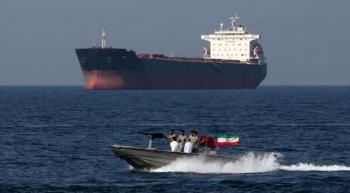













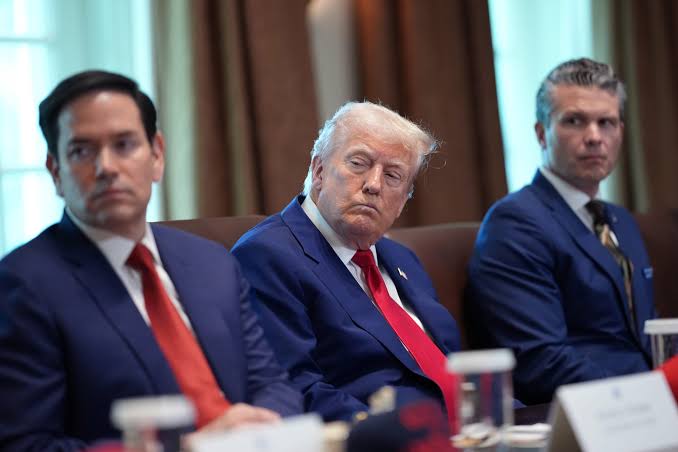


Alwaght- Though Iran war has entered its seventh month, the US President Donald Trump refuses to use the term "war" for his aggression against the Islamic Republic, and in his latest comments he described it the "military conflict" and even "small potatoes."
Trump appears to be trying to downplay the role of the Strait of Hormuz to pretend to the public that the war consequences are low-cost and controlled and to insunate that Washington has the upper hand against Tehran. But behind the gesture of calmness, there is an anxious president that is greatly worried about the results of the upcoming midterm elections.
He wants to suggest that just contrary to his predecessors, the campaign against Iran has not bogged the US down in a war of attrition and actually a swamp as costly and exhausting as Vietnam war. This pretence is because he wants to assuage the political pressures against himself and other Republicans. But this struggling not only failed to give his position and the GOP a boost, but also in many areas has delivered the reverse.
Public discontent with surging fuel prices
Despite Trump’s recent announcement of a deal to secure access to and control over a significant portion of Venezuela’s oil reserves, claiming it would soon drive down US fuel prices, the market has moved squarely against his promises. Far from falling, fuel prices have extended their climb, notching fresh record highs.
The AP reported this week that diesel prices hit $5.85 per gallon for the first time in US history. In its analysis, the AP noted that rising diesel costs could compound electoral troubles for Republicans heading into November. Because diesel is the lifeblood of the freight and delivery network that moves goods across the country, its surge is pushing up transportation costs for a broad swath of everyday products. Consumers, in turn, are likely to see those increases show up on store shelves. That dynamic, the agency added, threatens to pile more political pressure on Republicans before election day, particularly since many voters are already dissatisfied with Trump’s handling of the economy and the fallout from the war his administration set in motion.
Meanwhile, gasoline prices hit $4.14 per gallon this week, up about 6.5 cents from a week earlier. With less than two months until the midterms, the trend is shaping up as a potential Achilles' heel for the GOP, fueling anxiety in Washington over the war’s economic and political ripple effects and how they’re landing with American voters.
A report released in late August by the Center for American Progress estimated that the war with Iran has already added $1,200 to the average household’s costs, driven by higher fuel expenses and the inflationary fallout.
The latest official data, from early September, show the energy index up 14.7 percent year over year, with gasoline alone surging 24.6 percent above last year’s levels. Food prices have risen 3 percent annually. So even as the broader inflation rate edged down to 3.4 percent, a critical slice of household necessities continues to see steep price hikes.
Retail sales unexpectedly fell in July for the first time in nine months, Reuters reported, a sign that consumer spending is losing momentum, a trend that takes on added weight amid rising energy costs.
And a Financial Times poll released September 6 found that 57 percent of Americans say they are financially worse off under Trump, up from 53 percent in August. At the same time, approval of Trump’s economic stewardship has slipped to 33 percent, with rising living costs and fuel prices cited as the top drivers of discontent.
US war for Israel's security
Trump has argued over and over that he began Iran war for the US interests and world peace, but his critics have different opinion.
They say that this war serves the strategic aims of the Israeli regime rather than directly serving the American interests. Analysts and political figures at Council on Foreign Relations say that the Israeli Prime Minister Benjamin Netanyahu encouraged Trump to get involved in a war that serves the Israeli interests.
Middle East Policy magazine in a piece writes that the American justifications for war like nuclear program, missile program, and the so-called Iran proxies in the region align more with the Israeli interests, not those of the US. They maintain that the enormous military and diplomatic support provided to Tel Aviv by Washington, including direct involvement in war, has given rise to a question: Is Trump truly fighting Iran for the US security or for the Israeli goals?
Rising military toll
One of the main drivers of domestic opposition to continuing the war with Iran is the rising US military death toll, a factor that has intensified criticism of the Trump administration. According to the latest Pentagon figures, 18 American service members have been killed and 756 wounded, bringing total US military casualties to 774.
Critics argue that this level of loss, combined with the protracted nature of the conflict and its soaring costs, directly undercuts Trump’s pledges to avoid lengthy foreign entanglements. Widespread coverage of the casualties, along with scrutiny over how the Pentagon is recording and classifying them, has only added to the political pressure bearing down on the administration.
Depleted munitions
Though Trump and his War Secretary Pete Hegseth argue that the US weapons arsenal has not been depleted during Iran war, reports suggest considerable drop in the weapons and ammunition stockpiles, something that can curtail the US capability to fight a prolonged war.
Media outlets have recently reported that nearly 80 percent of the air defense rockets have been consumed during conflict. This has aroused the ire of Trump and his War Secretary.
Estimates from the Center for Strategic and International Studies (CSIS) suggest that restoring some missile stockpiles to pre-war levels could take until 2031. The issue has become so sensitive that roughly 50 members of the Joint Chiefs of Staff have been subjected to polygraph tests as part of an investigation into leaks regarding munitions shortages.
Critics say these developments flatly contradict Trump’s claims about the strength and full readiness of the US arsenal, and could become a political liability for Republicans heading into the elections, especially with recent polls showing waning public support for the war.
Beyond that, the expanding conflict with Iran and the damage inflicted on US military infrastructure in the region, coupled with the war’s staggering costs, have ignited a fresh wave of domestic criticism.
The Trump administration has requested a $1.5 trillion defense budget for fiscal year 2027, and the Pentagon has asked Congress for roughly $80 billion in supplemental funding to cover war-related expenses and other military needs.
Those figures have fueled concerns about the war’s strain on the federal budget and the potential for cuts to social services, education, and health care. Critics warn that continuing down this path, with US debt already surpassing $40 trillion, could carry heavy economic and political costs for both the Trump administration and the American public. Senator Bernie Sanders, in opposing the defense budget, said: "It's time to invest in the American people, not endless wars."
Generally, a war that was supposed to showcase Trump’s strength has instead turned into an erosion of his political capital. With war costs mounting and public dissatisfaction growing, it is shaping up as a potential Achilles' heel for Trump and Republicans on the eve of the midterm vote.










