

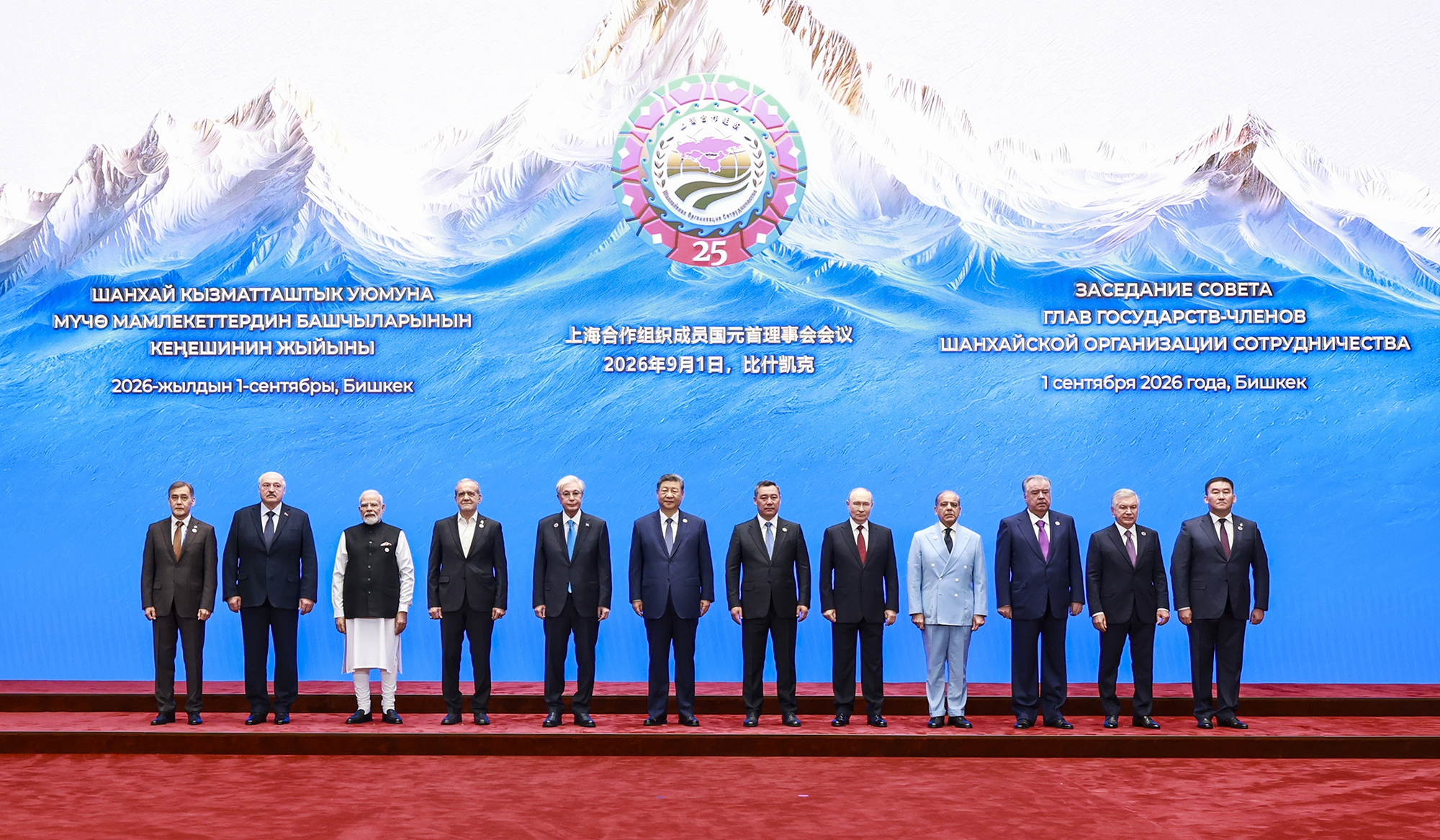


Alwaght- President Masoud Pezeshkian of Iran's visit to Bishkek this week was made as US economic pressure on Tehran enters a new phase. Washington has announced plans to impose fresh secondary sanctions on financial networks tied to Iran, and is even targeting banks and financial institutions that do business with the Islamic Republic. In this climate, Iran’s membership in the Shanghai Cooperation Organization (SCO) has taken on renewed urgency.
Pezeshkian arrived in Bishkek on Monday to attend the SCO heads-of-state summit and the “Shanghai Plus” meeting, where leaders from China, Russia, India, Iran, and other member states gathered.
Many analysts believe the SCO could help Iran cushion the blow of US sanctions. More than a protective shield, the organization may offer Iran an alternative framework, one where trade, energy, transport, investment, and at least some financial exchanges are less tethered to the US dollar and the American banking system.
How did SCO emerge?
The Asian organization was formally established in 2001, but its roots go back to the "Shanghai Five" grouping formed in 1996 by China, Russia, Kazakhstan, Kyrgyzstan, and Tajikistan. Uzbekistan joined the following year, and the SCO was officially born. Its original mission was largely security-focused: countering terrorism, extremism, separatism, and cross-border threats.
Over time, however, the SCO has evolved from a Central Asian security mechanism into a broader platform for political, economic, energy, and transport cooperation. India and Pakistan joined in 2017. Iran became a full member in 2023, and Belarus signed on in 2024, bringing the organization to ten members today.
For Tehran, this transformation carries special weight. Iran is no longer an observer or dialogue partner but a full-fledged member, with a seat at the table in the SCO's decision-making machinery.
From security organization to economic bloc
The SCO is no NATO, yet. There is no collective defense clause, no guarantee that an attack on one is an attack on all. Still, security remains a core pillar. Counterterrorism, counter-extremism, anti-separatism, organized crime, and cross-border threats top the agenda.But in recent years, economics has muscled its way to center stage.
The organization has built frameworks for cooperation on trade, investment, transport, energy, agriculture, industry, customs, and finance. There is even a dedicated working group tasked with boosting the share of national currencies in intra-bloc transactions, a quiet but telling move away from dollar dependence.
Iran's winning card: Trade without dollar
The SCO's most consequential function is its push toward dollar-free trade. For years, the organization has pursued a roadmap to increase the use of national currencies in intra-member commerce. That plan was formally adopted in 2022, and since then, central banks and financial institutions across the bloc have been working to build payment and settlement mechanisms that reduce total reliance on the greenback. Iran's central bank joined the relevant working group for the first time in 2023.
For Iran, that translates into a tangible opportunity: expanded trade settled in rials, yuan, rubles, rupees, and other national currencies.
More broadly, if Tehran can redirect more of its trade toward China, Russia, India, Pakistan, and Central Asian states, while leveraging national currencies, regional settlement arrangements, and non-Western transport networks—Washington's ability to fully isolate Iran economically will diminish.
Significance of SCO in trade and politics
The member states account for nearly half the world's population and a combined GDP estimated at over $23 trillion. The bloc also spans vast swaths of Eurasia, holding an outsized share of the region's energy reserves, mineral wealth, and industrial capacity. For Iran, that means a seat at a vast Asian market. China is already Tehran's top trading partner. Russia looms large in energy, transport, and strategic cooperation. India represents a critical energy market and a key player in Iran's transit projects. Pakistan and the Central Asian republics offer further regional trade openings. In short, SCO membership dovetails neatly with Tehran's "Look East" policy.
Geography is another major advantage. Iran sits at the crossroads of the Persian Gulf, Central Asia, Russia, the Caucasus, and the Indian subcontinent. Projects like the International North-South Transport Corridor, Iran's rail links to Central Asia, and connections to China's Belt and Road Initiative could dramatically elevate Iran's role in the Eurasian transport network.
The SCO itself has made transport cooperation and regional infrastructure integration a priority, backing linkages between the Belt and Road Initiative (BRI), Eurasian projects, and the North-South Corridor. That matters enormously for Tehran because more indispensable a country becomes as a transit hub, the harder it is to squeeze it out of the regional trading system.
The SCO has also become a political platform for Tehran. In July 2026, foreign ministers from member states declared that unilateral coercive economic measures are unacceptable and disrupt international economic cooperation. Then in March 2026, the bloc issued a formal statement on military strikes against Iran, reaffirming its commitment to Iran's sovereignty, security, and territorial integrity. Therefore, for Tehran, then, the SCO is not just a potential market, it is a political podium.