














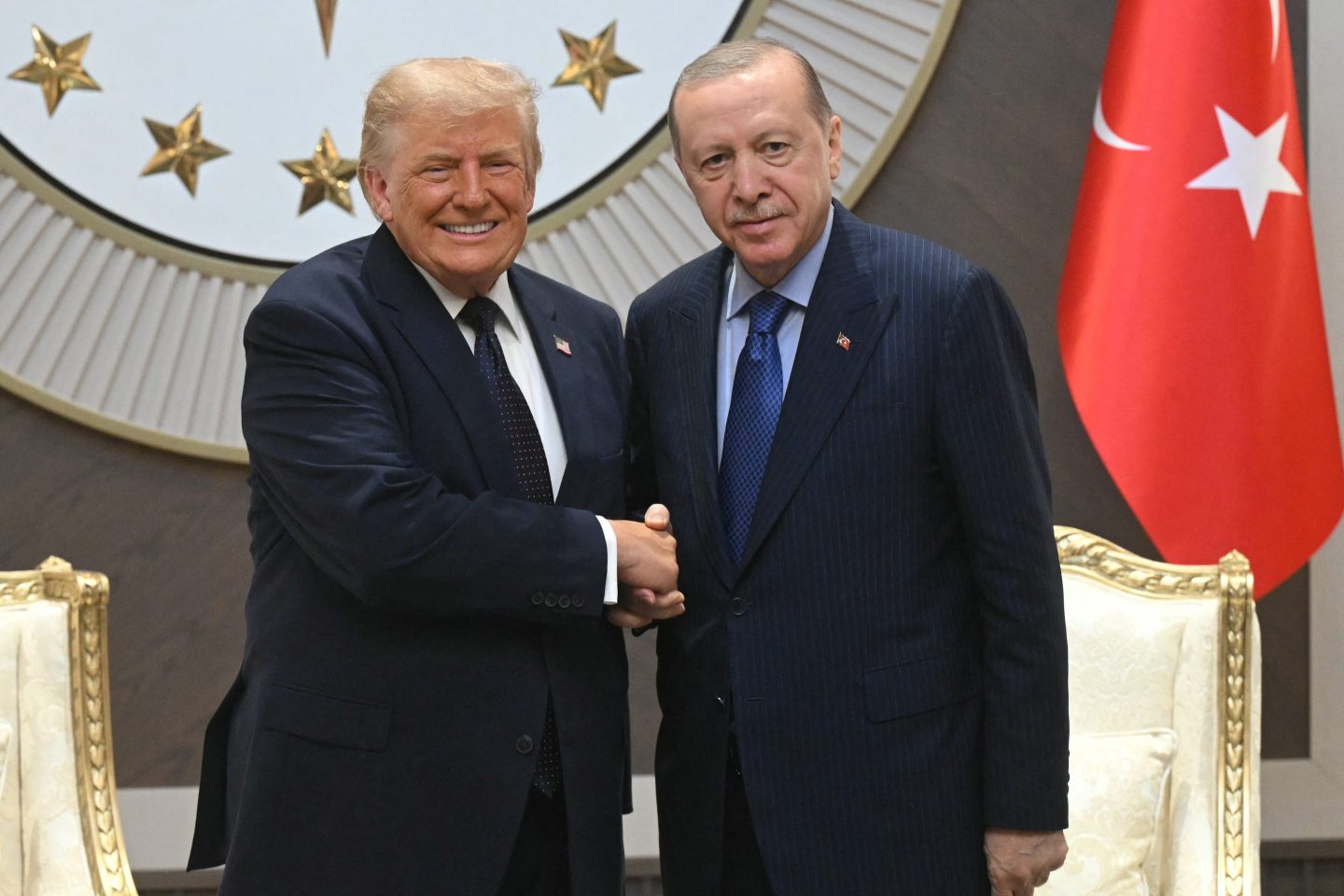


Alwaght- If we assume Trump’s Turkey trip came with an array of military sweeteners like F-35 fighter jet sales and demands to ramp up pressure on Hezbollah and the Iran-led Axis of Resistance, we should not read this visit simply through the lens of US-Turkey bilateral ties. Instead, we should frame it as part of Washington’s broader pivot: moving from a “direct confrontation” strategy to one of “regional balance engineering.”
The latest war on Iran proved, contrary to early estimates, that the Axis of Resistance did not collapse, but it held its command structure, logistics networks, and rebuilding capacity intact. For Washington, the takeaway was stark: military superiority alone would not shift the geopolitical balance. Hence the new US playbook eyes breaking the political, security, and geographic bonds that hold the Resistance camp together.
In this calculus, Turkey is not just another NATO ally. It is the hinge linking three critical theaters: the Eastern Mediterranean, the Caucasus, and the Levant. Shift Ankara’s strategic posture, and you ripple across Syria, Lebanon, Iraq, the Caucasus, even energy and transit routes. That is why incentives like the F-35 promise should not be priced as a mere arms deal. They are the cost of wiring Turkey back into US’s preferred security architecture.
Strategically, the US is eyeing review of the pressure calculus. Over the past two decades, the pressure on Iran was majorly direct, through economic sanctions, assassinations, limited attacks, and military presence around Iranian borders. But now Washington has come to the conclusion that it is more effective to redesign Iran's vicinity, in a way that Tehran will consume a major part of its power maintaining its strategic depth and managing simultaneous crises.
In this plan, Turkey will get a role beyond a security partner. The country can impact the Lebanese government, tip the scales in northern Syria, indirectly sway Iraqi developments, create geopolitical pressure in South Caucasus, and boost alternative energy and transit routes.
In effect, Washington is trying to rearrange the periphery of the Axis of Resistance rather than strike at its center of gravity. But we need to know thart this strategy is not just about security, and it is economic and geoeconomic at its core. If the US, with Turkey's help, can activate new transport and energy corridors while simultaneously disrupting the traditional routes that connect Iran to the Mediterranean, it could erode part of Iran's geopolitical advantage over the long haul, without ever fighting a full-scale war. Seen this way, files like the Caucasus, transit corridors, and northern Syria are no longer separate issues, bit they are pieces of a single map.
That said, the biggest wildcard in this strategy is Turkey itself. Unlike most American allies, Ankara is not looking to play a subordinate role, but it wants to be a regional power in its own right. And its leader Recep Tayyip Erdogan knows full well that Turkey's strategic value stems precisely from this position as a "mediator and balancer." If Ankara were to fully integrate into the US game plan, it would lose a big chunk of its leverage—vis-à-vis Russia, Iran, China, the Arab states, and the backers of the Axis of Resistance alike.
So the likeliest scenario is that Turkey opts for tactical cooperation without strategic alliance, working with Washington on certain files but steering clear of all-out confrontation with Iran or the Axis of Resistance. That is the same playbook Ankara has run with Russia in recent years.
But the less highlighted issue is that what is brewing today is not just a coalition against the Resistance camp, but a competition over post-war regional order. Washington knows that if regional players are charged with containing the crises, the US will see the cost of direct military presence cut, while at the same time the security of the Israeli regime is secured with less reliance on the American military deployment.
Viewed through this lens, the Trump-Erdogan meeting is not really about a few fighter jets, and it is not even about Hezbollah. The core issue is Washington's bid to build a "geopolitical containment belt" stretching from the Mediterranean to the Caucasus. In this architecture, Tel Aviv provides military deterrence; Turkey manages the geopolitical and transit nodes; certain Arab states supply financial and political backing; and the US plays coordinator and security guarantor for the whole framework.
Finally, we should say if this assessment holds, West Asia has entered a new phase. The main competition is no longer over controlling territory, it is about controlling corridors, influence networks, proxy states, and the connective routes that tie the region together.
In such conditions, any military deal, any weapons sales agreement, and any diplomatic visit and meeting make part of broader project of redesigning the balance of power in the region, a project whose failure or success will determine the future of the West Asia security order for the years to come.










