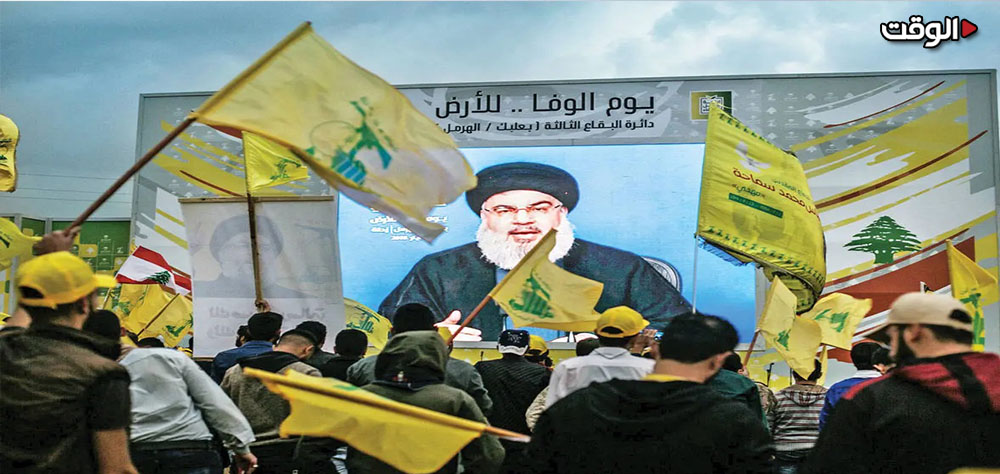











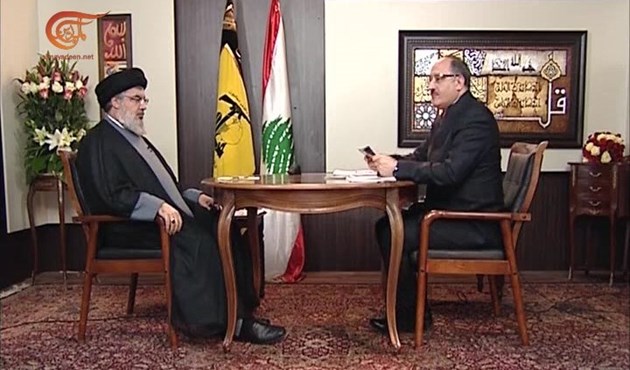


Alwaght- When Hezbollah Secretary-General Sayyed Hassan Nasrallah is scheduled to go on air, whether in a televised speech or an interview with a media outlet, all eyes are pinned on the silver screen. Across the occupied territories, the Israelis are all the more alert and vigilant. They wait for what Sayyed Nasrallah has to say so they can calculate the implications of his next threat.
Israeli media, in particular, go about broadcasting, printing, and publishing Sayyed Nasrallah’s speech, making headlines but more importantly analysis of what the master of rhetoric articulates.
After Beirut-based news channel Al-Mayadeen broadcast an interview with Sayyed Nasrallah on Monday, Israeli media went into the usual frenzy.
Israeli newspapers, websites, and news channels reported the contents of the interview with many considering Nasrallah’s threats to be on the increase.
Ehud Ya’ari, Israeli Channel 2’s Arab Affairs Analyst said: “At this point, Nasrallah is not taking the threats against Israel up a notch, but an entire leap.”
He added that: “In these very moments, Nasrallah said not only are there ammonia plants near Haifa but there are also several nuclear reactors in Israel. We have nuclear weapons arsenal…this means that he is not just talking about ammonia plants but about attempts to strike nuclear weapons that are either present or not in Israel.”
“Nasrallah told us that the possibility of war is not near but left us the threat to consider it,” Ya’ari said.
Other Israeli media outlets, on the other hand, conformed themselves with straightforward reports highlighting their key concern, which is Hezbollah’s ability to strike the Israeli-occupied territories.
The lead of the Ynet News article read as follows:
“In an interview with Lebanese channel Al Mayadeen, Nasrallah said that Hezbollah's missiles can reach every part of Israel, including "petrochemical plants, biological research institutes and nuclear reactors," which are all on the terror organization's list of targets.”
The Jerusalem Post had a similar introduction: “Nasrallah threatened on Monday that if a future war breaks out with Israel, his Shi'ite Lebanese terrorist group will strike all targets in the Jewish state ‘without any limits.’”
Yet the response of the Israeli media is just the tip of the iceberg. Behind the website pages and cameras, the Israeli regime, its military, intelligence forces as well as its public would be further estimating, evaluating, and analysing Nasrallah’s words.
Nasrallah’s influence on the Israeli public is no secret. During the 2006 war, the leader’s speeches were able to sway Israeli public opinion. According to a study by a high-ranking Israeli intelligence officer at the University of Haifa, Sayyed Nasrallah was the first Arab leader in 30 years who, through his speeches, had the potential to affect the Israeli public. The researcher whose last name was not disclosed by Israeli daily Haaretz and was only referred to as “Colonel Ronen, the chief intelligence officer for the Central Command of the Israel Defense Forces,” based his conclusion on his study of Nasrallah’s speeches during the July war in 2006.
Today, the case is no different, if not even more deeply engraved among the Israelis. Whenever Sayyed Nasrallah speaks, they are the first to listen. Whenever he threatens, they are the first to calculate their moves. The efficiency of Sayyed Nasrallah’s speeches have undoubtedly made Tel Aviv think twice before acting upon its plans. Every time he appears on the screen, the Israelis are all ears.