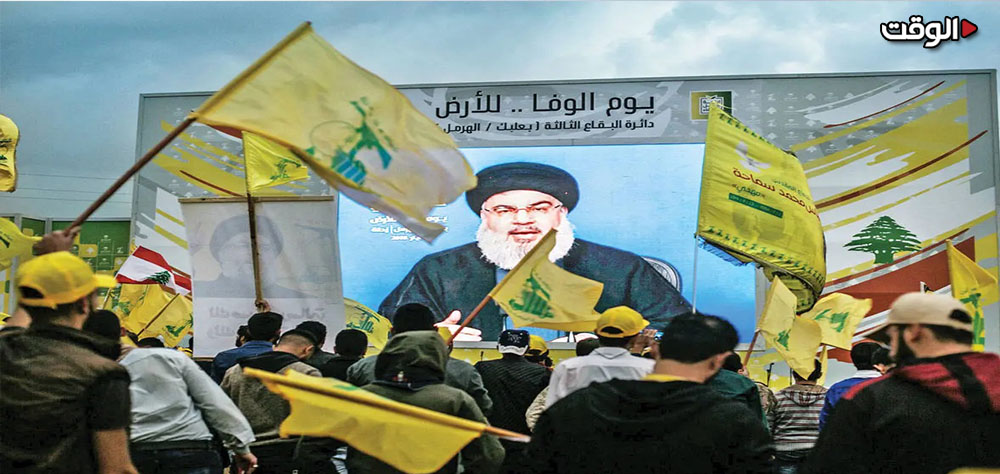



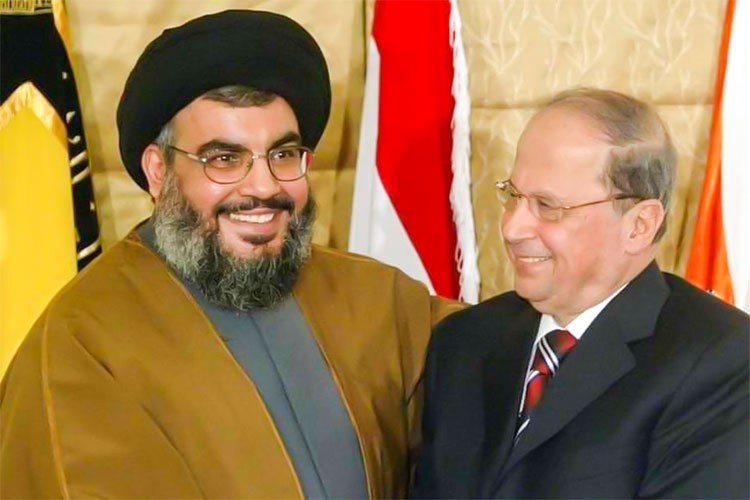


Alwaght- Signed between the Lebanese Hezbollah Secretary-General Sayyed Hassan Nasrallah and the leader of the Lebanon’s Free Patriotic Movement Michel Aoun on February 6, 2006, the St. Michel Church agreement after ten years since its going into effect, has weathered many soft and tough policies aiming at nullifying it. The most outstanding accord in the history of the country, the Nasrallah-Aoun agreement has survived toughest conditions ranging from the Israeli aggression of 2006 against Lebanon and the governments deadlocks to the dispute over the country’s presidency post. Hezbollah sees Michel Aoun as the most qualified choice for the Baabda presidential palace, insisting over and over that its favored candidate is the former army General Aoun.
It is the tenth anniversary of signing the memorandum of understanding between the Lebanese two sides, a deal which has survived despite the massive shocks which the country and its surroundings have experienced. The deal has presented a magnificent pattern to be boasted of across the country to make the opposing sides become united under the umbrella of the country. General Aoun who was one of the most outstanding opponents of Hezbollah while he was in exile, turned as one of the outstanding allies of the resistant movement.
The past ten years have never been without concerted plots targeting the sayyed-general alliance. Actually, several March 14 Alliance’s fractions have gone to great lengths to dig a gap between Hezbollah and the Free Patriotic Movement, however, Sayyed Hassan Nasrallah’s wisdom along with General Aoun’s acumen have thwarted all these plots about which we knew through the Lebanese media. The ties between the two sides were promoted to be simply a political bargain and not a nationalistic partnership.
The reality has proven that the accord has gone beyond simply creating a political coalition, presenting a motion pathway for two significant sides of the Lebanese political scene. If the agreement’s function was other than this, General Aoun would have sold Hezbollah during the 2006 Israeli war against Lebanon, as at the same time Hezbollah would have left the Free Patriotic Movement alone in most of its internal political disputes, the very latest of them is the presidential limbo. Hezbollah could stand by, instead of Aoun, its conventional ally the Christian leader and the member of the parliament Suleiman Frangieh.
The circles close to Sayyed Hassan Nasrallah and General Michel Aoun have not hidden the role of the fusion between the two sides in developing the relations which before February 6, 2006, were limited to a single phone call made by General Aoun in 1997 to Sayyed Hassan Nasrallah, expressing condolences to Hezbollah leader for the death of his son Sayyed Hadi Nasrallah who was killed by the Israelis in Aljabal Alrafee region. “I didn’t feel that we have not met before, there was trust”, said Sayyed Nasrallah in his interview with OTV news channel, commenting on the first meeting ever between him and General Aoun at that time.
The mutual confidence has produced a dramatic positivity for the two sides’ ties, developing from simply a deal to a coalition and later to an existential integrity. The existential integrity has shown itself through two resistant motions under a single national cover. The first is confrontation of the Israeli and takfiri dangers and the second is in facing the rampant corruption of the Lebanese government. Both of sides have set to move towards a strong Lebanon and not a weak one as some sides wish.
A full decade of harmony and mutual understanding between the Sayyed and the general has presented an example for all the parties inside Lebanon, and so the raging fires of sectarianism across the region have failed to spoil an accord which has apparently weathered all the difficult tests the history of the country has seen. Regarding the outcomes of the “historical agreement” during ten years some points need to be elaborated on.
First, the agreement between Hezbollah and Free Patriotic Movement stands as an example for all the Lebanese alliances which fluctuate as a result of different political shocks. Actually, the Sayyed and the general have presented an outstanding picture for all the allies and the opponents.
Second, the agreement has played the role of a national guarantee guarding the country against the strife in the toughest conditions the military and political administrations have gone though. This experience has proved that the country’s interests are preferred to the sectarianism which is fuelled by some sides for their own political and economic gains here and there. In fact, the coalition between Hezbollah and the Free Patriotic Movement has gone beyond the sectarianism and the religion-based groupings.
Third, the meeting held on February 6, 2006, followed by friendly meetings of the publics of the two sides held in both Riyadh Alsolh and Alshohada squares amid the sit-ins in the middle of Beirut, has strengthened the national immunity of a large portion of the Lebanese who experienced about 25 years of civil war. The agreement has also fortified the cords of unity, understanding and dialogue among the people of Lebanon.
Fourth, established a decade ago, the dialogue choice is perhaps what the political forces on the one hand and the different Lebanon’s sides on the other hand need in the present time most obviously because the power of Lebanon lies in coexistence and not the weakness and divide of the Lebanese people.
The political challenges targeting the two sides’ ties would never stop, even if General Michel Aoun wins the way to the Baabda Palace. However, the dialogue has come to create understanding and not to sell one for the other as the wisdom and the mutual trust have been responsible for keeping safe the ten years of ties between Hezbollah and the Free Patriotic Movement.